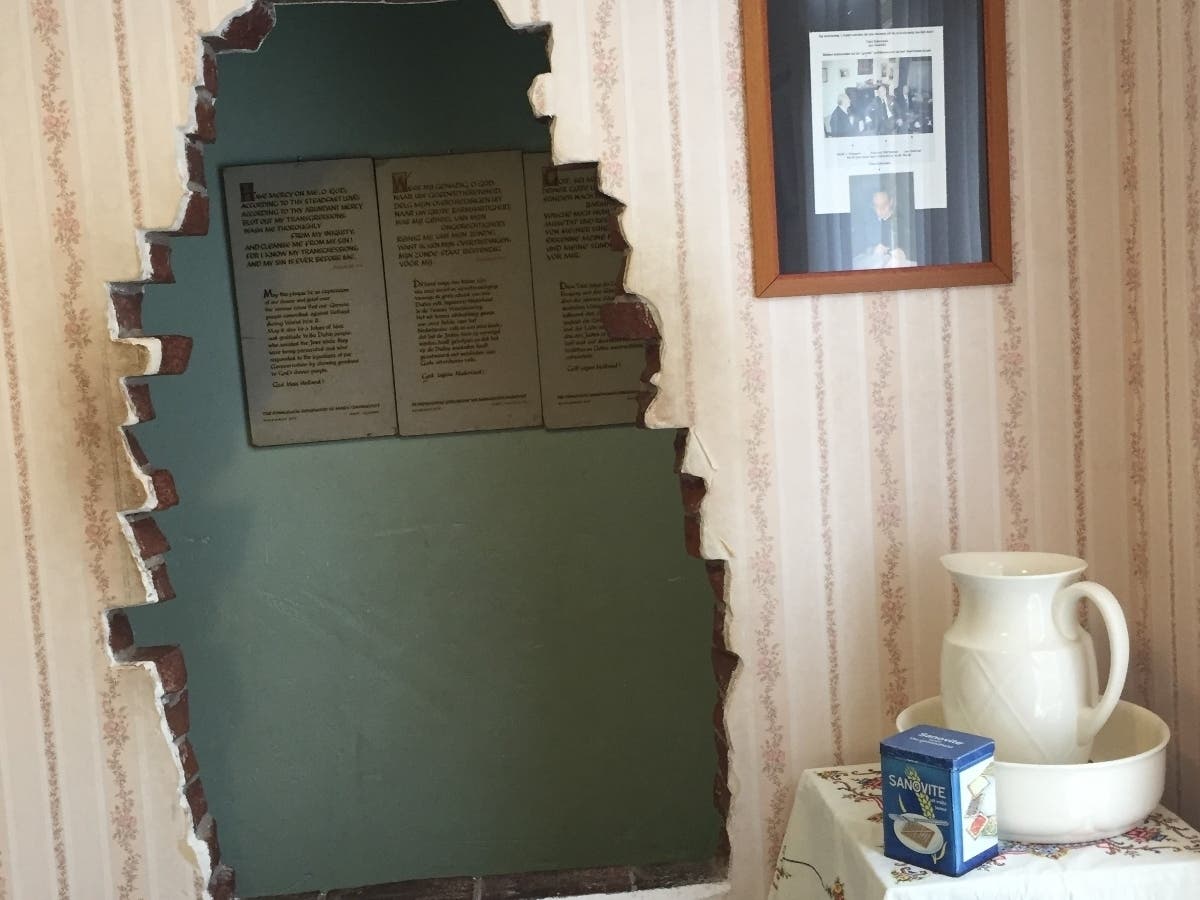
We climbed up the narrow steps to a third floor bedroom. There, beside a nightstand with water pitcher and bowl, was a large hole in the papered wall. Through the hole we could see the hiding place, where Jews, scrambling into the cramped space, had hidden whenever there was a knock on the front door below.
The place was the city of Haarlem, a twenty-minute ride on the train from Amsterdam. The home belonged to a watchmaker and his family. The time was 1944 in Nazi-occupied Holland.
Many people know now of Corrie ten Boom, the youngest daughter, who with her father, brother and sister took in fugitives during World War II. The only one to survive the Holocaust, she told her story in the book, The Hiding Place.
Find out what's happening in Stonehamfor free with the latest updates from Patch.
“God’s olden people,” Casper, the father, called his Jewish neighbors. After Germany invaded the Netherlands in 1940, the ten Booms began harboring Jews, along with members of the Dutch Resistance, who would then be moved to safe places away from the city.
But the ten Boom’s brave defiance of Nazi rule didn’t just happen. It was the continuation of a belief system cultivated for decades in the family. A century before, after an inspirational church sermon, Corrie’s grandfather had started a weekly prayer service to pray for Holland’s Jews, subjects of widespread discrimination.
Find out what's happening in Stonehamfor free with the latest updates from Patch.
Casper, his son, continued the practice, and the ten Boom home became a place of refuge. In 1937, Casper’s son, Willem, brought home a German Jew, who had escaped Munich after teenagers attacked him and set fire to his beard.
In the following years, it wasn’t unusual for the home above the watch shop to shelter six or more fugitives at a time. Corrie, unmarried and now a middle-aged woman, would find families in the countryside to hide them.
It all ended on the last day of February, 1944, with a banging on the door. Barging into the house, the Gestapo began searching every floor and room. Unable to locate the hiding place, they, nevertheless, arrested Casper, Willem, Betsy and Corrie, and set up a guard outside the house.
Miraculously, the Nazis never found the six fugitives: four Jews, including one woman, and two men of the Underground. Two days later, someone sneaked into the house and liberated them. All of the ten Boom family, however, were sent to prison. Casper, 84, died after ten days. Willem, released after the war from prison, died soon after from tuberculosis.
Betsy and Corrie were sent to three prisons, the last one the Ravenbruck concentration camp near Berlin, suffering cruelty and privation. There, Betsy succumbed to illness. Corrie, alone, returned after the war to Haarlem, where she again opened the ten Boom home to those in need, the homeless and mentally disabled. For over three decades she would write and speak about her experience in schools and churches around the world.
In 1968 she was asked to plant a tree in the Garden of Righteousness in Jerusalem to honor the ten Boom family and the hundreds of Jewish lives they had saved.
At the end of our tour in the ten Boom home, our guide brought us to the second-floor living room above the watch shop. Here we circled and listened as she recalled how the family, along with the fugitives they harbored, would often meet for song and prayer.
We live in a world still plagued by religious bigotry and racial hatred, she said. She asked us to pray, as the ten Boom family had done, “for peace in Jerusalem.”