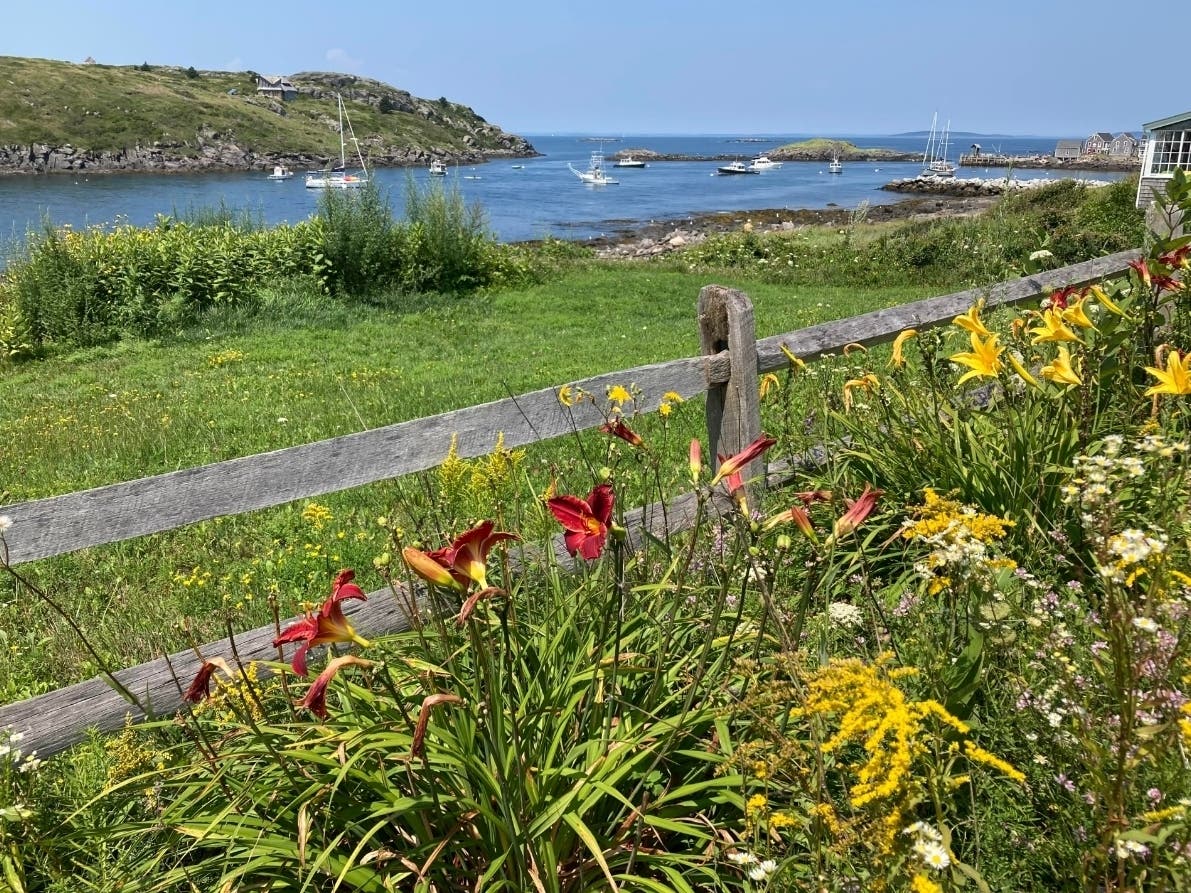
Last week we drove down-east to Wiscasset, Maine, then on to New Harbor, where we boarded the Hardy III for Monhegan. Located a dozen miles off shore, Monhegan is aptly named. In Algonquian, it means “out-to-sea island.”
Seventeen years before the Mayflower landed at Plymouth, Samuel de Champlain anchored his ship in the natural harbor between Monhegan and its sister island, Manana. Captain
John Smith visited in 1614.
Now it’s a lobstering village of about 70 residents, families and a few artists, except in
the summer, when tourists swell the island’s population.
Find out what's happening in Stonehamfor free with the latest updates from Patch.
Speaking of swells, as we headed out to sea, the Hardy III commenced to pitch and roll as
we ploughed through swells from a storm out to sea. The crew handed out ginger
candy and barf bags.
Becky, fortified with Dramamine, and Cindy, her cousin, went to the forward deck for
fresh air. Ann, Cindy’s mother, and I sat on the benches in the cabin, over the
boat’s keel, which I had heard was the most stable spot onboard. I got up to
get more ginger candy.
Find out what's happening in Stonehamfor free with the latest updates from Patch.
As challenging as our journey was, it was no match for that of Becky’s and Ann’s great
grandmother, Margaret Albee. Sometime around 1860, Margaret climbed into a dory
and was rowed to Monhegan. Having just graduated high school, she became the
next teacher in the island’s one-room schoolhouse. A century and a half later,
we were following her.
In a little over an hour, we pulled into Monhegan harbor and made our way up the gangplank
to terra firma. Here we picked up a golf cart Cindy had rented, a
godsend due to Ann’s and my mobility issues. There are no cars on the island,
and the dirt roads winding through the village or up the hill to the lighthouse
are narrow, which means we proceeded slowly, pausing often for tourists
afoot.
The first place we visited was Monhegan School. It was closed, but a workman let us in for a
quick look. In the main room, books and charts were piled on the floor so
shelves and walls could be painted. Here our ancestor, a teenager herself, had
welcomed the multi-aged children of fisherman. Here she taught them to read and
do math and how to write cursive.
In the school yard was a sign post the students had made. It said “Let there be peace on
earth” in several languages.
Teaching school through the long winter on the island may have taught Margaret Albee what she
didn’t want to do. In any case, the next year she returned to Wiscasset,
married and started a family.
We wondered if there were any other Albees on the island, and as we toured the little museum
at the lighthouse atop the island, we found answers. In a list of lighthouse
keepers, we read: Samuel Albee, 1841-45.
Then we came across another Albee. Her name was Sarah, and in 1888, after her husband died,
she opened the first boarding house on the island. Called the Albee House, it’s
known today as the Monhegan House.
Cindy had brought lunch for us, and we picnicked on the grass near the lighthouse,
looking out over the houses, cemetery, church and harbor.
In the afternoon we leisurely toured the village, and Becky and Cindy hiked to the
cliffs on the eastern side. Here, far below, the Atlantic breaks on the black
rocks. If it’s a clear day, you might think you can see Portugal.
As we boarded the Hardy III for the return voyage, the tide was low, and the ramp steep. Once
boarded, we found our seats, then watched as several boys and men leaped from
the docks into the green water beneath. It’s a tradition, one of the crew said,
a way of saying good-bye.