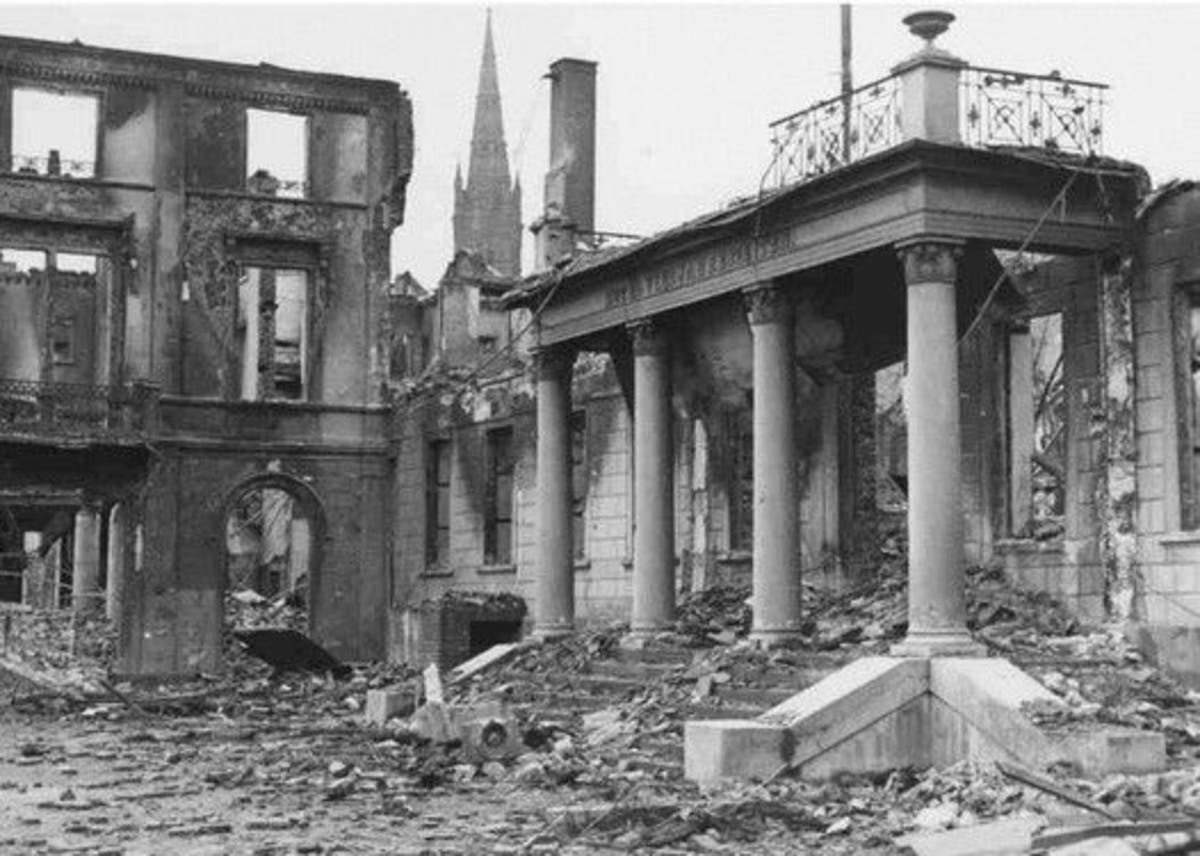
By the time he got to Germany, the war was over, but not the destruction. Once known for its hot springs, Wiesbaden, like cities across Germany, was now a pile of rubble. Survivors loaded carts with broken concrete and chipped mortar from bricks in the street. Women and children begged for food.
For the American soldier, barely 21, it was a scene of desperation. Disarmed soldiers, refugees from the east, and liberated Jews filled camps set up by the Allies. People were hungry, ill and cold.
Corporal James Drinkard had joined the United States Army Air Corps two years before, but because of illness, his oversees tour had been delayed. Now, like thousands of other young Americans, he was growing up too fast in a world struggling to emerge from darkness.
Find out what's happening in Stonehamfor free with the latest updates from Patch.
Early letters he wrote his parents back in Bristol, Virginia, were light-hearted. But early in the new year, his letters took a somber tone.
James had left college to enlist. He would later complete his undergraduate degree, then go on to law school. Now stationed in Wiesbaden, he read everything he could get his hands on. An earlier letter told of getting a copy of Richard Wright’s novel, Black Boy. It wasn’t the sort of book most young white men from the South would be reading. He was starting to understand points of view very different from his own.
Find out what's happening in Stonehamfor free with the latest updates from Patch.
Reading his letters 72 years later, Stoneham resident Carol O’Loughlin picks up on the changes in her father’s letters. “Dad never talked to us about the war,” she says. But now, for the first time, she is getting a glimpse of what he was experiencing, and how it affected him after he came home and resumed his education.
After law school at the University of Virginia, James married, started a family, and for several years practiced law. But his heart wasn’t in it. So he enrolled at Union Theological Seminary in Richmond. Becoming a Presbyterian minister, for the next 40 years he pastored churches in Virginia, North Carolina and Tennessee.
But in Germany in 1946, his daughter comments, things were pretty intense. As a soldier in an occupying force, her father would certainly have seen the emaciated forms of Holocaust survivors. Perhaps he walked by the ruins of the Great Synagogue of Wiesbaden, burned by the Nazis on Kristallnacht, 1938. Each day he would have become more aware of the cruelty and deprivation of the Third Reich. Just three months before, verdicts were handed down at the Nuremburg Trials, and ten Nazi leaders had been hanged.
Let’s go back to that winter day in 1946 as James Drinkard sits down to write a letter home. It’s Sunday evening, and quiet on the base.
“Most of my day has been spent in peace and contemplation,” he tells his parents. Then, in a thoughtful mood, he continues: “It seems to me that the world is faced with more difficulties at this time than at any other.” He has seen what a belief in racial superiority has done, and he knows racism is not dead. He asks:
“Why can’t we, with all our microscopes, telescopes and cyclotrons, see through the petty differences of race and creed which are the roots of strife? Why can’t man play the part of the brother he was created to be?”
Then a final line: “May God help me as I strive to be more tolerant. Love, Jimmy.”