Neighbor News
Ordinary people, extraordinary accomplishments
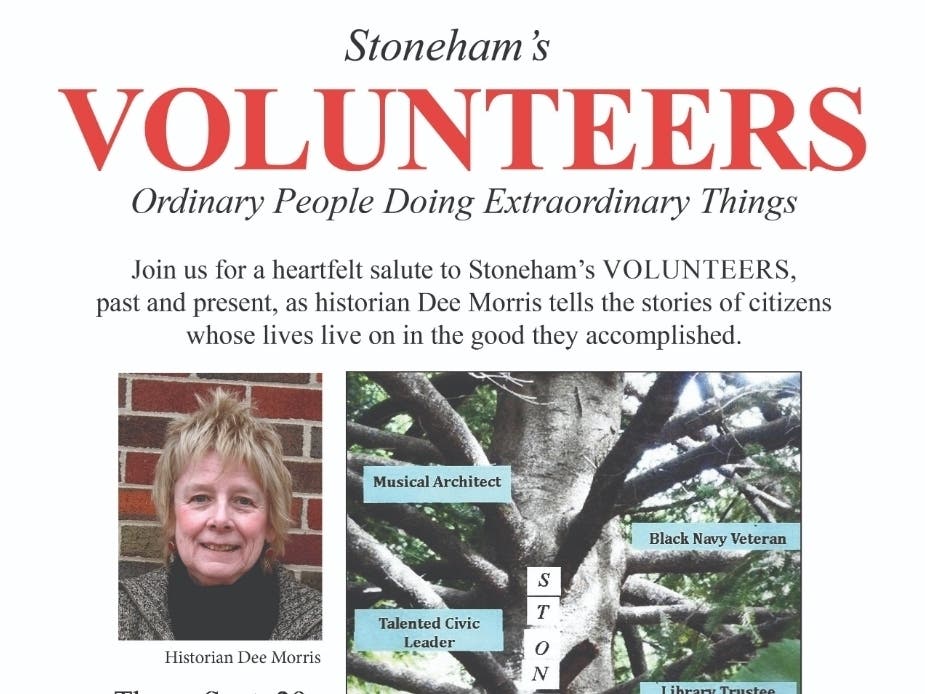
Historian Dee Morris at the Stoneham Public Library Sept. 29
When I started writing columns for this paper, years ago, I wondered if I would run out of stories to tell. What I’ve learned, however, is that there are a thousand stories of the people of Stoneham, past and present. And when those are told, there are a thousand more.
One of our best story tellers, the historian Dee Morris, has also been fascinated by the lives of our town’s people, not the rich and the famous, but the everyday folk of Stoneham.
The 19th century historian William B. Stevens called us a “yeoman” town. By that, he meant we have descended not from royalty or high office, but from working men and women: farmers, shoemakers, blacksmiths, mill workers, homemakers, soldiers and sailors.
Find out what's happening in Stonehamfor free with the latest updates from Patch.
On Thursday evening, Sept. 29, Dee Morris will tell the stories of six amazing citizens of Stoneham, or as she puts it, “ordinary people who did extraordinary things.” She’ll do this at the Stoneham Public Library, starting at 7 p.m.
Among those she’ll talk about are a musician, a mason, a teacher and a soldier. She’ll also tell stories of two people who helped establish our amazing Library and compassionate care for our seniors.
Find out what's happening in Stonehamfor free with the latest updates from Patch.
From our town’s early days, Stoneham men and women have given of themselves to make our town and country a better place. In some cases, they risked their lives and livelihood. In some cases, they lost their lives.
I’m thinking of William Henry Heath, M.D., who graduated from Harvard in 1853. The next year, at age 25, he opened a medical practice in Stoneham. Seven years later he married Delia Maria Belknap. Many of us know Dr. Heath for his service as a Civil War surgeon. In May 1863 the Massachusetts Surgeon-General sent word to Heath asking if he would take the place of the surgeon of the 2nd Massachusetts Regiment, who had been taken prisoner by Rebel soldiers. The need was urgent.
Dr. Heath quickly packed a valise, wrote a good-bye note to his wife and boarded a train for Virginia. Treating the wounded and sick from multiple battles, he “served with great faithfulness and zeal, being distinguished as a very careful and skillful operator…. He was recognized as one of the best surgeons and truest men in the corps,” a colleague wrote in his notes.
Tragically, Dr. Heath came down with “typho-malarial fever,” which was ravaging the troops on both sides. The disease proved fatal, and he died at Chattanooga, Tennessee. Widowed at age 28, his wife Delia lived on, never marrying, until 1913. They are buried together in Lindenwood Cemetery.
A courageous Civil War hero, Dr. Heath should also be remembered for his service as a community organizer in Stoneham. Flash back to 1858, three years before the Civil War, and we find William Heath riding to Salem in a buggy with Col. Lyman Dyke. On the way, Dr. Heath shared his dream of a free lending library in Stoneham. A year later, Dr. Heath, Col. Dyke, J. Parker Gould, Amos Hill, John Hill and William Hurd submitted an article to Town Meeting calling for “a free public library,” and stipulating that $300 be set aside for expenses. The article was passed.
Next Thursday evening, Sept. 29, historian Dee Morris will continue the story of the Stoneham Library when she tells the story of another remarkable citizen, George Hinchcliffe, whose connections with the philanthropist Andrew Carnegie led to the construction of today’s beautiful Library at 431 Main St.
She will also tell the stories of five others and their contributions to our town. You’ll be both amazed and inspired.