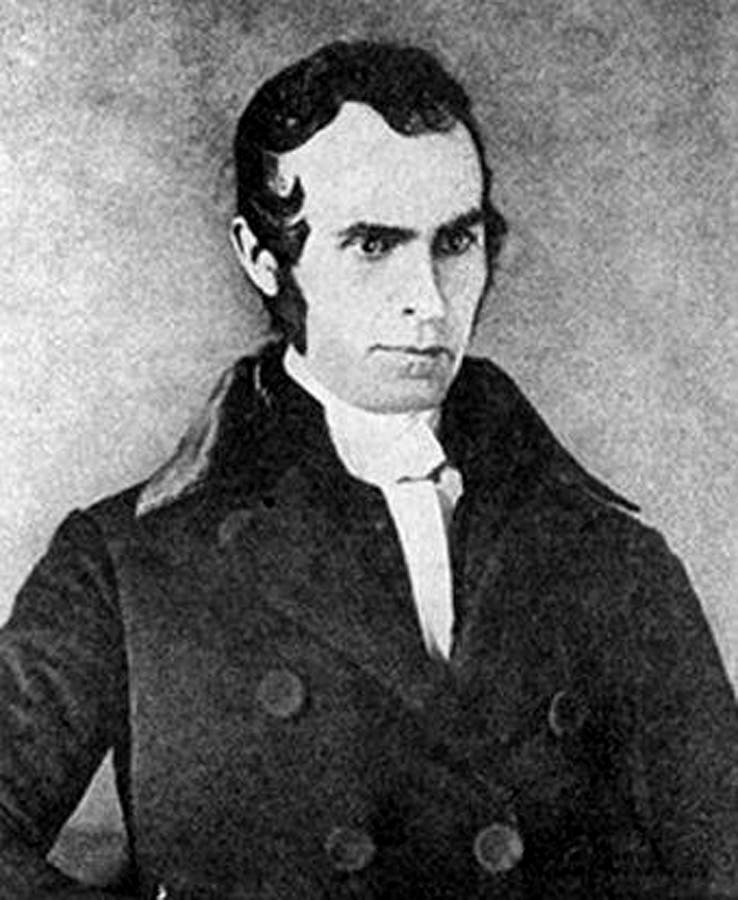
Cleve, my late father-in-law, loved “Snowbound,” by John Greenleaf Whittier, and could recite long passages of this lyrical New England poem. Whittier wrote it in Amesbury soon after the Civil War, although it was set at his ancestral home in Haverhill.
I, too, love the poem’s imagery—“The white drift piled the window-frame,” the “hearth-fire’s ruddy glow.” The poem is a 759-line memorial to New England rural life and virtues, family and friends.
Called “Greenleaf” by his friends, Whittier was one of the so-called Fireside Poets, along with Henry Wadsworth Longfellow, James Russell Lowell, William Cullen Bryant, and Oliver Wendell Holmes, Sr. But the Haverhill poet had another side that most people don’t know about.
Find out what's happening in Stonehamfor free with the latest updates from Patch.
Born into a Quaker family in 1807, Whittier grew up on a farm, attended Haverhill Academy, and for a while worked as a teacher and a shoemaker. When he was 19, he submitted a poem to the Newburyport Free Press, edited by William Lloyd Garrison. Garrison published it, and that was the beginning of Whittier’s career as a poet, journalist and abolitionist.
Whittier was passionate about writing, but also about the plight of slaves in the South. One of the first members of the Boston Anti-slavery Society, he became an outspoken advocate for universal freedom. His poems appeared regularly in The Liberator, and in Philadelphia he helped write the charter of the American Anti-Slavery Society.
Find out what's happening in Stonehamfor free with the latest updates from Patch.
In 1833 he published “Justice and Expedience,” urging immediate abolition of slavery throughout the United States.
As much as we would like to believe that New England readily embraced the anti-slavery cause, we would be mistaken. In the 1830s, abolitionists, men and women, black and white, were harassed, assaulted and driven out of towns, including Stoneham. In 1835 at an abolitionist meeting in Concord, N.H., Whittier was mobbed and stoned.
Rarely in good health, Whittier traveled throughout the Northeast. While in Philadelphia, working for the American Anti-Slavery Society, he became editor of the Pennsylvania Freeman. Soon after, however, a mob attacked the print shop and burned it to the ground. Managing to escape, Whittier returned disguised as a woman, and retrieved the printing plates for the next day’s paper, which he published.
In 1846 Whittier brought out Voices of Freedom, a book of poems against slavery. In “The Branded Hand,” he tells of a Massachusetts ship captain in Florida who was caught with fugitive slaves on board. He was thrown in prison, fined, and the letters “S.S.” for “slave stealer” branded on the back of his hand.
Another poem praises the courageous women of the Boston Female Anti-Slavery Society. Attacked by a mob, they were forced to abandon the hall, but reassembled in the home of a sympathizer.
In his poems, Whittier shot back at the pro-slavery mobs and their attempts to silence the them, writing, “Streams which brawl most loud/ Along their course are oftenest shallow,/ And loudest to a doubting crowd/ The coward publishes his valor.”
Perhaps Whittier’s darkest poem, “The Slave Ships,” narrates the fate of 160 slaves aboard the French slaver “Le Rodeau.” Stricken by a contagious disease that left them blind, they were shot, hung or cast into the sea as unsaleable cargo.
Whittier’s anti-slavery poems are a long way from “Snowbound.” And it’s worth noting that he wrote this winter idyl after the Civil War. After decades of struggle, Whittier had finally come home.
Sometime this winter, I’ll pull the 1866 book off the shelf and relish again the opening words: “The sun that brief December day/ Rose cheerless over hills of gray.”
But I will never read “Snowbound,” or Whittier, the same way again.
Note: Ben Jacques is the author of In Graves Unmarked: Slavery and Abolition in Stoneham, Mass., available at The Book Oasis, 311 Main St., in Stoneham. He also writes a biweekly column for the Stoneham Independent.