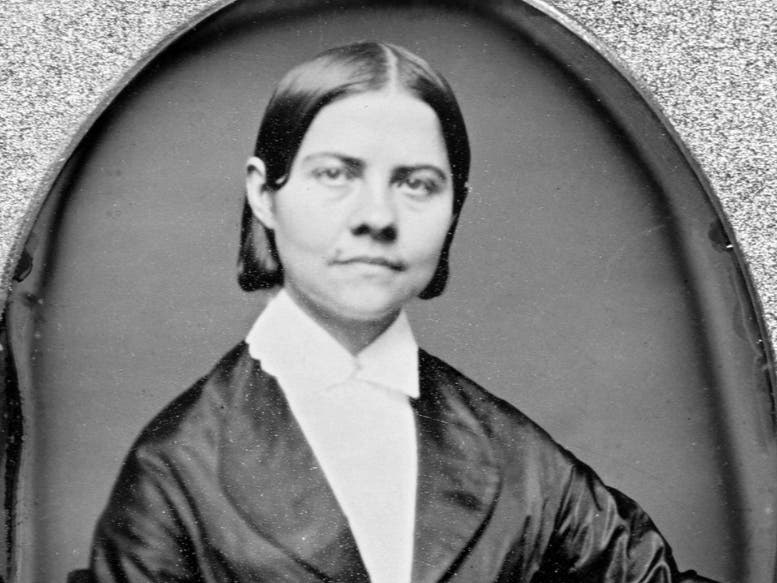
Lucy Stone was the eighth of nine children born to abolitionist parents on their farm in West Brookfield. The family, under the patriarchal thumb of the father, worked hard to send the oldest son to college. If Lucy wanted an education, she would have to find her own way.
Which she did. After five years as a primary school teacher, she saved enough to enroll in Mount Holyoke Female Seminary, but dropped out to care for her sick sister.
In 1837 in her church in West Brookfield, she heard the minister read a letter, sent to Congregational churches throughout the state, condemning Sarah and Angelina Grimké for abandoning the “woman’s sphere” to spread their anti-slavery messages. The Grimké sisters were Quakers from the South who had located in Boston and were lecturing to both female and mixed audiences.
Find out what's happening in Stonehamfor free with the latest updates from Patch.
Meanwhile, Lucy had heard of a college in Ohio that accepted women, as well as blacks, and at age 25 enrolled in Oberlin College. Earning high honors, she became the first woman in Massachusetts to gain a college degree.
After graduation, Stone considered how she could best advance the two causes she was passionate about, the freeing of almost four million slaves in the South and women’s rights. Told she had a melodious voice, she wondered if she could join other abolitionists on the lecture circuit.
In 1847 in her brother’s church in Gardner, she gave her first public speech. Then she moved to Boston, the hub of the abolitionist movement, where she become a paid lecturer for the Massachusetts Anti-Slavery Society. In lecture halls, including Faneuil Hall, she was a success, speaking once to an audience of three thousand.
Find out what's happening in Stonehamfor free with the latest updates from Patch.
When she drew criticism for mixing women’s rights into her anti-slavery lectures, she agreed to promote the rights of women only on weekdays, and the anti-slavery message on weekends.
In the following years Stone became a leading suffragist, helping to plan the first national woman’s rights convention in Worcester in 1850. To this conference came over a thousand delegates from eleven states, including Sojourner Truth and Ernestine Rose, daughter of a rabbi in Poland. Advocating “equality before the law, without distinction of sex or color,” the conference established a road map for action in education, social relations, civics, politics and publications.
In the years to follow Stone was key in establishing both the Massachusetts and American Woman’s Rights Associations. And she collaborated with Elizabeth Stanton and Susan B. Anthony in the national movement.
Stone hoped that Massachusetts, which had led in the anti-slavery movement, would also lead in granting women the right to vote. In this she was disappointed. Writes Barbara F. Berenson in her recently published book on the Massachusetts suffrage movement: “Despite its reputation in modern times as a liberal and progressive state, however, Massachusetts led the deep and prolonged resistance to woman suffrage.”
In 1853 Stone presented a petition with 2,000 signatures to the Massachusetts Constitutional Convention calling for the word, “male,” to be dropped from voting requirements. The Senate committee in charge of voting promptly denied it.
Stone also advocated for women’s property rights, and in this she was successful. In 1855 the legislature passed a law allowing married women to own and sell property, manage their own earnings and make wills.
That same year she married Henry Browne Blackwell, an ally of the suffrage movement. He and Lucy would found and co-edit the Woman’s Journal, a weekly published in Boston and Chicago, widely influential in spreading the suffragists’ message. Their daughter, Alice, would would become an ardent suffragist and succeed her parents as editor.
During the Civil War, the call for women’s rights was largely subsumed by the war effort. But the movement quickly reemerged, with suffragists linking their cause to the freedom movements both of the American Revolution and abolition of slavery.
In 1873 Stone spoke to a packed Faneuil Hall crowd, demanding that the government honor the principle of “no taxation without representation.” Also that year, even though they could not vote in municipal elections, four women ran for seats on Boston’s School Committee. And won! Many men who opposed women’s suffrage acknowledged their primary role overseeing the education of children.
This victory led Stone to see the achievement of municipal voting rights as a wedge with which to crack open widespread opposition to full suffrage.
It’s hard for us, in retrospect, to grasp the enormity of the struggle of Massachusetts suffragists to change not only the attitudes of male voters, but of women. It seemed that church, state and society were fortified in opposition. In Boston thirteen society women organized against suffrage. Meanwhile, 140 men, including the president of Harvard, published an ad in the newspaper opposing suffrage.
Still, Lucy Stone pressed on, speaking in towns throughout the Commonwealth. Announcing her lecture in Malden, a local minister noted that “a hen will undertake to crow like a cock at the Town Hall this afternoon.”
In early spring of 1875, Lucy Stone came to Stoneham. It had rained that day, turning the snow to slush. Notwithstanding, a good-sized crowd filled Town Hall. In the audience was a reporter from the Stoneham Independent. For many years, newspapers had belittled the woman’s rights movement and scorned the suffragists. Reporting on the first national convention in Worcester in 1850, the New York Herald described it as “a motley gathering of fanatical mongrels, of old grannies, male and female, of fugitive slaves and fugitive lunatics.”
Another newspaper called it “a hen’s convention.” Another, “an insurrection in petticoats.” So it was remarkable that when Lucy Stone arrived in Stoneham, our local paper announced her upcoming lecture like this:
Miss Lucy Stone, the well-known and able ‘defender of women’s rights,’ will lecture in Town Hall on Friday evening, March 12th, 1875. Miss Stone is a thorough and interesting speaker, and although the question she proposes to discuss at this time has many bitter opponents, [it] also has friends, and in this talented lady an able exponent, whose independence of character enable her to stand undaunted and proclaim what she believe to be truth and principles of justice and equity.
Not only was the Stoneham newspaper taking Lucy Stone seriously, it was crediting her as a “talented” and “able exponent,” a person of character, who sought to advance “many truths.”
A week later the Independent reviewed Lucy Stone’s lecture. It was well attended, the reporter wrote, despite the “water and slosh to be waded through to get to the Hall.”
Stepping to the podium just before 8 p.m., Lucy Stone “held her audience in a remarkably attentive and quiet manner for about an hour and a half. . . . Her voice, though not loud, could distinctly be heard in the rear of the hall.”
Stone spoke of the “injustice of taxation without representation,” that women who paid taxes had no vote in the making of laws. Legally, they had been “placed in the category with idiots, insane and felons.”
She called for the right of married women to own property, and to reap the same pay for their work as men. As a schoolteacher, she had been paid half what male teachers earned.
Stone also updated her audience on progress that had been made, the creation of local, state and national organizations, the launching in 1870 of the Woman’s Journal, which she edited. Although women could not vote in general elections, Massachusetts suffragists were pushing to vote in municipal elections, starting first with the election of school committees.
Dependent on the votes of men to obtain suffrage, she called on all men—single, married, fathers, brothers—to vote for representatives who would uphold rights of women.
Finishing his review, the Independent reporter wished the speaker success, something we don’t see in today’s “objective” journalism, but which must have made an impact on readers:
“May she live to reap the full fruition of her labors in the cause so dear to her and which she has so faithfully and fearlessly advocated before a prejudicial community.”
Four and a half decades would pass before women would gain full suffrage in the United States, and Lucy Stone would not live to see the ratification of the 19th Amendment. Neither would Susan B. Anthony, Elizabeth Cady Stanton, or many of the Stoneham suffragists.
But that night in 1875 when Lucy Stone came to town may have been the turning point in the minds and hearts of many Stoneham citizens.
Note: Thanks to Melissa Davidson Kyle for her research and to Barbara F. Berenson for quotes and biographic details about Lucy Stone. Her book, Massachusetts in the Woman Suffrage Movement, Revolutionary Reformers, is an excellent account of the movement in the Commonwealth.