Community Corner
Foundation Plants Hide and Beautify
Foundations are great for holding up your house, but they're kind of ugly. So today we'll talk about beautifying your home with foundation plants.
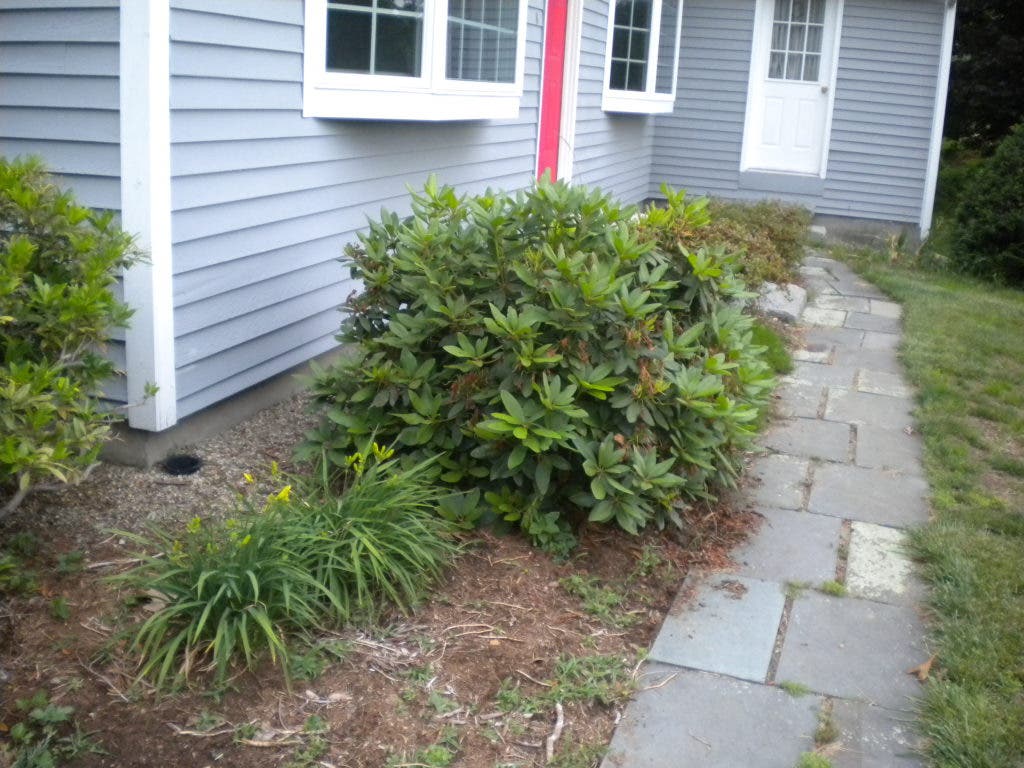


Now is the perfect time to trim your flowering shrubs. Rhododendrons, azaleas, lilacs and just about any spring-flowering shrub have finished blooming and are ready to be pruned to a great shape.
Don't wait too long, as they produce blooms for next year on new growth. Cut with sharp shears and shape the plants in a pleasing manner. Never trim anyting so it's flat on the top, give it a slight slope so the snow doesn't break the plant.
Also there's no need to put anything on the wounds of the plant unless it's bigger than 2 inches in diameter. Nature will take care of anything smaller.
Find out what's happening in Sudburyfor free with the latest updates from Patch.
Many of the flowering shrubs are foundation plants around your home. Here's a story about what happens if you don't trim them back.
My first house was a 1920s colonial with a tiny lot with the worst set of foundation plantings I’ve ever seen on a house. In addition to planting inappropriate species, they were planted too close to each other and the house. Also, they were allowed to overgrow about 20 years too long.
Find out what's happening in Sudburyfor free with the latest updates from Patch.
Especially troublesome were a couple of evergreen yews that were covering the windows and trimmed to an ugly shape that was not flattering to the cute house. They also severely restricted access to the front door. So what’s a new homeowner to do?
You guessed it. You get a couple of friends together on the hottest weekend of the year and decide to rip the suckers out. We started with what seemed like the least amount of work, putting a chain around the base of the plant and hooking it to my Jeep. Then I got a running start and when the chain tightened the car leaped off the ground about 6 feet and stalled. Once my heartbeat slowed down below stroke speed, I checked the car to see that the rear end hadn’t been ripped out, unhooked the chain, put the car away and went to see how the yew was pulled out of the ground. Now you would think that having had a 4,000-pound car with a whopping 365 horsepower, going 20 mph and playing tug of war with it would have the yew looking pretty sad. As you can probably guess the plant hadn’t budged and in fact there wasn’t even any damage.
So next we took a handsaw, a particularly rusty and dull handsaw, and started cutting the trunks of the bush off about a foot from the ground. Once the entire bush was cut we discovered that first, the painters hadn’t painted behind the bush for about 30 years and in fact our gray house had once been a lovely mustard yellow, and second, the cutting of the upper part of the bush is the easy part – you’ve still got to get the roots out.
Proceeding along, we dug around the roots and with a combination of chopping with an axe and digging with a shovel finally got a 10-foot diameter crater with the ugliest 300-pound chunk of gnarly yew roots anchored firmly in the center.
By now it was getting dark, so we called it quits and started back on the project about three weeks later with sharp tools and an upcoming housewarming party deadline looming. The yew finally yielded to steel and muscle, but not before teaching us a very good lesson – choose the right foundation plant and take great pains to trim it and keep it looking right.
Foundation plants came about out of necessity. A pretty home would be built on a stone and mortar foundation and something was needed to hide it. In Colonial times the foundation plants were a combination of things you could eat and things you could make stuff out of - such as herbs, vegetables, lilacs and if you could get seeds some strawflowers or sunflowers. Wild junipers and bayberries were also dug up and planted near the foundation for candle making.
Current thinking on foundation plantings has evolved from this completely practical beginning to a very simple idea - hide the foundation.
Today’s plantings are used as a design element to transition the eye from the low, soft, fine horizontal texture of the lawn to the hard, vertical form and scale of the home. They also can introduce seasonal colors and flowers and varying shades of green to bring the beauty of the outdoors right up to and sometimes into the home space.
If you’re a beginner gardener and putting in some foundation plants this fall, do yourself a favor and remember three things:
- space the plants for their mature form and size, not their cute little form in the container at 1 year old
- this is New England and it snows here
- the sun rises in the East and sets in the West, and full sun exposure is south.
In the years when my first home was built, very formal, symmetrical, high-maintenance foundation plantings were de rigueur. In those days if you planted something on one side of the door you planted another one on the other side of the door and it had better have a conical shape and be an evergreen. Nowadays with many homes having multiple rooflines and irregular foundation shapes I like to combine a variety of shapes, sizes and textures not only to hide the foundation but also to tempt the senses.
And even though I make fun of yews, I like to have a ratio of one evergreen to three deciduous plants, and yews do provide a consistent green color. However, please don’t trim them to unnatural shapes. Select one with the right natural shape and let it be.
My all-time favorite foundation plant is andromeda. It is an evergreen shrub, grows to be about 4 feet tall and 4 feet around and has light green waxy foliage. It is one of the early blooming shrubs that lets you know that winter is over, and it has showy chains of white to golden flowers that cover the entire bush. Andromeda does not do well in shady locations and prefers very acidic soil, lots of peat moss (it’s native location is in the peat bogs of Europe) and lots of mulch. Never use any lime on it. They tend to have a life of about 25 years, then they get weak and don't flower, so rip them out and put in new ones when this happens.
Another good plant is the dwarf rhododendron. They’re in the same family as azaleas (which are also good foundation plants) and have slightly larger evergreen leaves, will grow only about 3 feet high and don’t require trimming until they’re about 50 years old. Their flower colors run the gamut from white to purple, and they also love acid soil.
When planting them, place them in the hole about 6 inches higher than they were at the nursery. They tend to be planted too low. Also, mulch heavily in the fall and it doesn’t hurt to spray on some anti-desiccant spray to keep the leaves from drying out in the winter winds.
Somewhere I heard that a home without foundation plants looks like a “doll house plunked down in the middle of a pool table” and I tend to agree.
If you’re new to gardening, planting some of these around your home can be one of the easiest most rewarding projects for your new home.
Some Garden Trivia for today:
- In the Netherlands, in 1634, a collector paid 1,000 pounds of cheese, four oxen, eight pigs, 12 sheep, a bed, and a suit of clothes for a single bulb of the Viceroy tulip.
- Morphine was given its name in 1803 by the discoverer, a 20-year-old German pharmacist named Friedrich Saturner. He named it after Morpheus, the Greek god of dreams.
- No species of wild plant produces a flower or blossom that is absolutely black, and so far, none has been developed artificially.
- Nutmeg is extremely poisonous if injected intravenously.
- Oak trees do not have acorns until they are 50 years old or older.
- One pound of tea can make 300 cups of the beverage.