Arts & Entertainment
Every Picture Tells A Story
Stories are on display in Swampscott painter Sacha Gassel's Boston studio.


Every picture in Sasha Gassel’s studio tells a story. “A painting,” he says, “is supposed to convey something. It’s not just a splash of color over a living room couch.”
Each work is world into itself, and, in his larger pictures, every corner has small story within the larger story.
Take Moses. Notice the red hands of God, Moses at the lower left with a scroll, indicative of the Torah, the single figure of the woman with a red arm holding a child, and then the repetitive figures in distress, and the swirl of sky in the middle of the painting, not near the top where one would expect it.
Find out what's happening in Swampscottfor free with the latest updates from Patch.
“I’m interested in the battle between good and evil,” says Gassel, “between darkness and light.”
“Composition,” says Gassel, is his main focus. He plans out each painting in detail on paper with pencil, so that when he paints, he thinks “only about painting.”
Find out what's happening in Swampscottfor free with the latest updates from Patch.
He sees himself as part of a medieval tradition in that his style is characterized by repeating patterns of images and a careful placement of lines—the repetitions acting almost like a musical piece, like rhythm, with lines bringing the eye back and forth.
His work is “not an imitation of space,” but a “coming out or pushing out.”
“I’ve written a book about all this,” says Gassel, “but it’s in Russian.”
In Manhattan, advertising mixes with skyscrapers and figures of people in the city. Note the lamppost in the left lower side of the picture swaying to the side, and the figures entering to the subway to the lower right, their repetition against the solitary figure in white who is seated and plays a flute.
Gassel, who was educated in the Soviet Union, has lived in Swampscott for over 30 years.
Gassel makes some of his own paints. He grinds stones like malachite or lapis between two marble stones and mixes the powder with egg yolk. The result makes the colors more vivid and layered, to “reflect light just a little bit,” and add depth to the surface.
The effect of these vibrant colors is evident in his series of icon paintings. Icons are a style out of the eastern orthodox religious tradition of depicting saints and holy figures.
They are characterized by an emphasis on faces, lots of gold leaf and were originally done on wood. In the Soviet Union, Gassel worked at restoring old icons.
One piece he calls his “grandmother,” her history from centuries ago is a “family story passed down.” Her calm, expressive face surrounded by traditional black robe of a religious figure, she gazes at Jesus while the monastery she founded sits just behind her.
Family features in others of Gassel’s works.
One of his granddaughter is of a young blond girl with a swan curled at her lap, in a pastoral landscape of gently swirling blues and golds, a setting that emphasizes not only her youthful beauty, but a bubble of innocence and peace around her, as if to protect her from adulthood and all its worries and burdens to come.
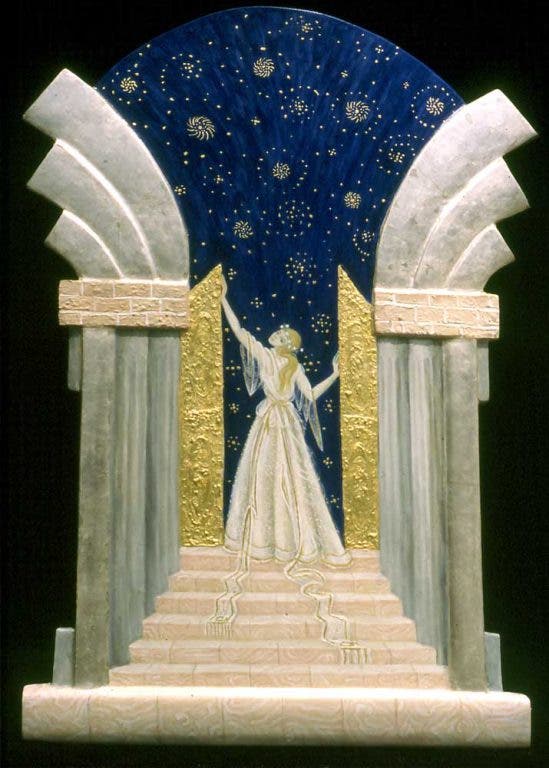
And Doors to the Sky depicts a blond woman, Gassel’s daughter, ascending a staircase toward a golden gate. Her long white dress makes her look like an angel.
The figure is poised at the top of the steps, one arm holding onto the gate and the other reaching toward a star studded sky. This one hangs in Brigham and Women’s Hospital because that’s where she was cared for in her final days, before she died.
Located at 30 Ipswich Street, just down the street from Fenway Park, Gassel welcomes visitors to come and see his work.
You won’t be disappointed.