Arts & Entertainment
If Walls Could Talk
What do a Chinese wallpaper, a castle in Scotland and a British paper conservator living in Swampscott have in common?


Quite a bit, as it turns out.
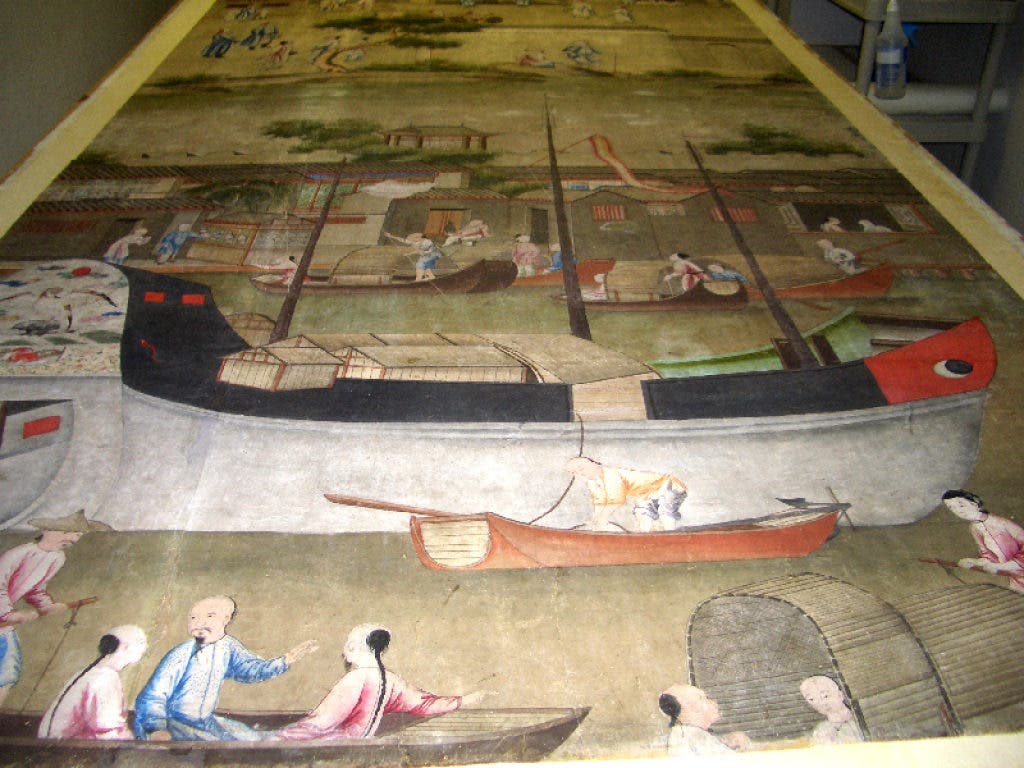
Let’s begin with the wallpaper, called the Drummond wallpaper. Hand-painted in China in watercolor circa 1780, the lively scene depicts the “hongs”—foreign factories—of Canton (the city now known as Guangzhou)--the only Chinese city open to foreign trade at that time.
Both fashionable and expensive, such watercolor wallpapers were made for western export and often brought back by merchants and ship captains as part of their own private buying sprees. This one comprises 18 rolls of 12’ by 4’mulberry bark and bamboo paper.
Find out what's happening in Swampscottfor free with the latest updates from Patch.
Next, Scottish royalty. Enter James Drummond, captain for the East India Tea Company and eighth Viscount of Sthrathallan, a title that came with a castle. Drummond commissioned the wallpaper, brought it back with him on one of his several trips to China, and hung it in the Ladies’ Salon of his castle for almost 200 years.
Sometime in the 1980’s it was taken down off of the wooden frames on which it was tacked, rolled up, and began a peripatetic journey. When the paper first came up for sale Bill Sargent, then curator for the Peabody Essex Museum, wanted it but it was in very poor condition and the cost for repair prohibitive.
Find out what's happening in Swampscottfor free with the latest updates from Patch.
And last but not least, . She first saw the partially restored wallpaper at the Victoria and Albert Museum in London, where she headed up the Paper Conservator Division for 11 years.
Fast forward to 2006. Webber is now living in Swampscott. Due to her extensive work in paper restoration, she’s met with the folks at the Peabody Essex Museum. The wallpaper is again for sale, and this time the Peabody Essex has the money to buy it and pay for proper restoration, through the Lee and Juliet Folger Fund in honor of William R. Sargent—remember him?--the guy who wanted the paper in the first place, decades before.
Webber was hired to do the restoration. Over the next 9 months, she headed up an arduous process that involved peeling off old backing, re-applying layers of new paper, retouching tears, fold marks, thinning, punctures, as well as degradation of all sorts, and repainting sections.
How was it restoring what is considered by the PEM to be “largest known view of these [foreign factories}?”
Webber considers the question. “You worry about it,” she responds.
The result of her work is stunning.
The paper is a vibrant snapshot of Canton in the 1780’s. In every corner is someone going about their day. A river packed with small boats—sampans, and a larger junk to the right—runs along the bottom. Then come the “hongs,” each flying the flag of the foreign country—Denmark, Spain, France, Sweden, England, Netherlands. In one panel two men in western dress chat.
Above the “hongs” is the Chinese section of city. Everyone is in Chinese dress. Interspersed between the smaller buildings and green trees are jugglers, a tightrope walker, people shopping at carts and a man working in a field. And as is typical in Chinese art, the more worldly images at the bottom are crowned by what is considered the more spiritual images--mountains. The wallpaper doesn’t have western perspective--the people at the top of the paper are the same size as the people at the bottom.
It’s easy to imagine a person whiling away rainy Scottish afternoons staring at this paper and sipping tea, another English convention imported from China.
The Drummond Wallpaper is available for all to see in the Peabody Essex Museum in Salem, in the Chinese section of Asian Decorative Arts on the second floor.
I highly recommend a visit to investigate this local treasure.