Arts & Entertainment
Little House on the Prairie Grows Up
Local author Elizabeth (Betsy) Buechner Morris recreates the California Trail.
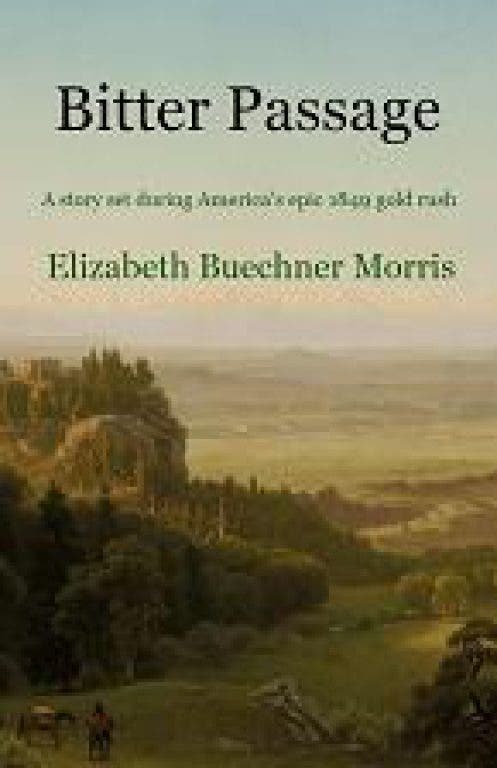

Partway through Elizabeth Buechner Morris’s novel, Bitter Passage, the main character, Frida Reinhardt, is traveling in a boat taking her to Independence, Missouri, where she, her husband, two sons and toddler daughter will begin their trek along the California Trail, west toward the newly discovered gold on Sutter’s Farm.
She is trying to explain to her teenage son why she puts up with her husband’s arrogance and bullying, why she agreed to the journey.
Find out what's happening in Swampscottfor free with the latest updates from Patch.
Frida points to the rosy gold in her wedding ring, the same gold her grandmother wore, the grandmother who told loving stories of her grandfather. When Frida grew older, she learned that in fact her grandfather had died drunk by the side of the road on his way home from his mistress’s house.
Frida says, “She was determined to love her husband and so she did. She wore the ring he had given her, and she was buried with it on her finger.”
Find out what's happening in Swampscottfor free with the latest updates from Patch.
This combination of intelligence, compassion, and straightened circumstances makes Frida Reinhardt a fascinating character, and the sense of worry and foreboding surrounding the story of her family’s trek ever westward makes for great reading.
The germ of the novel came from Morris’s own family.
Morris’s great great-grandfather left what was then Prussia and is now Germany in 1848, as one of 3,000 educated, well-to-do immigrants frustrated after a political attempt to unify and reform Prussia failed.
When gold was discovered in California in 1849, a number of these immigrants joined the 300,000 people who went west in search of riches.
Morris’s great great-grandfather, along with his wife, two sons (one of whom became Morris’s great-grandfather), and his small daughter, bought a covered wagon and headed west.
This great great-grandfather kept a diary of the trip, which Morris’s husband found by accident in the Widner Library at Harvard. None of the family had previously known of the journal’s existence.
Morris says the diary, translated from the original German, was “so boring you couldn’t imagine.” Written “like a sailor’s log” it noted the weather, the distance travelled, what they saw, but briefly. The daily accounting contained “no sense of emotion, desires or fears.”
From those bare facts, Morris went on to invent a rich, detailed narrative. Frida, based on the “strong women in my family,” embodies the “best Germanic qualities.”
The character of Frida’s husband, Hermann, “embodies the worst;” Hermann is a “restless character” who is motivated by “greed.”
In part, Morris credits her ability to recreate the pioneer world view to the 5 years she and her husband, Monty, spent traveling around the world in their sailboat, Salsa, after her retirement as a banker from Bank of Boston.
Sailing and the pioneer experience share the “sense of relying on yourself and each other emotionally as well as for survival.” On a boat you must be “amazingly self-reliant,” make your own electricity, catch your own clean water — you are “off the grid in every sense.”
She tells of the time they dismasted, “lost a sail off the coast of South America,” and had “to jerry rig another sail” in order to make land.
Morris also calls the editorial support of her writing groups “crucial.” Her local group, with members from Swampscott, Marblehead and Salem, has been going strong since 1999.
Her Cambridge group is entering its 25th year, and Morris has been a member for 8.
If you enjoy being taken to another place and time in the company of complex characters and a sure footed narrator, you will enjoy this book.
Those interested in hearing Morris speak and read from her novel have two upcoming opportunities: on Wednesday Dec. 7, 7 pm, Morris will speak at the Abbot Public Library in Marblehead; on Friday Dec. 8, at 2 pm, she will be a guest of The Explorers, 10 Federal Street, Salem.
Both events are open to the public.
Bitter Passage is available for sale at The Spirit of 76 Bookstore in Marblehead, as well on-line from her website at: http://www.elizabethbmorris.webs.com/ and at Amazon.