Community Corner
Travel Back in Time: Tewksbury Hospital
Travel Back in Time with the Wednesday Patch Passport, to discover the history and roots of Tewksbury.


was established in 1852 as one of three state almhouses needed to help care for the influx of immigrants into Massachusetts.
These houses were the first venture into caring for the poor by the state of Massachusetts, previously, this duty had been carried out by the cities and towns in the commonwealth.
According to records, on May 1, 1854, the Tewksbury Almhouse opened with a capacity for 500 people and the population grew to 668 patients by the end of the first week, and more than 800 by May 20. The population continued to grow and by Dec. 2, 1854, 2,193 paupers had been admitted to Tewksbury Hospital.
Find out what's happening in Tewksburyfor free with the latest updates from Patch.
In 1866, the almshouse began accepting the pauper insane, becoming the state's first facility to specifically accept cases with the diagnosis of chronic insanity.
By 1874, the facility became diversified, 40 percent was used as a mental illness ward, 27 percent as a hospital ward, and 33 percent as an almhouse. Tewksbury Almhouse became Tewksbury State Hospital in 1900 and Tewksbury State Hospital and Infirmary in 1938, and continued to serve as a last resort for patients in need of shelter and supervised care.
Find out what's happening in Tewksburyfor free with the latest updates from Patch.
Throughout the 20th century, Tewksbury State Hospital played a major role in the care of patients with infectious and chronic diseases. Tewksbury State Hospital is the pre-eminent historic example in Massachusets of a public health institution developed and operated by the commonwealth.
Anne Sullivan, the tutor and companion of Helen Keller, was a patient at Tewksbury Hospital from 1876 to 1880. Nearly blind from untreated trachoma by age 7 and two unsuccessful eye operations, was allowed to leave Tewksbury and enroll in Perkins School fo the Blind and her life changed profoundly.
At age 20, Anne graduated and went on to become Helen Keller's teacher and companion. One of the buildings on the Tewksbury Hospital Campus is named after Anne Sullivan.
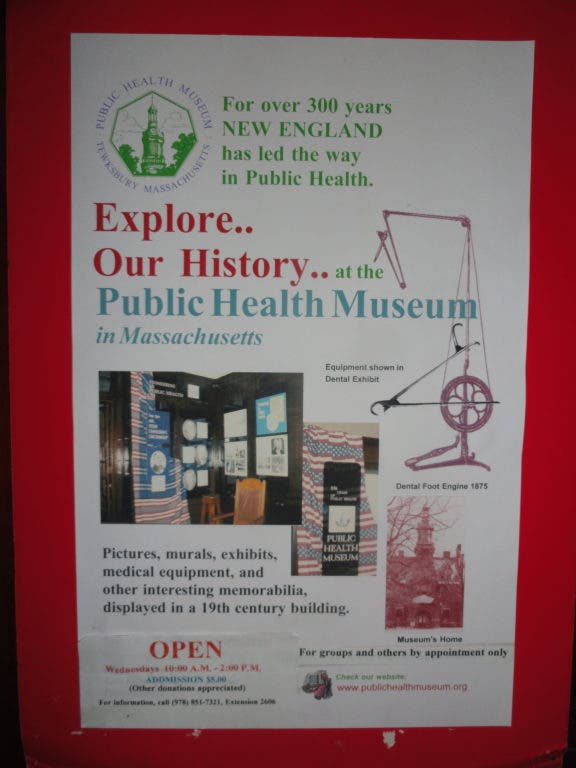
The old administration building, at 365 East St., now houses the Public Health Museum. The museum was incorporated in 1990 and opened to the public 1994. This building and the Tewksbuy Hospital Campus were placed on the National Registry of Historic Places.
The museum houses a wide variety of historic artifacts and memorabilla. There are exhibits on the Pioneering Leaders in Public Health, Paten Medicine, Public Health Hospitals, Nursing Education, Mental Health History, State Laboratories, Campagn Against Tuberculosis, and an exhibit on the 50th anniversary of the Salk polio vaccine. And 1930s Work Progress Administration (WPA) murals celebrating the industries of the Merrimack Valley are an added addition to the museum.
The mission at the Public Health Museum is to be proactive in providing up to date information and promote public awareness and preparedness in addressing these issues, said Duncan Hazel, manager of the Tewksbury Public Health Museum.
The 21st century presents many challenges in public health that we could not have imagined, Hazel stated. Childhood obesity, drug resistant strains of germs, pandemic flu, West Nile virus, and emergency preparedness in the wake of terrorist attack are just a few of the challenges public health agencies are dealing with today.
Tewksbury Fast Facts:
- Tewksbury was founded in 1637.
- It was officially incorporated in 1734.
- Tewksbury has an area of 21.1 square miles.
- Notable residents have included Civil War Gen. Adelbert Ames, teacher Annie Sullivan, sculptor Mico Kaufman, TV news personality David Wade, radio personality and columnist Paul Sullivan.
- As of the 2010 U.S. Census, Tewksbury has a population of 28,961.