Community Corner
Current William J. Lee Town Hall Building Was Former Wakefield High School
The venerable structure was actually "recycled" for use as a Town Hall.
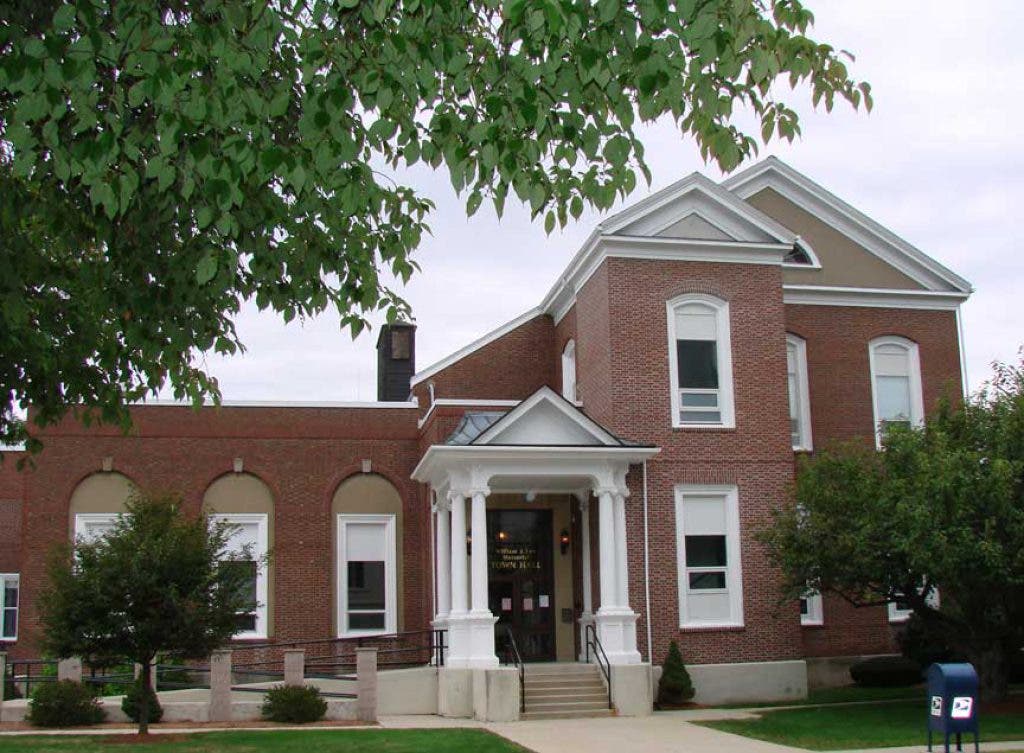


The story of the building presently used for Wakefield’s Town Hall begins in 1871. The town was still getting used to the name of Wakefield, Massachusetts; it had taken the new name in honor of Wakefield Rattan Company owner Cyrus Wakefield who had donated a new Town Hall building.
The donated Town Hall was magnificent. Standing on the corner of Main & Water Streets, the three-storey structure had a fashionable mansard room and thick brick walls. The structure had room for almost all town functions. The Town Library occupied one-half of the first floor of the building. The brand new Police Department (begun in 1871) was in the basement, which was also fitted with jail cells. A commodious auditorium inside the building was used for town meetings as well as for cultural events and dinners. A beautiful memorial in honor of the town’s Civil War soldiers was housed inside the building. And the Town hadn’t spent a dime on its construction.
Freed from the burden of constructing a Town Hall, the town turned its attention on its second priority, the High School. Wakefield High School, begun in 1847, was housed in the old South Reading Academy on Lincoln Street. Increasing enrollments were making the building increasingly inadequate for its purpose.
Find out what's happening in Wakefieldfor free with the latest updates from Patch.
On April 3, 1871, the Honorable P. H. Sweetser, Chairman of the School Committee, formally brought the matter to the attention of Town Meeting. A committee of five, consisting of Cyrus Wakefield, Lucius Beebe, Oliver Perkins, Richard Britton and George Packard, were appointed to consider the educational needs of the town. In May, these gentlemen reported the need for the immediate purchase of land for the erection of a ‘suitable edifice’ to house the town’s High School.
After favorable action by the Town Meeting of 1872, the Building Committee purchased the old Prentiss property on the corner of Main and Lafayette streets. (Caleb Prentiss had been the minister of the First Parish Congregational Church in the 1770s.) The c. 1740 Prentiss house was sold and moved off the property and the High School Building Committee set out to construct a structure suitable for housing the town’s High School.
Find out what's happening in Wakefieldfor free with the latest updates from Patch.
Architect John Stevens, who had designed the Town Hall, was hired to design the new school building. Designed in the fashionable mansard style, like the Town Hall, the new High School building held the latest in technology, boasting a Chemical Room, marble-fitted cloak rooms and a full range of ‘recitation rooms,’ fitted out with speaking tubes and bells. The whole was pronounced “ample and elegant,” a suitable “Temple of Learning” for the town’s young scholars, engaged in noble pursuit of higher learning at Wakefield’s brand new High School building.
The structure was used as Wakefield High School until 1923, when a new high school building, on the grounds of the former Cyrus Wakefield mansion, opened on Main Street. At that time, the 53-year old former high school, renamed the Lafayette School, was converted into a centralized eighth grade to accommodate overcrowding in the neighborhood elementary schools. All of the eighth graders in town, with the exception of the Greenwood School students, attended the Lafayette School. Twelve years later, in 1935, $671.35 in federal ERA funds, was used to renovate a space in the Lafayette School “for sewing.” In 1936, though, the eighth graders were returned to their neighborhood schools and the School Committee transferred control of the Lafayette Building back to the town.
In that same year, the selectmen's report in the Town Report noted that "Several meetings with representatives of the various military organizations have resulted in a plan to remodel the old Lafayette School ... which would provide additional and much needed municipal offices, and also quarters for the veterans." In January, 1937, $17,000 was authorized by Town Meeting for the remodeling work, which was undertaken as a WPA program. An additional $6,700 was appropriate to finish the project in 1938.
The Lafayette Building had been completely transformed. The carved wooden corbels and ionic columns were stripped from the facade. The third floor Mansard storey, with its finely grained Welsh slate roof, had been completely removed. The second floor above the present Department of Public Works offices was also removed, and a high flat roof was built in order to accommodate an auditorium. A north wing was added on all three levels. The Common Street entrance was closed and its porch removed; a new vestibule was added on Lafayette Street. And the entire wooden building was clad in a brick-face veneer.
In 1938, the Town voted to authorize the Board of Selectmen to grant use of rooms in the Lafayette Building to the Veterans' organizations free of charge. Some municipal offices were also located within the building.
"Municipal Departments" were also to be located in the building, first the Welfare Board, and then the Selective Service Board of both Wakefield and Reading. In 1949, the H. M. Warren Camp No. 34, Sons of Union Veterans of the Civil War, was granted space in the building, so that their mementos and other records could be kept there. Throughout this period, the Hall inside the building, outfitted with a piano and fifty chairs, brought in a small revenue for the town. The hall was also used by the Recreation Commission for ‘folk dancing and pageantry.’
In December of 1950, the Town Hall donated by Cyrus Wakefield was damaged by a small fire in the basement. Throughout the 1950's, discussion raged as to the advisability of repairing and remodeling the building, or tearing it down. One option suggested for the raising of funds for remodeling the Town Hall was the sale of the Lafayette Building, along with the Municipal Light Department Building. The fire damage in the Town Hall was really not that extensive; the building continued to be used for municipal offices throughout the '50's. In 1958, however, the building was torn down, and the Lafayette Building was officially designated the Town Hall.
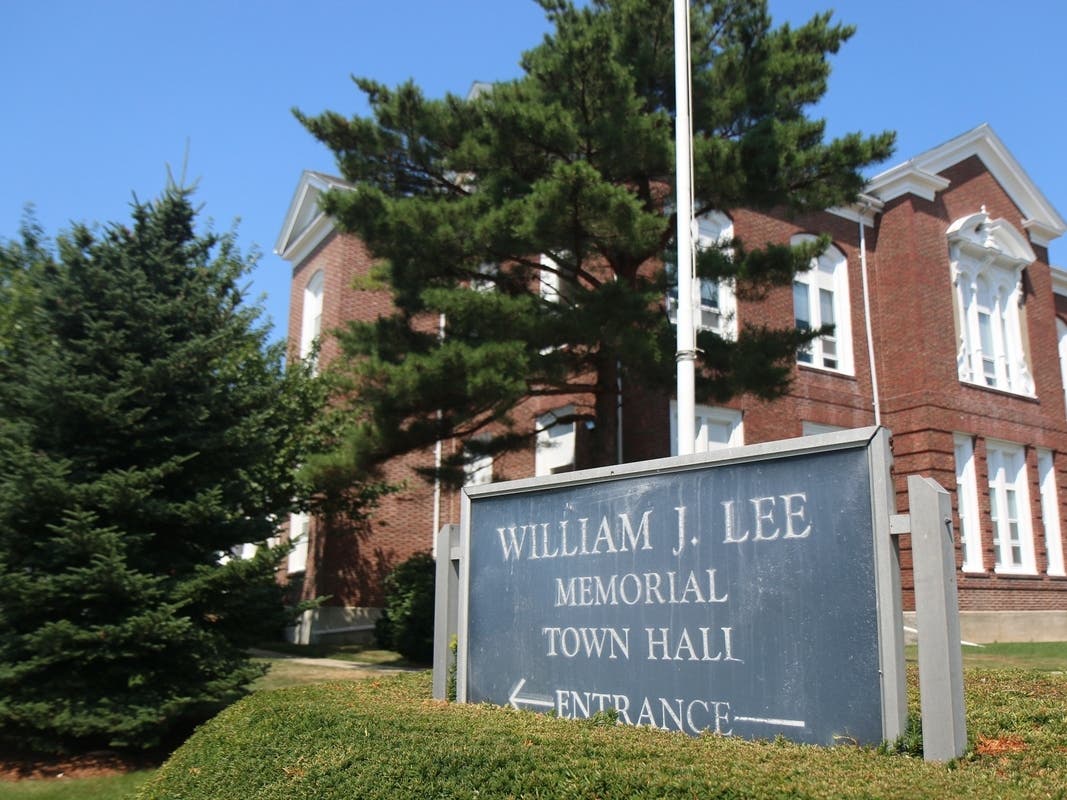
In 1990, the building was renamed the "William J. Lee Memorial Town Hall" in honor of the late William J. Lee, a successful attorney whose many contributions to the town and its organizations had earned him the unofficial name of “Mr. Wakefield.”
The building was extensively remodeled in 1998 when the Town received a Community Development Block Grant to make the Town Hall accessible to the disabled. The Town contributed some of its own funds at the time for much-needed general improvements.
The building is listed in the National Register of Historic Places.