Community Corner
History: Major Horace M. Warren, Wakefield's Civil War Hero
Wakefield's Civil War hero.
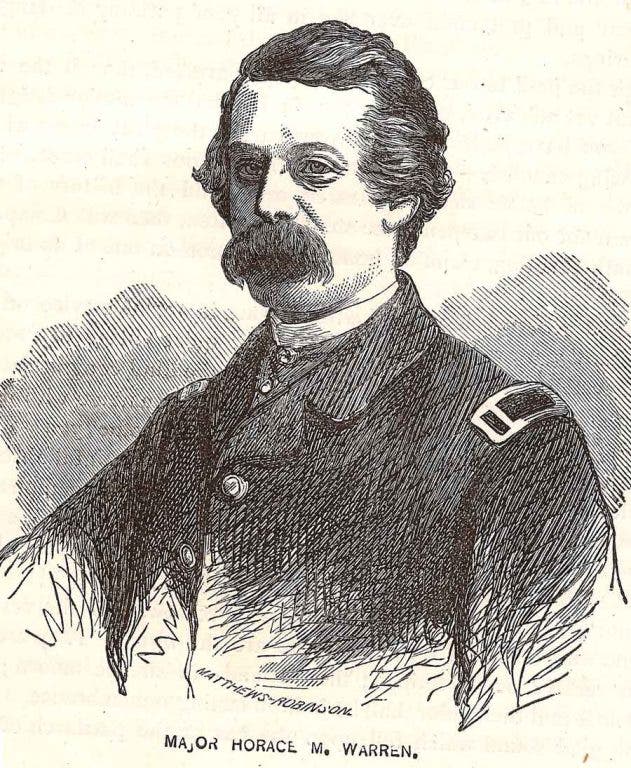


Among the gallant men from our town who served in the battle between the states, the pre-eminent South Reading hero was Horace M. Warren.
Horace was born in Topsham, Maine on July 8, 1841, the son of Edwin R. and Mary H. Warren. A lineal descendant of Moses Warren of Waltham who had fought at the Bunker Hill Monument and at Dorchester Heights during the Revolutionary War, he was a 19-year old clerk when, as a member of the local ‘Richardson Light Guard,’ he answered Abraham Lincoln’s call for a party of 3-month volunteers to defend the national government.
He was one of 79 South Reading men who answered that initial call in April of 1861. The recruits spent a night lodged in Faneuil Hall in Boston where they were equipped for service, and then proceeded south through New York to Annapolis, Maryland. The company was attached to the 5th Massachusetts Regiment at Company B. Their 90-day service was nearly over when the Army was ordered to move against the Confederate forces at Manassas. As the Battle of Bull Run began, the South Reading soldiers got their first taste of battle. Several were wounded, and three were imprisoned at the battle, which had been a disastrous one for the Union Army.
Find out what's happening in Wakefieldfor free with the latest updates from Patch.
Very soon afterward, their term of service ended, so the volunteers from South Reading were mustered out of service on July 31, 1861. Private Warren, however, almost immediately re-enlisted. On August 21, 1861, he became 1st Sergeant of the Co. E. 20th Massachusetts Regiment. Three months later, at the battle of Ball’s Bluff, Virginia, the loss of superior officers placed the 20-year old Sergeant Warren in command of his company. While in command, he was seriously wounded. Union losses at Ball’s Bluff were considerable: Over 200 had been shot, among them a grandson of Paul Revere, a son of Oliver Wendell Holmes and Edward D. Baker, a U. S. Senator from Oregon.
The harried surgeon doing triage on the wounded doubted that Warren could survive, and ordered him left behind so that attention could be paid to men with a better chance of survival. The men in Horace Warren’s command, however, rejected the doctor’s advice. They sheltered their Sergeant, bundling him up and placing him in a boat in order to transport him, in the pouring rain, across the Potomac to shelter. Under the cover of a barn, he was sheltered until, after 24 hours without medical attention, he was finally brought to a Union hospital in Poolsville where his wounds were treated.
Find out what's happening in Wakefieldfor free with the latest updates from Patch.
In January of the following year, he was considered well enough to make the journey home. He had been wounded in the arm, the leg and the body; his left arm was virtually useless. Wracked by his injuries and nearly emaciated, he had returned home a very different man than the idealistic boy who had left South Reading a mere five months before.
In August of 1862, however, another call for volunteers was made, and the Richardson Light Guard again responded. Horace Warren was determined to serve the Union once again. He was elected First Lieutenant of the Company, which was this time assigned to the Massachusetts 50th under the command of General Banks in the Department of the Gulf. The company served during the siege of Port Hudson, where they were under continuous fire for 42 days. After the fall of Vicksburg, Port Hudson was at length obliged to surrender on July 8, 1863. The rest of his Richardson Light Guard companions were then mustered out, but Warren was offered the position of adjutant in Company S, 59th Regiment, under Colonel Jacob Gould. Commissioned an officer, he stayed with the Regiment through a series of skirmishes and battles including the battle of Spotsylvania.
At Cold Harbor, Warren was once again wounded, but he declined to muster out, and stayed with his Regiment. After Lt. Colonel Hodges was killed, Horace Warren acted as Assistant Adjutant General. The rank of major was conferred upon him on August 4, 1864.
Action in the Petersburg campaign, part of General Grant’s fourth offensive on the Confederate capital of Richmond, brought a furious fight for the capture of the Weldon Railroad line from August 18 – 21. During a skirmish in this campaign, a fatal bullet would find Major Warren.
He died on August 27, 1864, eight days after he was wounded. His funeral and burial were held at South Reading. Flags flew at half mast on the day of his funeral at the First Parish Congregational Church. Schools and shops were closed on this day, in honor of this son of South Reading who had fought so valiantly and had made the supreme sacrifice.
The Warren family was one of six South Reading families to send three sons to the War of Rebellion, and one of only three South Reading families to lose two sons in the War. Alvin S. Warren, two years younger than Horace, had died of fever at Fortress Monroe in June 12, 1862. The eldest of the Warren boys, Edwin R. Warren, served in the Navy during the War, and would survive to return home after the War.
In 1867, after the conclusion of the War, the town’s Grand Army of the Republic (GAR) post would be established and would take the name “H.M. Warren Post.” In 1896, the Town of Wakefield voted to erect a fine new brick school on Converse Street. The School Committee had chosen to name the new school the “Highland School,” but the Town Meeting rejected the name, opting instead to name the new building the H.M. Warren School after our hometown hero.
The Wakefield Historical Society upcoming exhibit will memorialize Warren in “South Reading in the War of the Rebellion,” opening on June 5th and continuing throughout the summer.