Community Corner
History: The Harvard Knitting Mills
Wakefield's premier textile manufacturer led the nation in progressive treatment of employees.
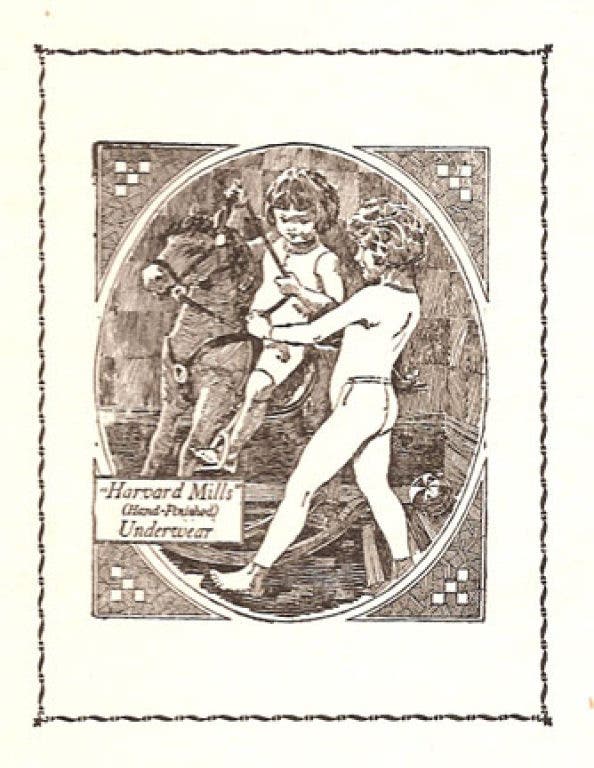

The single largest employer in Wakefield during the first third of the twentieth century, the Harvard Knitting Mill at one time employed 20% of the mill workers in New England. Thought to be the first company to institute an employee profit sharing plan while still paying generous wages and also providing free medical services for their employees, the Harvard Knitting Mill set a standard that few other employers could rival.
It all began in 1888 with a one-room mill in Cambridge employing 30 workers. Elizabeth Eaton Boit, aged 39, and Charles Winship, aged 25, had worked together in both the Dudley Hosiery Mills in Newton Lower Falls and the Allston Mills. They pooled their resources and, with $2500 in combined funds, they purchased eight second-hand machines: three knitting machines and five finishing machines. Charles Winship supervised the knitting operations and marketed the products to wholesalers while Elizabeth Boit supervised the finishing operations and did the mill’s bookkeeping in the evenings.
Within a year, they had outgrown their Cambridge facility and moved to a new home in the Taylor Building at Main & Lincoln Streets in Wakefield. Over the next seven years, the company grew rapidly, soon filling all available empty space in the four-story building. They employed 160 workers at the mill and another 250 women who worked at home, hand crocheting the finishing touches on the fine jersey undergarments, which had the brand name “Mérode.” The company also specialized in men’s hosiery.
Find out what's happening in Wakefieldfor free with the latest updates from Patch.
In 1897, Harvard Knitting Mills undertook the construction of their own factory, a fine brick buiding on Albion Street boasting three stories and a full basement, along with a two-story wing. The company’s philosophy was to manufacture the very best quality product possible, while doing all they could to provide for their employees. It was a winning strategy. Winship-Boit had established themselves as one of the area’s premier textile manufacturers, as well as one of the most progressive companies in the industry. So quickly did the company continue to grow that it was necessary to add to their physical plant in 1901, 1903, 1907, 1909, 1911 and 1921. By 1929, the 600 knitting and sewing machines turned out 1500 dozen garments per day. Their fine quality cotton, silk, lisle or woolen garments were marketed nationally at stores like Lord & Taylor.
In the 1920s, however, changing trends in fashion and technology had an adverse impact on the industry. Rayon was becoming fashionable and required different techniques and machinery. In addition, the knit-wear market went into a general slump. Unlike other companies that cut wages from 10% to 40% and eliminated jobs in order to maintain profits for the owners and management, the Harvard Mills instead put the workers first, but since their profits had dissipated, it was necessary to eliminate their profit sharing program by 1927. With the coming of the Depression, however, cuts could not longer be avoided: the company began eliminating jobs.
Find out what's happening in Wakefieldfor free with the latest updates from Patch.
After Elizabeth Boit’s death in November of 1932, Charles Winship incorporated the company in 1934, with his sons taking leadership roles. During the 1940s, military contracts helped the company to survive, but after Charles Winship’s death in 1946, the company went out of business.