Schools
School IT Recommendation: Hire a School Technical Support Supervisor
School Committee Vice Chairman Tom Markham outlined his plan for fixing the school system's technical support system.
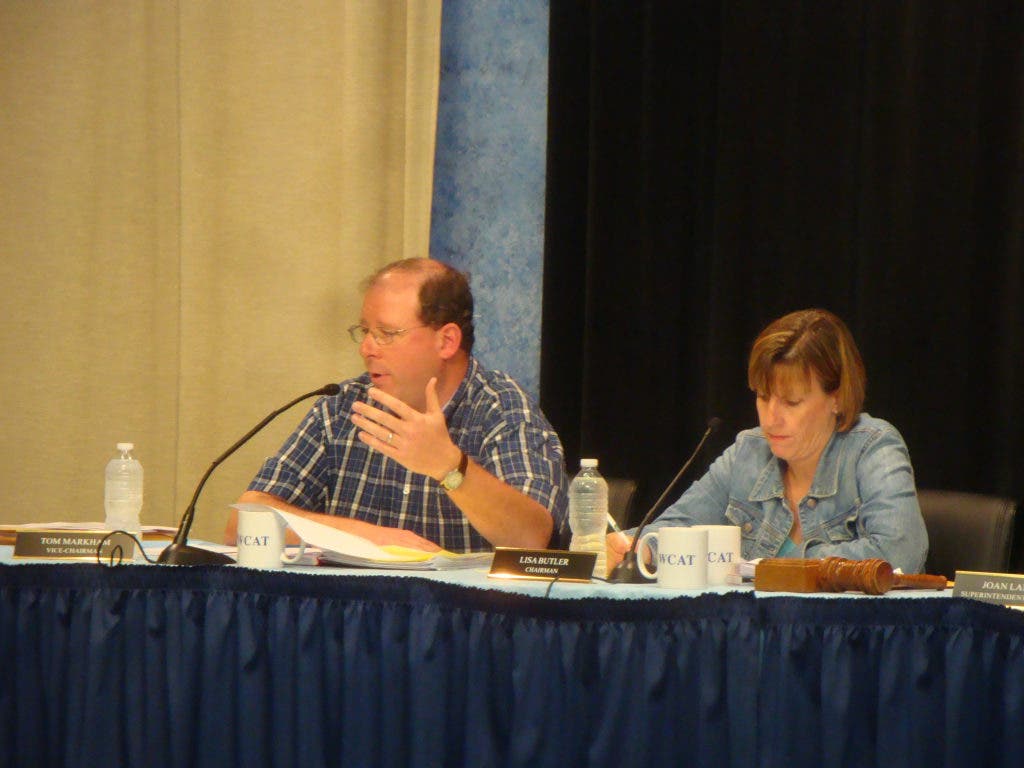
The discussion on the school system’s information technology situation continued at Tuesday night’s School Committee meeting, where Vice Chairman Tom Markham presented his plan on the necessary steps to take and what strategies would be most effective to fix the school's IT issues.
Members of the committee have met with numerous people, including Superintendent Joan Landers, town administrator Stephen Maio and IT director David Knox about the problem.
“We had a great opportunity, over the past week or so, to review the feedback from the staff survey as well as the report from Mr. Knox,” Markham said. “However controversial it may be, it certainly was telling and it had some pretty important data points in it.”
Find out what's happening in Wakefieldfor free with the latest updates from Patch.
Markham said that his dealings with Maio and Knox were positive, and he felt that the two were committed to doing their part in the process of making consolidation in the town and school IT department work, despite the system’s existing problems.
Markham’s first recommendation to the committee was to add a technical support supervisor to the existing staff based in the schools, so that if problems were to arise, there would be someone nearby to help solve the problem.
Find out what's happening in Wakefieldfor free with the latest updates from Patch.
“One thing we’re calling on is called ‘school based support,’ what we know now as ‘help desk,’ although it’s been a little disjointed in the past year on how that’s actually functioned and flowed,” Markham said. “What we’re recommending is to have two areas, which would be school based support technicians, which would have geographies.”
One of the proposed school-based support technicians would operate out of the high school, and would also support IT functions at the Woodville and Greenwood schools, in addition to the central office. The other school-based support technician would operate out the Galvin Middle School, and would also support the Dolbeare and the Walton schools.
According to Markham, there is a funded position of this type in the budget that is currently vacant, and after meeting with business administrator Michael Connelly, it was determined that adding this position would be budget neutral.
As far as the issue of prioritizing tech support requests, Markham’s plan called for a three-level approach to fixing those problems. Level one would account for basic, frequently reoccurring requests that could be fixed easily and quickly without the need for people like the Superintendent to get involved. A level one request, for example, might be unblocking a blocked website that a teacher wants to access for a lesson.
The person responsible for a level one request would be a designated person at each school who is tech savvy, potentially a particular teacher or staff member. Ideally, a level one request could be handled in under an hour.
A level two request would go to the area technician, who would handle tech problems that prove to be more serious. A level two request would have a response time of between two-three days, and would occur if, for instance, a computer were to crash, and it could not be restored by anyone on site.
If the area technician is unable to solve the problem, then he would go and submit a formal work order to the town’s IT director. This would constitute a level three request.
Members of the committee were mostly in favor of the plans direction, though some concerns were raised.
Committee member Chris Callanan asked how the plan would force communication back and inform the request submitter that his request had, in fact, been received and was being worked on.
Markham said that most of the requests that were submitted tended to be level one requests, which should ideally be principal level requests, and not Superintendent, so in that respect, a requestor could just walk down the hall if necessary, rather than make a phone call or leave an email that might wind up being lost in cyberspace.
The committee will continue to work towards the IT solution as the summer goes on, with the goal of having a memorandum of understanding (MOU) with the town by Sept. 1, in time for the start of school.