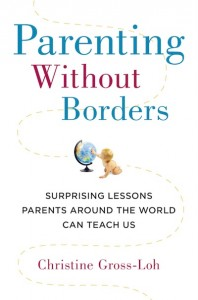
In this week's Parent Yap column, the moms are talking about a recent article by Christine Gross-Loh talking about how expected milestones for children vary considerably around the world. Here's what Tasha Schlake Festel, Regina Martine, Julie Keysor, and Lisa Paglierani had to say.
Tasha Schlake Festel
Find out what's happening in Wakefieldfor free with the latest updates from Patch.
Awesome. Another article bashing me as a terrible American parent, bringing up rotten, spoiled, dependent, and self-centered American children that pale in comparison to the children of the world.
Yes, Christine Gross-Loh writes a lovely article about how respective values in different countries shape the way children are raised and their achievements measured. I enjoyed that perspective and found the differences fascinating. However, I resent the judgement in her tone. She implies that the American focus on verbal and academic achievement is bad. She suggests that the most important thing a child can be is nice, and the only way for this to happen is by sacrificing academics and teaching them kindness. And that American parents suck at it.
Find out what's happening in Wakefieldfor free with the latest updates from Patch.
I call baloney.
I am one of those American parents that 'talked, talked, talked' to my kids, even when they were babies and 'couldn't respond back.' Seven and nine years later, I still talk to them, and since they were each a year old, they've been talking back. Quite intelligently and confidently, I might add. They have vocabularies that belie their ages and have thoughts and opinions on everything. I love this about my children. I consider it one of my finest parenting triumphs that my kids are awesome company. They're interesting and informed. They're thinking beings. And they learned that through our conversations. Yeah, that's right. It is a result of all of that needless talk, talk, talking that started before they were old enough to respond. I wouldn't change a thing. Some of my best and most thought-provoking conversations have been with my elementary-aged children.
According to the author, we lousy American parents have raised helpless kids, able to read and talk, but unable to care for themselves or anyone else. Well, that's just downright offensive. My kids help themselves - and each other - at least as much as I help them. To cite the example in the article, they know how to hang up their own coats... and make their own dinner, clean their rooms, run errands, walk to their friends' houses, get themselves ready in the morning... all without my assistance. I consider that independence.
Another piece of the author's argument that offended me referred to how American children are actually taught. That we cram knowledge down their throats, never allowing them to absorb what is around them. As she put it: There are cultures where parents define intelligence as simply being able to know something needs to be done, and doing it. There are places where learning is not taught, but caught; where being a quiet and astute observer is how a child learns the skills he needs to thrive.
She claims that American kids suffer from knowledge being "taught, not caught." Again I must call baloney. I don't teach my kids to fix problems or be kind. I model that. We don't sit down and have a lesson on how to be nice. I don't read them books that explain how to solve each issue that may arise. I encourage them to think. And through thinking they make the choice to be kind, to do what's right, to fix what's wrong.
The way I see it, intelligence and the ability to carry on a conversation are irrelevant without independence, compassion, and the ability to think. When I think about the kids I know - both my own children and the children with whom they choose to associate - I see a community of children that are thinking, intelligent, sensitive and caring, with a strong sense of self and a motivation to succeed. I love the kids I know, with very few exceptions.
Maybe I'm delusional. Or maybe I'm just lucky to only know "the good ones" in American society. But I highly doubt it. I'm tired of the generalization. Yes, there are helicopter parents and there are rotten kids. Yes, there are tiger moms and there are bullies. But let's not forget that those people are on the fringes. Most kids can read, speak, and care for themselves and others. And they're right here in America, meeting the most important milestone across the world: they're growing up to be their own people, learning, growing, messing up, and fixing it.
At what point do we stand up to these parenting critics and say, a la Howard Beale from the movie Network, "I'm as mad as hell and I'm not gonna take it anymore!"
C'mon, parents! We're not awful, and neither are our kids.
Regina Martine
I consider my self a “well-intentioned parent,” but I don’t think I stressed too much about when my kids met certain developmental milestones like crawling, walking and talking. Of course, they fell within the established “normal” range and all reached the same milestones at more or less the same ages, so there was no real cause for worry. As they got older, I didn’t drill them on learning their letters or reading on their own, I read to them a lot and I figured that when they were ready to read by themselves, they would do it. I didn’t bombard them with Baby Einstein videos or flash cards or expose them to anything overtly educational other than DVDs of Schoolhouse Rock. I don’t think I went above and beyond to prepare them for academic success. But I wonder if I should have prepared them more for independent life. I tell my kids all the time that it isn’t my job to do things for them, but to teach them how to do things for themselves. I say that, but I’m not sure I’m doing it.
When I was a child, I remember obsessing, struggling, and practicing, practicing, practicing so I would be able to tie my shoes at school without help. Now, my husband has to tie the cleats of most of the 10-year old soccer players he coaches. I also walked to school in kindergarten with a group of kids. No adults. Last year when my oldest child went to middle school, I realized that she had literally never crossed a street by herself. Maybe a kindergartner isn’t developmentally ready to tie her own shoes, or wander the neighborhood without supervision, but a fourth grader certainly is, and yet some important skills that were considered vital in the past have fallen by the wayside in favor of early academic readiness.
Now that my kids are older, I wish I had paid more attention to other milestones such as independence, cooperation, and self-sufficiency. Those are the skills they seem to be lacking in now. I fear I will end up with academic superstars who can’t seem to figure out that maybe they should start a load of laundry if all the clothes they want to wear are in the hamper. Lately, they have gotten a little more responsible, a little more independent, and a little more accepting of the fact they are capable of a lot more than they ever tried to do on their own. I still feel like it is a daily battle to remind them to put their backpacks away, and put their shoes away, and pick up after themselves. Would it be easier now if I was more diligent about teaching them to be independent when they were toddlers? I guess I’ll never know.
Julie Keysor
I don’t recall a lot of milestone comparisons when our kids were young. We had a 12 month old child with limited mobility and were thrilled when she walked and even more so when she ran. We were so overwhelmed with doctor’s visits, pregnancy complications, surgeries, and a bout of back pain that out focus was just to cope. We didn’t have much to compare and when we did it was often to the kids we saw in the hospital.
That all changed, however, with the onset of school. Let me first say that I absolutely love our daughters’ school. The teachers are fabulous as is the school’s culture. Nonetheless, I see “milestone’ pressures all the time. A few weeks ago, our 2nd grader came home distraught that she wasn’t scoring…in her words “as well as my friends” on the math mad minute. We asked her what she needed to do to get better—she said “practice”, and so we started the flash cards again but her concern remained high. After a brief chat with her teacher it seemed that this ‘milestone’ expectation was self-imposed by my 2nd grader—her teacher said she was fine—but this experience made me think: “Is it really so bad if we work on math facts this summer if she didn’t meet the milestone this spring?” “Who sets the milestones?” MCAS and other educational standards put a lot of pressures on the teachers and kids—is it worth it and does it accomplish what it needs to?
The article also made me think about my 2nd grader’s recent ancestry poster project. I loved the idea but even more so I loved seeing the kids interact with the parents and other kids to discuss their poster. I left thinking, “Wow, what a great way to increase sense of self-worth in our children.” Nonetheless, I still get the dummy slap of the year. My daughter did the project while recovering from strep throat. She was determined to do the project entirely by herself—she adamantly refused any parental help—so much so that she retraced my tracing of Scotland by flipping over the drawing I did, tracing it, and then attaching it flipped and upside down to the board! You should have seen my husband turning his head this-way-and-that-way trying to figure out just how that drawing reflected Scotland! Anyway, she was incredibly proud of that accomplishment. When I brought the poster to school, I noticed that most of the other kids had projects that looked well—a bit more polished. (Dummy slap #1—don’t compare her work to others). When I heard the kids were presenting their posters to the Walton community I thought, “Oh no, her project’s different.” So I emailed the teacher and said we could help her a bit more it would be better for the Social Studies fair. (I will give myself credit for not approaching it with my 2nd grader which is something I would have readily done given the situation.) Her teacher replied, “Her project was great!” (Dummy slap #2) Yes, my daughter did sense her project was “different” and did express being nervous at the community event because her project didn’t look as good, but when I told her that her teacher said her project was great she regained her confidence and was once again proud of what she did. It then became clear to me what was important: her pride in what she could do without parental help, learning about something different than her immediate areas, learning about other areas through other people, and talking with her peers and adults about her interests. How it looked didn’t matter—it was a 2nd grade poster project! But the processes that got her there were important.
This takes me to one of the messages I really liked in the article: less focus on the milestones—more on process. We try to work on both outcome and process in our home. We don’t always succeed—our kids are very focused on outcomes—but we do try, pretty hard actually, to get them to focus on the processes that get them to outcomes. The article is worth a read…and a few moments to ponder…”are we (parents/society) teaching the kids the right things?
Lisa Paglierani
This article was a nice reminder to focus on what really matters. Overall, I believe I have my parenting priorities in order, working toward the end goal of four healthy, happy adults who contribute to the world in a positive way. I wouldn’t say that I put my children’s scholastic achievements ahead of their “kindness and character,” as the author accuses many American parents of doing. However, sometimes it feels natural to let academic concerns take center stage.
We’ve all heard the ubiquitous parenting advice not to compare our children to anyone else’s, with the assertion that each child will develop at his or her own pace, but the overachiever in me can’t help it sometimes. It is a source of pride if my child reaches an academic milestone on the early side, even though I know deep down that this is unlikely to make a difference in the long run. My mother insists that I began to speak at five months, and sang the alphabet on my first birthday. Whenever this comes up, I unsuccessfully argue the accuracy of this claim, then make a joke (often while standing at the kitchen sink) about how that head start didn’t get me too far in life. Joking aside, I know that it will be my children’s ability to work at full potential, and maintain this ethic, that will outweigh the ages at which they first achieved their milestones.
Of utmost importance is teaching my children to be quality human beings. But academic milestones can be quantified in a way that character development cannot. If my son can write his letters and my daughter masters the multiplication table, they are one recognizable step closer to knowing all the things they are meant to learn. In contrast, teaching things like personal responsibility and respect for others is a more nebulous process. I don’t have a report card showing that my daughter has completed Strength of Character or Independent Thinking. I can only base her progress on the acts I observe, like when she surprises me by cleaning her room, only to feel like we’ve had a huge setback when she treats her brother with unsolicited contempt and cruelty. It makes me feel vulnerable, like there is a new opportunity for failure every day. So, I can understand why parents seek validation in the academic progress of their children.
Fortunately, my children have reached their early milestones at satisfactory ages, and I’ve seen enough compassionate behavior and growing independence in them that I am optimistic for their future. As they get older, they also reveal their individual strengths and abilities, and it’s been a joy to watch these come to light. We’ve witnessed their various talents in writing, art, and music, but also felt the swell of pride upon seeing one nurture a younger sibling, or even crack us all up with an inappropriate joke. Gross-Loh’s article underscores that the skills we can’t measure in our children are no less valuable because of that. With summer upon us, I can think of no better time to put aside any concerns about academic milestones.Get more local news delivered straight to your inbox. Sign up for free Patch newsletters and alerts.