Neighbor News
Bedford VA Police Teach First Responders How to Help Veterans
Training designed to divert Veterans suffering from PTSD to the support they need.


By Robert M. Cook
Edith Nourse Rogers Memorial Veterans Hospital (Bedford VA)
Several area law enforcement agencies are taking advantage of a new training program offered by the Bedford Veterans Affairs Police Department that will help them better serve Veterans who may suffer from PTSDand mental health issues.
Find out what's happening in Walthamfor free with the latest updates from Patch.
Bedford VA is partnering with local police, fire and correctional departments to bring best practices to first responders when they encounter Veterans.
Salem Police Sgt. Harry Rocheville was so impressed with the training that was delivered in May that he wants 45 Salem Police officers to take the program later this fall. Rocheville said police officers from Salem, Acton, Danvers, Gloucester and Wakefield took the training this spring and now have a much greater understanding of how they should treat Veterans who may suffer from mental health issues.
Find out what's happening in Walthamfor free with the latest updates from Patch.
The training was administered by Bedford VA Police Lt. John Rocca and Elizabeth Price,who serves as the Bedford VA’s Operation Enduring Freedom and Operation Iraqi Freedom ProgramManager.Rocheville commended the Bedford VA Police Department for offering the training because police officers cannot get this type of training either in house or at the Massachusetts Police Academy.
Rocheville said Bay State police departments need to be proactive on this issue with so many Veteransreturning from Iraq and Afghanistan. Salem is also unique because it is court seat for Essex County superior, district and family courts where Veterans often end up withoutproper intervention.
“Our goal is to keep them out of the court system if we can,” Rocheville said.
Wakefield Deputy Police Chief Craig Calabrese saidapproximately15 of his police officers took the training.
“It was excellent. I’ve tried to promote it as much as I can,” Calabrese said.
He said just having a greater understanding of what returning Iraq War and Afghanistan Veterans may experience proved to be extremely worthwhile.
“There’s more and more Veterans coming back all the time who have PTSD issues and we want to be able to help them,” Calabrese said.
Acting Danvers Police Chief Pat Ambrose said all 46 police officers, some of whom are also Iraq War and Afghanistan Veterans, took the training in February and really appreciated it.
One of the best things that Danvers Police officers reported they learned was how to approach Veterans who experience PTSD or mental health issues. With the right approach, Ambrose said police officers can break down barriers to communication and refer the Veteran to the appropriate resources.
“It was really like the next step in the process to add to what we already have in place,” Ambrose observed.
Bedford VA Police Lt. Rocca, an Army Veteran and former Military Policeman, said his department has reached out to several police, fire and correctional departments since he and some of the mental health providers fromEdith Nourse Rogers Memorial Veterans Hospital (Bedford VA)launched their outreach program in 2014.
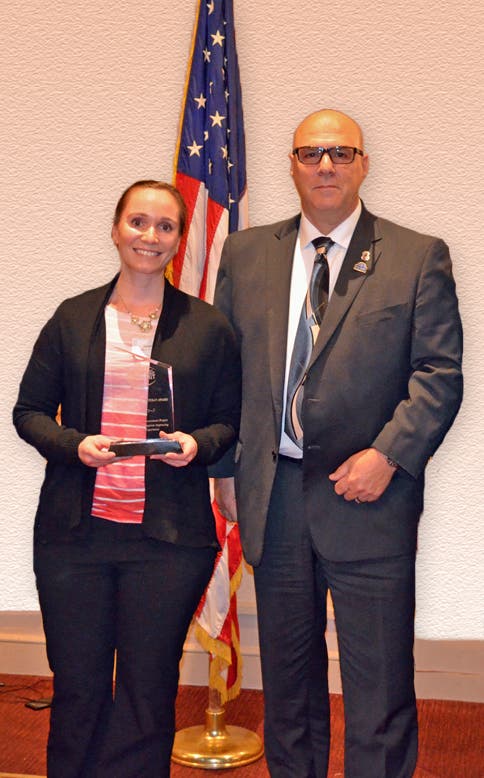
Their unique approach to increase awareness in the first responder community throughout the regionalso garnered them an award among all New England VA hospitals at the second annual VISN 1 (Veterans Integrated Service Network) QualitySummit in June. But winning this recognition is not what motivated Rocca to do this program.
“If we can save one person and give somebody the tools and the ability and words to say that they can help one person, then we can say we have been successful,” said Rocca.
Rocca said the idea to do Veteran PTSD outreach came following a VA and community Mental Health Summit in Haverhill in 2014 where VA and the community partner to explore the best ways to meet the needs and challenges of Veterans.
Questions were raised about the best ways to help troubled Veterans. It occurred to Rocca that many police officers, firefighters and corrections officers didn’t have a great deal of experience helping Veterans who have returned home from the battlefields in Afghanistan, Iraq and other wars.
In addition to the Wakefield and Danvers police departments, Lt. Rocca said they havemade presentations to police departments in Billerica, Salem, Watertown and the Lowell Police Academy. He said they have also presented to the Salem Fire Department and they are planning future trainings with the Gloucester and Lowell police departments, Department of Homeland Security and the National Parks Service.
Rocca said the first responders are being trained how to recognize signs that a Veteran mightneed mental health counseling. They are also being made aware of how they can help some of their colleagues who are Veterans if they exhibit signs of PTSD. Rocca said it is a serious issue because 22 Veterans commit suicide everyday in the U.S. “That number is astronomical when you think about it.”
Rocca said that all 26 men and women who make up the Bedford VA Police Department are Veterans, which makes them great peer educators for other first responders.
A big part of the program is educating first responders about the reality of PTSD and how it is not just limited to Veterans who served on the front lines. He said anyone can experience it just from witnessing traumatic events.
Rocca said he experienced PTSD when he was teaching a CPR class at the Boston VA. He recalled that when he demonstrated CPR on adult and juvenile dolls, he was fine. But he couldn’t demonstrate CPR on the child doll.
Rocca attributed this to an incident in 1976 when , as an MP, he was called to try to save an unresponsive 3-month-old girl at a base housing complex. A few hours later, he learned the child died. At the time,he was able to continue doing his job and later created a family of his own. But when he attempted to do CPR on the child doll many years later, he experienced the emotional trauma he subdued at that time. He said he couldn’t demonstrate the CPR techniques in the class until he composed himself.
He also said many members of his family and three of his four children have served in the military. His children are Army Veterans who did more than one tour in Iraq. The difference between himself and his children and many other Veterans he encounters is that they know they can turn to the VA for help if they experience PTSD.
He believes First Responders may experience similar situations when they head to a fire or a motor vehicle accident where they have to extricate the victims with the Jaws of Life. Getting those Veterans to seek helpis always a tough challenge because many Veterans believe admitting they have some mental health issues could jeopardize their job.
By giving these First Responders some training, Rocca believes “they get more tools for their tool belts” that will help them do their jobs better.
Besides Rocca and Price, other Bedford VA officials who were recognized at the VISN 1QualitySummit included: Lashanta Petroski-Ackley, the acting Suicide Prevention Coordinator; VASH Social Worker Rachel Walter, Peer Support Specialist Alex Whitelaw, Mental Health Specialist Brenda Kline, Suicide Prevention case manager Rebecca Dreifuss and Operation Enduring Freedom and Operation Iraqi Freedom Coordinator, Jolene Coronella.
###
To learn more about the First Responders PTSD program, please contact:
Lt. John Rocca,
Lieutenant and Training Division Coordinator,
Firearms/ATR & Defensive Tactics/GDR ,
U.S. Dept. of Veterans Affairs Police,
Bedford Veterans Medical Center,
200 Springs Road , Building. 78,
Bedford, MA 01730
Operations Desk (781)-687-2404
Training Room (781)-687-2402