Neighbor News
CRWA, DCR, CANOE, and CRCK COMMIT TO REMOVING INVASIVE VEGETATION FROM THE CHARLES RIVER LAKES DISTRICT
This post is a press release for the CRWA / DCR press event held on Thursday, August 20th 2015 conving water chestnut removal on the Charles
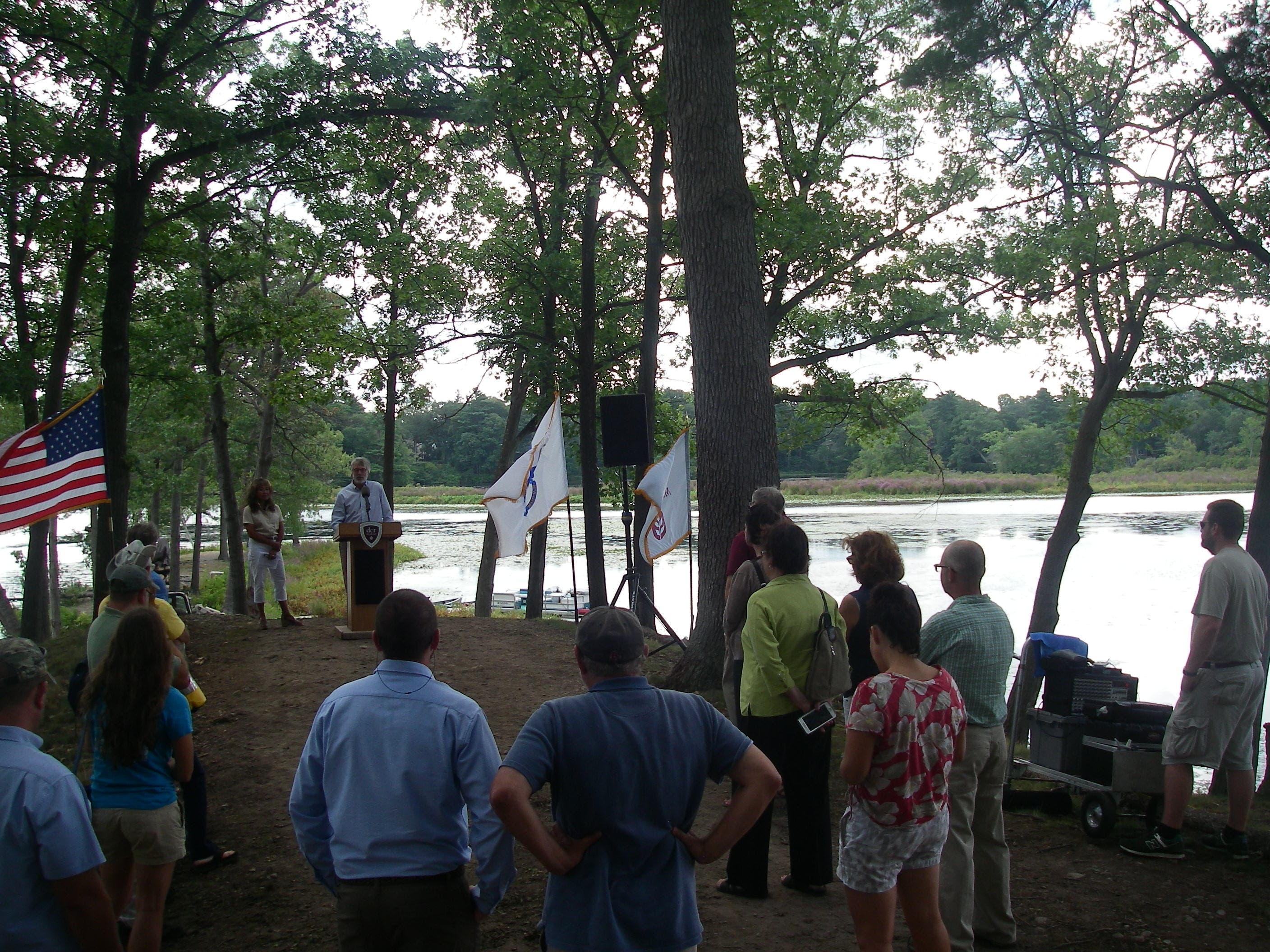


WALTHAM, MA – On Thursday, August 20th 2015, Charles River Watershed Association (CRWA), along with the Massachusetts Department of Conservation and Recreation (DCR) and the Citizens Alliance for NOxious weed Eradication (CANOE), a local citizen’s group, celebrated the success large-scale mechanical harvesting and organized group hand-pulling of invasive weeds choking the Charles River Lakes District along the banks of the Charles river in Waltham.
Located in the communities of Newton, Waltham and Weston, the Charles River Lakes District has long been obstructed by water chestnuts, whose prolific growth negatively impacts fish and wildlife habitat and impedes recreation in this heavily used section of the river. The slow-moving, nutrient-rich and shallow waters of the Lakes District make it particularly vulnerable to invasive aquatic plant growth. Every summer, CRWA coordinates volunteer groups to help remove the weeds by hand, and has strongly advocated for state funding for large-scale mechanical harvesting to eradicate the problem.
Commissioner Sanchez of the DCR kicked off Thursday’s press conference with her assurance that the water chestnut removal program will be able to continue it’s work for seasons to come. Sanchez mentioned her familiarity with the issue as a resident of the Lake Cochituate area in Framingham, MA where this invasive species was once problematic, but has since been eradicated, and expressed DCR’s commitment to achieving the same success on the Charles.
Find out what's happening in Walthamfor free with the latest updates from Patch.
To date, the harvesting project has targeted more than 60 infested acres in the Charles River Lakes District through a joint partnership between CRWA, DCR and CANOE. CRWA and CANOE have raised $25,000 to assist with the project and have used these monies to leverage a 2:1 match of funds from DCR’s Public Private Partnership program for a total of $75,000 for this season. DCR hired Aquatic Control Technologies of Sutton, MA to conduct the mechanical harvesting. Additional support has been provided from the Town of Weston through funding of hand pullers and another mechanical harvester operated by Larry Smith of Charles River Canoe and Kayak (CRCK).
This season, CRWA’s volunteer hand-pullers removed over 80,000 pounds of plant materials from the river. Focusing on areas inaccessible to harvesters because of shallow water or intermixed native plant life, volunteers added this impressive amount of help to the overwhelming efforts of ACT and CRCK’s large-scale harvesting periods throughout the summer.
Find out what's happening in Walthamfor free with the latest updates from Patch.
“The total amount of invasive eradication is still being tabulated but, by all accounts of local residents and other individuals associated with the project, this season has been one of the most successful to date. Everyone I talk to is both surprised and impressed by the small amount of this pest that remains compared to when we began in June.” –David Lipinski (CRWA Volunteer Coordinator)
“The weed removal work done this summer by volunteers, DCR, Charles River Canoe and Kayak, Boating in Boston, CANoE, and our CRWA staff, has been exceptional” said Bob Zimmerman. “We are indebted to Representative Kay Khan, Senator Cynthia Creem, and the entire local legislative contingent for finding the necessary funding.”
Zimmerman also shed light on the problem of phosphorous content in the Charles, which is a main component in water chestnuts, saying “I must also point out that removal efforts like this are only interim solutions. The real problem is phosphorus loading of the river, a problem which CRWA continues to focus on. Without reducing phosphorus-laden stormwater that flows into the river, these measures are intimately doomed to failure. We cannot let that happen.” Zimmerman added that this pollution is attributed to, among other things, car exhaust which deposits the phosphorous from gasoline on streets in liquid form and is later carried to rivers as run-off.
The effort to eradicate invasive vegetation in the Charles is a multi-year project, and DCR has made a commitment to addressing this issue, although having the necessary funds to complete the mechanical harvesting component is critical. To ensure that invasive water chestnut does not spread, CRWA will continue to collaborate with state agencies and watershed communities to control stormwater runoff, which delivers phosphorus to the river, and maintain adequate water levels in the Lakes District in warm summer
About Charles River Watershed Association:
Charles River Watershed Association’s mission is to use science, advocacy and the law to protect, preserve and enhance the Charles River and its watershed. One of our country’s first watershed organizations, CRWA formed in 1965 in response to public concern about the declining condition of the Charles River. Since its earliest days of advocacy, CRWA has figured prominently in major clean-up and watershed protection efforts that have dramatically improved the health of the Charles.