Arts & Entertainment
Bestselling Author Visits Watertown to Promote “The Sandcastle Girls”
Author Chris Bohjalian's latest novel tackles horrors of Armenian Genocide
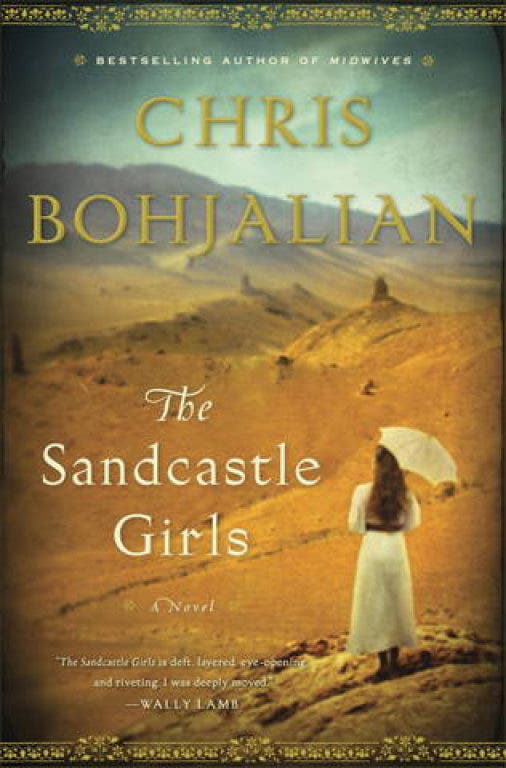
Over the course of his career, novelist Chris Bohjalian has taken readers on many journeys. “Midwives,” a No. 1 New York Times bestseller, centered on an isolated Vermont farmhouse where a home birth goes tragically wrong. “The Double Bind” traveled to Long Island in the 1920s and follows a young social worker’s descent into madness. And “Skeletons at the Feast” chronicled the last six months of World War II in Poland and Germany.
His fifteenth and latest book, “The Sandcastle Girls,” will hit bookstores on July 17. It is a love story steeped in the author’s Armenian heritage. It begins with Elizabeth Endicott, a young American college grad who travels to Syria to assist Armenian refugees during the First World War. The refugees had been forced into the desert by Turkish rulers attempting to eradicate Armenians from the Ottoman Empire. Hundreds of thousands of Armenians were killed in what is now known as the “Armenian Genocide.”
Bohjalian’s story, however, fast forwards to 2012 suburban New York, where a grandchild uncovers Elizabeth’s story of love, loss -- and a wrenching family secret that has been buried for generations. The author will be signing his book later this month when he makes two stops in Watertown: the Boston-Kermesse Armenian Street Fair on July 21 and the Armenian Library and Museum of America on July 26.
Find out what's happening in Watertownfor free with the latest updates from Patch.
Prior to his visit, Bohjalian discussed his latest novel with Watertown Patch. Here are some excerpts:
What will it be like to come to Watertown, with its big Armenian population?
Find out what's happening in Watertownfor free with the latest updates from Patch.
It will be wonderful! I love Watertown! And even if I had never been there before, I would be brimming with excitement. I was in Armenia in May, and NEVER had I felt less like a stranger in a strange land.
“The Sandcastle Girls” will be published on July 17. Why did you choose that title?
I need to be coy, because my answer easily could be a spoiler. But it is, in part, juxtaposition between the associations we bring to sandcastles -- playfulness and a childlike innocence -- and the nightmare that was the Syrian Desert for Armenians in 1915. Also, sandcastles are ephemeral: They don't last.
What do you hope readers come away with after reading your book?
Well, I hope they are moved and happy they read the novel. And for many Americans, I hope they come away a little more knowledgeable about the Armenian Genocide. The fact is that most Americans know very, very little about it. My narrator glibly refers to it as “The Slaughter You Know Next to Nothing About.”
What inspired you to write about the Armenian Genocide?
I’ve been contemplating a novel about the genocide for most of my adult life. I tried writing one in the early 1990s between “Water Witches” and “Midwives.” But it was a train wreck of a book. If I’m going to be kind, I might simply call it “apprentice” work. But “amateurish” would be fitting, too. (Scholars and masochists can read the manuscript in my alma mater’s archives.)
A few years ago, my Armenian father grew ill. And as we visited, we poured over family photos together and I pressed him for details about his parents, who were survivors from Western Turkey. I also asked him for stories from his childhood. After all, he was the son of immigrants who spoke a language that can only be called exotic in Westchester County during the 1930s.
Finally, a good friend of mine who is a journalist and genocide scholar – Watertown’s own Khatchig Mouradian -- urged me to try once again to write a novel about what is, clearly, the most important part of my family’s history. So I did. And this time, it all came together.
Most people are aware of the Holocaust and other genocides, such as ones in Cambodia and Rwanda. Why do you think so few know about Armenia’s genocide?
I think there are a variety of reasons: A principal one is that the post-War Ataturk Government wanted to be perceived as a modern, Western democracy. It didn’t want to be saddled with the sort of barbarism that was involved with what Raphael Lemkin christened “genocide.” And while news cycles moved more slowly in the 1920s than they do now, they did move.
And people’s memories are short.
Moreover, there are two differences between the Armenian Genocide and the Holocaust. First, the Holocaust occurred smack in the middle of Western Europe and the Ukraine. You can’t murder 6 million people from the Seine to the Volga without a lot of witnesses. The Armenians were slaughtered in eastern Turkey and the Syrian Desert. As my fictional narrator asks rhetorically in The Sandcastle Girls, “How do you kill a million and a half people with nobody knowing? You kill them in the middle of nowhere.”
Second, there is the issue of recognition. A few years ago, I heard the incredibly inspiring Gerda Weissmann Klein speak at the University of Texas Hillel. Gerda is a Holocaust Survivor and the author of (among other books) “All But My Life.” Someone asked her, “What do you say to people who deny the Holocaust?”
She shrugged and said simply, “I tell them to ask Germany what happened. Germany doesn’t deny it.”
As Armenians, we have a Genocide in which fully three-quarters of the Armenians living in the Ottoman Empire were killed and yet it remains unrecognized by Turkey and its allies. I think that’s why we are hungry for novels that tell our story – and that tell the world what our ancestors endured a century ago.
Bohjalian will be signing copies of "The Sandcastle Girls" at the on Saturday, July 21 from 2 p.m. – 4:30 p.m. He will also appear at a at the Armenian Library and Museum of America on Thursday, July 26 at 7:30 p.m. These events are free and open to the public.