Health & Fitness
A Week of History and Inspiration
"We have done the impossible, and that makes us mighty." --Malcom Reynolds (Joss Whedon's 'Firefly')

It's easy to get overwhelmed sometimes. The workload involved at our training command can often leave you feeling completely swamped, as though you're up against impossibly difficult odds. Sometimes you find yourself so stressed out, as I did this past week, that you don't see how you could possibly manage to succeed at this place.
This week, we're reminded that the United States Navy does its best work in the face of impossible odds, and no challenge is insurmountable for the world's finest sailors.
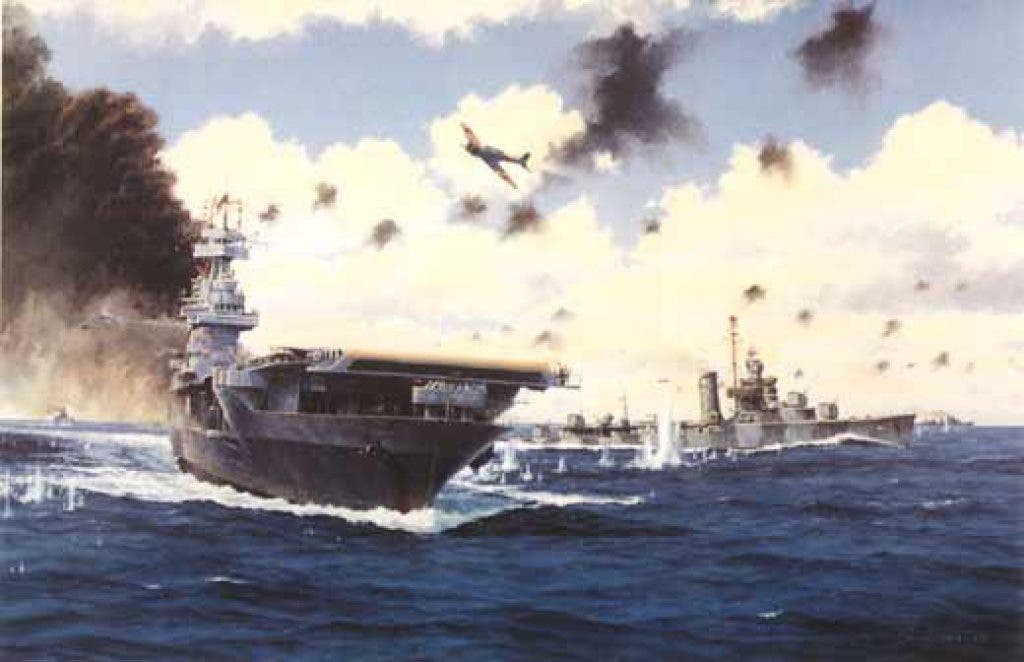
This week, the Navy commemorates the 70th anniversary of the Battle of Midway (June 4-7, 1942), the turning point in the war against the Empire of Japan. The Japanese had taken us by complete surprise at Pearl Harbor just six months prior. On the same day, the Japanese also hit American bases in the Philippines and at Wake Island. For the first six months of the war, we were on the defensive. The Japanese had hoped to deal another devastating surprise blow to our Naval forces at Midway, and effectively take us out of the war in the Pacific. At Midway, the Japanese fleet was vastly superior to our own—the Japanese matched us by 6 to 7 ships to each one of our own. They deployed four carriers to our three (one of which—the Yorktown—was still so severely damaged after the Battle of Coral Sea that the Japanese had, reasonably, assumed it had been destroyed). The sheer strength of their forces at Midway should have been enough to end our role in the Pacific theater of World War II, and open up our western seaboard to Japanese invasion.
Instead, we surprised them. Having cracked their encryption codes just before the battle, we knew where they would attack, and when. Instead of catching us by surprise, they were instead surprised by a carrier strike force they had believed to be defending Pearl Harbor, Hawaii—a force which included the Yorktown, now apparently fully operational, less than a month after it had been thought destroyed.
Against overwhelming odds, defying the amazingly superior size and strength of the Japanese force, we held out, turning the Japanese back. Though we lost the Yorktown, we sank all four Japanese carriers. Despite being so severely outnumbered, the casualty total at the Battle of Midway was 307 US service members lost to 3,057 Japanese service members lost. True to the intentions of the Japanese military strategists, Midway effectively ended the war—just not for us. The Japanese never recovered from their devastating loss at Midway. There were, to be sure, bitter and hard-fought battles to follow. Guadalcanal, Iwo Jima, Okinawa—none of these were a walk in the park. But Midway devastated the Japanese Navy, and although it would be several months before the US Navy was in a position to assert superiority on the Pacific, the Japanese found themselves unable to mount major offensives after Midway.
The other major event this week will be the 68th anniversary of the D-Day invasion (June 6, 1944), which would begin to squeeze the life out of Hitler's Third Reich (the Western Allies were now closing in on Germany from the west and the south—from France and Italy; while the Soviets closed in on Germany from the east). Hitler's reach extended nearly as far west as Spain and his forces in the east were still locked in bitter conflict with the Soviet Russians. In short, Hitler (and his allies Mussolini and Franco) dominated nearly all of Europe.
And yet, again, we defied overwhelming odds and brought Hitler's regime to an end.
D-Day carries particular personal significance for me, as well—my grandfather, Francis Foley, was a Navy coxswain aboard an LST (Landing Ship-Tank) on D-Day. He was a driver for one of the smaller “Higgins-Boat” landing craft used to transport troops to Omaha Beach (those would be the smaller troop-landing craft seen at the start of Saving Private Ryan). Talk about the odds being against you. My grandfather was a priority target—if the driver of the landing craft were taken out, the landing craft never reaches the beach to drop those troops. Those troops, in turn, were landing on a heavily fortified beach that had been “zeroed” (pre-sighted) by enemy artillery; was under overlapping fields of machine-gun fire; had mines planted in the sand, and had close to zero cover from enemy fire, while the enemy enjoyed the cover of a complex bunker system overlooking the beach. If you were very, very lucky, you made it across that beach.
By comparison, this place is a breeze. This week, there are significant anniversaries in the Navy's history that not only remind us of how trivial our worries are, but also remind us that we are at our very best when we're faced with overwhelming tasks. This is the same US Navy that defeated the vastly superior British Royal Navy in not just one, but two wars (we also celebrate the Centennial of the War of 1812 this month); crushed an overwhelming Japanese Naval Force at Midway; braved the U-Boat infested waters of the Atlantic during two world wars to defeat the Germans, twice; kept the Soviet Union at bay and averted nuclear war; and—oh yeah—killed Osama bin Laden. Impossible is just what we do.
So, I'm going to take this week head-on, and face it with the fighting spirit of those who have gone before me.
Hooyah.
"I represent the fighting spirit of the Navy, and those who have gone before me to defend freedom and democracy around the world." — from the Sailor's Creed