Community Corner
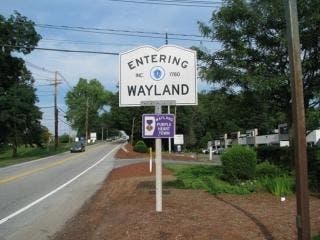
Wayland Town Seal: What Does It Represent To You?
The Boston Globe recently ran a piece focusing on town seals, including Wayland's.


WAYLAND, MA—Every town's got a distinguishable seal, a stamp that defines its history and pride.
This week, the Boston Globe's Lucas Phillips explored the meaning behind these town seals in a piece called "Unsealing the History Behind Town Seals."
In it, the Globe references Wayland's seal, which"shows Indians living traditionally on their own land just as colonists arrive bearing a white flag of peace. Towns like Needham and Watertown depict meetings of mutual respect on their seals."
Find out what's happening in Waylandfor free with the latest updates from Patch.
Wayland was originally a village in the original Sudbury settlement in 1638. After a fight over taxation, the town split up and the original Wayland village officially became East Sudbury from 1780 to 1835. In 1835, the town was renamed Wayland.
"The Puritan Village" by Sumner Chilton Powell details this early history in the book, excerpts of it shared by the Wayland Historical Society, which gives a glimpse into the possible inspiration for the seal.
Find out what's happening in Waylandfor free with the latest updates from Patch.
"Wayland was the first settlement of the Sudbury plantation, established in 1638, and incorporated in 1639. Among the 60 original men, women, and children, were 15 Puritan families who had traveled in the ship Confidence from England. These original families included the Curtis’s, Grouts, Stones, Haynes, Noyes, Bents, and Goodenows. Bringing with them the English pattern of farming, with collective fields and grazing along with individual lots, they named their town Sudbury after the town in Suffolk, where their pastor Edmund Brown and some of their company had lived. "
Photo via town of Wayland
Get more local news delivered straight to your inbox. Sign up for free Patch newsletters and alerts.