This summer, Wellesley College senior Elizabeth Thayer made her way to a wedding by dancing down the street behind a marching band in India, where she was working to improve the public health in small villages surrounding the town of Kanakapura.
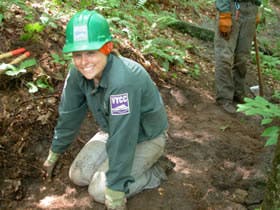
Junior Ana Thayer worked with an all-female leadership development crew to tackle conservation projects in Vermont, including building a bridge over a stream and creating trails. She lived in a tent for nine weeks, cooked her own food and explored an old-growth forest and cave.
These students are among the more than 300 Wellesley College students, faculty, alumnae and staff who will discuss their off-campus learning experiences at the 10th annual Tanner Conference, an all-day event Wednesday, Oct 27. With presentations ranging from "Cheap and Undesirable: Affordable Housing of the Past" to "Fast Cars, Hot Chicks and Social Activists: Ugandan Hip Hop in Social Development," Wellesley travelers return to reflect on the challenges and lessons of their experiences around the world. The conference is free and open to the public.
Find out what's happening in Wellesleyfor free with the latest updates from Patch.
The first Tanner Conference took place in 2001, established through the generosity of Wellesley trustee Estelle "Nicki" Newman Tanner '57. In the 10 years since, the conference is an annual exploration of the relationship between the liberal arts classroom and students' participation in an increasingly diverse and independent world.
"One of the great things about the conference this year is the chance to look back at how Wellesley has changed in the past decade," said Lee Cuba, co-chair of the conference committee and professor of sociology. "The kind of experiences that students are engaged in creating has definitely broadened."
Find out what's happening in Wellesleyfor free with the latest updates from Patch.
Reflecting Wellesley's increased focus on international and experiential learning is the number of college-funded internships, which has increased from just 30 in 1999 to more than 300 today. Countless other Wellesley students seek out such opportunities independently. As Wellesley's presence in the world has grown, so has participation and attendance at the Tanner Conference. This year, 25 percent more students applied to present at the event, said Joanne Murray, executive director of the Center for Work and Service at Wellesley.
"The topics have evolved to be more interdisciplinary in their approach, and that is reflected in this year's conference," Murray said.
Students were invited this year to tag their own projects with three keywords that guided the organization of the event's program, rather than having their presentation organized by broad categories as had been done in years past. Cuba said a shift in topics led the committee to reorganize the presentations and reclassify projects.
"It became clear to us that we couldn't use the same out-of-date, too-broad categories," Cuba said. "I don't think 10 years ago you would have seen sustainability as a tag for anything, and it's a big one now. You look back at these programs and you see what the global issues were at the time and how they've changed and shifted."
Tagged under "youth" is a presentation by junior Chanelle Lansley, "From Oreo to Mzungu: Experiencing the Disconnect Between Africans and African Americans in Uganda." Working in Kampala, she taught at a local school and volunteered at an orphanage for children with HIV/AIDS. She also learned lessons about her own racial identity.
"It had never occurred to me that I would encounter discrimination in East Africa," she said. "My rationale was flawed; although we shared the same skin color, our past experiences and present circumstances were remarkably different."
Also in the youth category is senior Katherine O'Donnell's presentation, "Life Behind Bars: My Summer Spent in a Maximum Security Prison." O'Donnell worked at New York's Bedford Hills Maximum Security Prison for Women in the Parenting Center helping to coordinate visits with female inmates and their children. She found common ground with inmates as they discussed the latest episode of "The Bachelor," while also learning much about the prison system.
"Statistics have shown that children see their fathers in prison more than children see their mothers who are in prison," she said. "The summer has opened my eyes to a whole new world that always existed but that I had never seen. I hope to take the knowledge that I gained this summer and apply it to my continued work with children and parents in the future."
This year's Tanner Conference also features new technology, including a Web-based application where attendees can use their phones to plan the conference or compare their schedule for the day with a friend's. Students and faculty in the computer science department spent the summer creating a large touch-screen map, which allows users to see where students have been interning and to read a description of their Tanner presentation and schedule information. Another interactive screen will feature photos submitted by students, where users can touch an interesting snapshot and access information on the student's presentation.
Roundtable discussions, which have always been a highlight of the conference, this year will focus on the research and service learning that Wellesley has undertaken in the past decade, and the progress the college has made.
"A Wellesley education does not end in May, nor does the classroom door divide her intellectual experiences from her world experiences," said Winifred Wood, a senior lecturer in the Writing Program. "Perhaps most important, through their work outside the classroom, students come to understand how they can extend the gift of a Wellesley education to others."