Health & Fitness
Original Mass Pike Planned to Bisect Westborough
Westborough, they argued, would be destroyed by this plan.
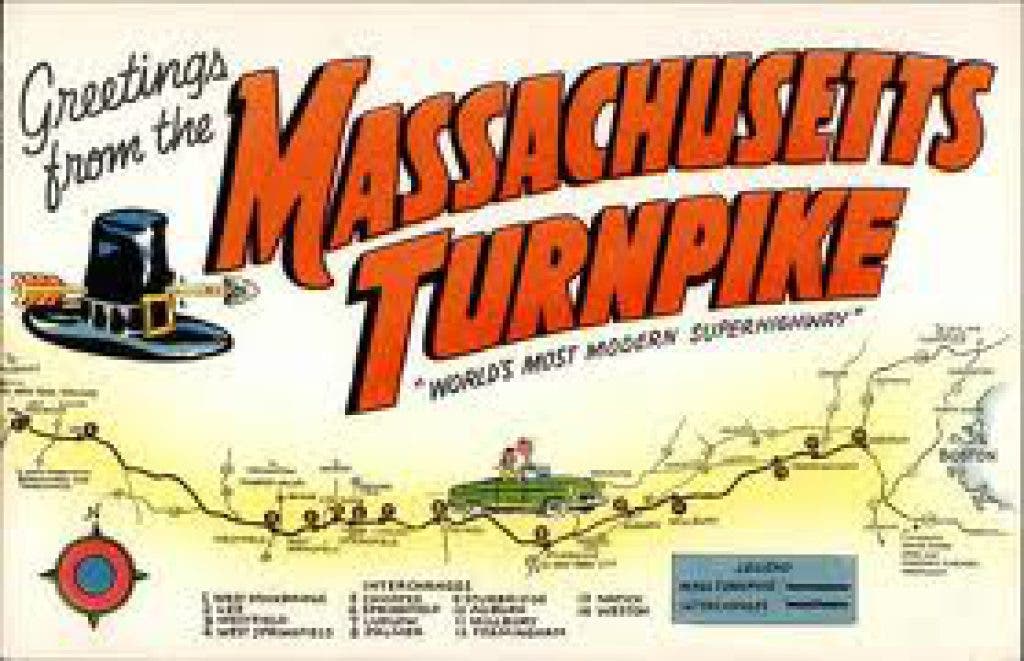


Massachusetts Turnpike
In 1948, it was determined by the Massachusetts Department of Public Works that the present westerly routes from Boston were sadly inadequate and that the existing Boston and Worcester Turnpike that opened in 1932 was not a viable alternative to a controlled access commercial route between Boston and New York. Route 9 was described as being obsolete, inadequate to handle the increased traffic to the growing western communities and a traffic safety nightmare. Although local, state and federal officials were all in agreement that something must be done, Massachusetts at the time was heavily in debt and unable to take financial responsibility for such a monumental project.
Find out what's happening in Westboroughfor free with the latest updates from Patch.
In 1952, William F. Callahan proposed the formation of a new authority. Initially called the Boston-Springfield Highway Authority, it was renamed the Massachusetts Turnpike Authority when Callahan introduced legislation for its creation in the Massachusetts State House. In May 1954, the Massachusetts Turnpike Authority floated a $239 million bond issue to finance the proposed turnpike. Following the success of other turnpike issues in the Northeast, the Mass Pike bonds were sold out in three hours.
The Westborough Controversy
Find out what's happening in Westboroughfor free with the latest updates from Patch.
In the early 1950s, when the Turnpike Authority was finalizing the layout of the new road and acquiring property along the route, the town was made aware that the new toll road was engineered to bisect the town within a ½ mile south of the Rotary. The residents as well as local businessmen and selectmen were furious and petitioned loudly to state officials. Westborough, they argued, would be destroyed by this plan. The plan was to traverse from the east of the Great Cedar Swamp and maintain a westerly route that paralleled Route 30 as close as possible into Grafton. Locals exerted pressure on legislators and got the road moved to its present location away from downtown and closer to the Upton town line.
Construction of the initial section of the turnpike from West Stockbridge to Weston began in January 1955 and completed through Westborough in 1956. The privately owned 122-mile toll road was completed in 1957 at a cost of $257 million. It was designated as Route I-90 in 1959.
In 1964, Route I-495 was being constructed through Westborough and connected to Route 9 in 1967 but was not officially opened until 1968. Although Route 495 passed over the MassachusettsTurnpike, the two roads were not approved to connect.
As early as 1967, a connection of Route I-495 and the Mass Pike was requested but was denied by the Federal Utilities Commission as being unnecessary. At the time, the closest access from the Pike to Westborough was in Millbury at exit 10 and in Framingham at exit 11.
However, there were political issues prior to completion concerning a federally funded interstate, Route I-495, being linked to a for profit (private) highway, the Massachusetts Turnpike. The Federal Highway Commission would not allow the connection and Governor John Volpe and the state DPW Commissioner Frank Sergeant weren’t pleased. Not to have the two major highways connected in the middle of the fastest growing area in the commonwealth was absurd. So the governor decided that the state would initiate the design layout, secure the necessary land, get the finances and then pressure the feds into taking action.
It finally took a fast-track bill initiated by Representative Francis X. Davoren to finalize the plan.
But it was not until 1969 that he Massachusetts Turnpike was connected to Route I-495 and immediately became the busiest and most profitable interchange outside of the Route 128 loop.