Schools
Q&A: Catholic Memorial's President Paul E. Sheff
CM president talks about how school is not just known for sports. Also did you know that 3% of the student population is from China and Korea?
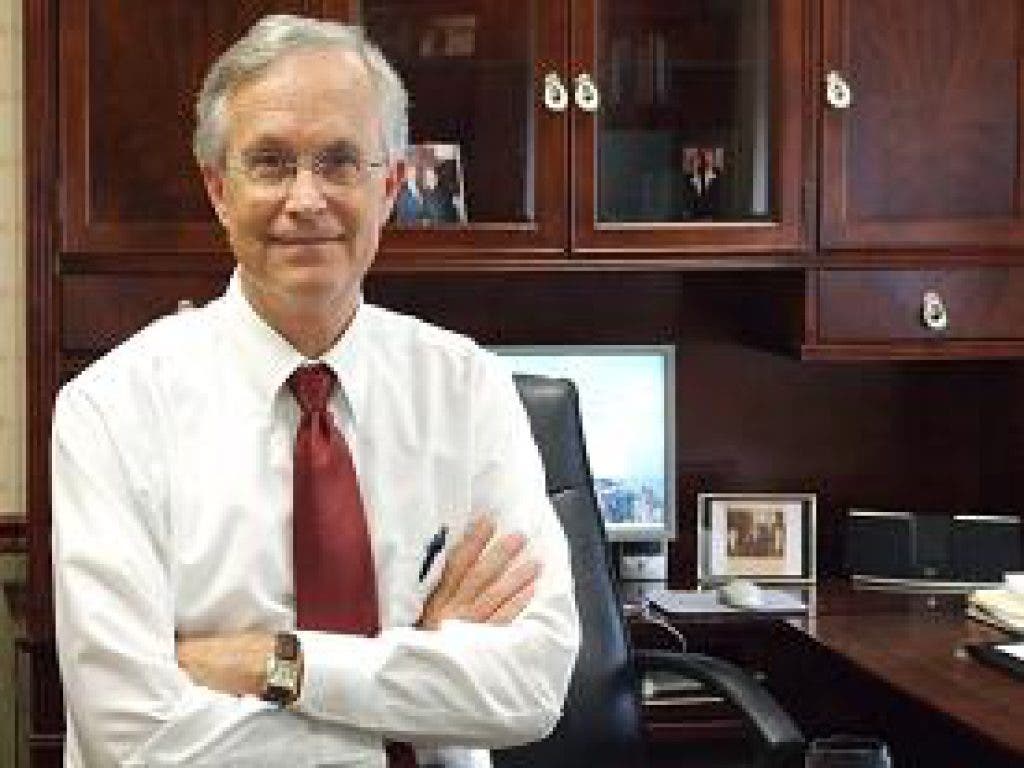
Since the school's now-President Paul E. Sheff's own graduation from the 1962, the has developed into a top Boston-area school, one of West Roxbury's more emblematic spots, and a gateway for young men from as far as Asia, and as near as a five-minute walk away.
Entering his fourth year as the school's head, Sheff spoke with West Roxbury Patch about how he became the school's president, how the school has evolved, what will come next for CM, and more.
How did you come into your role as president of Catholic Memorial School, and is there a difference between being a Head of School, as , and being president at Catholic Memorial, as you are?
Find out what's happening in West Roxburyfor free with the latest updates from Patch.
Sheff: I came into the role from a non-traditional background. Quite commonly heads of schools are drawn from within secondary education and academic ranks. I came into the office from the world of higher education and institutional advancement – fundraising, alumni relations, marketing and communications. The idea of being president of Catholic Memorial presented itself through a chance meeting in the Ft. Myers airport with the president of Catholic Memorial, Br. James MacDonald, CFC. During our conversation Br. MacDonald encouraged me to think about replacing him. Although my earlier career was spent in secondary education (I was an English teacher), I was quite happy to remain in higher education and institutional advancement. But that conversation served as the genesis for my decision to return to secondary education.
I became a candidate for the job in January of 2008, was elected in May of that year, and on July 1 was sitting in the president’s office after 21 years in higher education and 27 years in institutional advancement.
Find out what's happening in West Roxburyfor free with the latest updates from Patch.
A president and a headmaster are both the chief executive officers of a school. The main difference, as I see it, is that a president is primarily responsible for mission, vision and resources, and far less responsible for the day-to-day running of the school. Heads of schools are more closely involved with the students and faculty than I am as president. My position is more oriented toward external relations.
What were your impressions of the school when you first arrived, and what has changed during the three years of your tenure as president?
Sheff: Well, because I sat on the board of directors of Catholic Memorial from 1999-2005, I was somewhat familiar with the school in present-day terms. That was important because my view of Catholic Memorial was formed when I was a student from 1958-62. Although there are some fundamental similarities between Catholic Memorial in 1962 and 2008, the differences are quite remarkable. Taking over as president in 2008, I found a school that had successfully completed its 10-year re-accreditation, that had undertaken a strategic planning process, and that had just celebrated the 50th anniversary of its founding. In other words, it was in pretty good shape.
In my early remarks to the school community, I stated that my goal as president was to put in place the conditions and circumstances that would allow the school to celebrate another 50 years of serving young men. I talked specifically about the need for a vision for the school, and the need to address shortcomings in our physical plant. Vision is important, I told the faculty, because vision not only describes what the school wants to look like in the next seven to 10 years, but it also identifies how that “look” will make the school more distinctive in the very competitive marketplace that is secondary education in greater Boston and beyond. As for our physical plant, except for renovating our athletic fields eight years ago, the high school building had not been significantly altered since it was first opened nearly 50 years ago. Although our middle school building had been renovated in 1993, our high school building needed to be brought into the 21st century.
Our vision for Catholic Memorial will center around a commitment to global education and public speaking. The first is almost a given in our rapidly interconnected world. Colleges and universities are heading into the global world at break-neck spend. As a college preparatory secondary school, we have an obligation to ready our students from that immersion. The second component of vision has more to do with the history of public speaking at Catholic Memorial.
Tell me about that. In the main I think people see Catholic Memorial through the prism of athletics. Are there other points of distinction for which the school should also be known?
Sheff: Long before any athletic team had won any trophy, the debate team had already won several local tournaments and had begun to make a name for itself on the national stage. In 1962 CM debaters placed 5th at the National Catholic Forensic League tournament in Miami Beach. Since then the school has had dozens of state champions and three national champions. In addition to speech and debate, CM has a very strong theater program (last year it put on a magnificent production of "Les Miserables") and a vibrant arts program. Our mock trial team was invited by Harvard Law School to sit in on one of their mock trial sessions, serving as the jury. Through our efforts to raise money to find a cure for breast cancer, we have been recognized not only nationally, but also by the Massachusetts General Hospital, where we were named to their top 100 (donators). I could go on, but certainly we have more going for us than athletics.
Catholic Memorial is seen by some as a “city school.” Is that tag appropriate? From where do you draw your students?
Sheff: Certainly CM was a city school in my day, if by “city school” one means that the majority, if not the overwhelming number of students, come to Catholic Memorial from the Boston communities. In the early 1960s most of the students came from West Roxbury, Roslindale, Jamaica Plain, and Hyde Park. Dorchester would be next in line. Today that is not the case. Approximately 52 percent of our students come from communities outside Boston (outside Rt. 128), 45 percent from Greater Boston, and three percent from Korea and China. We draw our students from 80 communities, as far south as Cape Cod, as far west as Shrewsbury, and as far north as Saugus.
Having said that, however, we very much see our school as part of the fabric of Boston with its various racial and ethic communities.
Furthermore, having been founded in West Roxbury, we strive to be a good neighbor and an asset to this wonderful neighborhood.
Catholic Memorial is an all-boys school, and a school with an active faith commitment. What benefits are derived from both of those characteristics – why all-boys? Why faith-based?
Sheff: What I like about us as an all-boys school is that we really understand what it means to be a boy, ages 12 to 18 (Catholic Memorial has a middle school and high school). This is really important for there is a great deal of evidence out there that boys, compared to girls, are doing less well academically, going to college at lower rates, graduating at even lower rates, and with higher incidents of substance abuse and incarceration. Some have even referred to the situation as a “crisis.” I do not think there is a crisis, but there is no doubt that boys are struggling much more now than when I was a student. I think parents understand that we really “get” boys and how to help them succeed.
As for being faith-based, we are quite serious about our commitment to our Catholic-Christian identity and to the legacy that has been passed on to us by the Edmund Rice Christian Brothers. One does not need to be a Catholic to be at Catholic Memorial, but one does need to understand that ours is a community that embraces the reality of a transcendent God, the gift to the world that was Jesus Christ, the gospel message that is our inheritance, and our need to live out that message on a daily basis. Many parents, even non-Catholics, find this to be an important component of one’s growth into adulthood.
What do you see on the horizon for CM over the next three years?
Sheff: This summer we are finishing up multiple facility projects, amounting to $1.6 million, that will transform our athletic fields, Perry Gymnasium, two of our three science labs, and will result in the creation of a seminar room. In the near future I would like to renovate and expand the front entrance to the high school. We will continue to push and promote our vision, based on global education and public speaking. And finally we will continue to expand the number of communities from which we draw students. All of this is very exciting, and will certainly go a long way to insuring that CM is able to celebrate another 50 years of existence.