
Sports
Black Belt Just the Beginning for Westwood Student
Matt Haddad earned his first black belt at age 9.


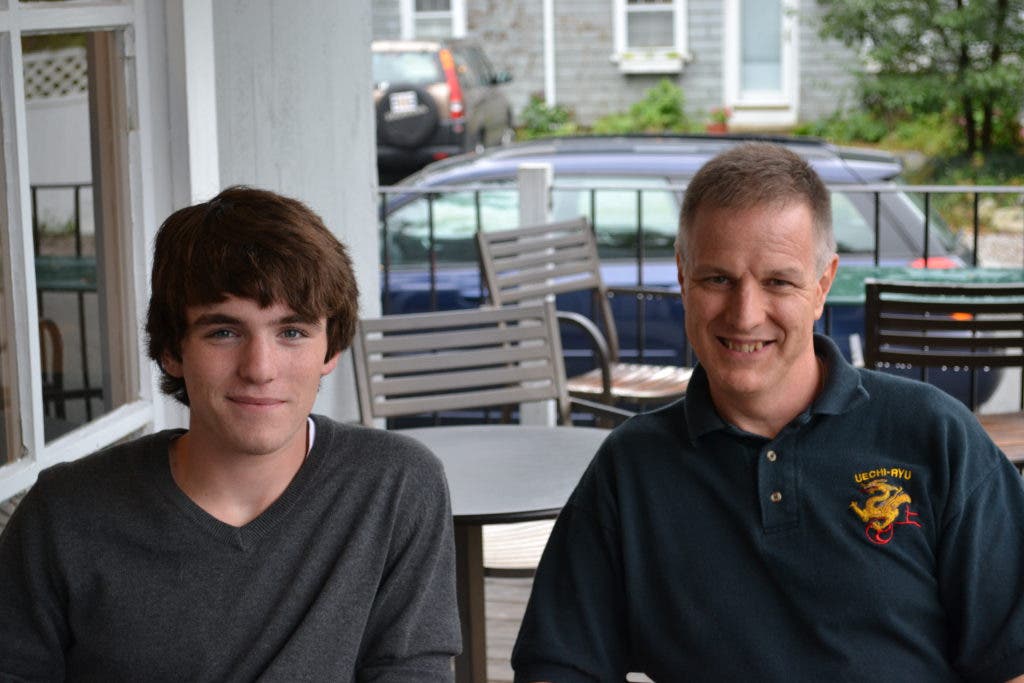
It's been nearly eight years since Matt Haddad earned his first black belt in Uechi-Ryu karate, a form of martial arts he began learning when he was just 4 years old.
"I was too young to do anything else," Haddad said. "And then my mom said, 'Well, do you want to try karate?' And I said, 'Yeah, sure, why not, that sounds interesting.'"
In 2003, Haddad earned his junior black belt at age 9 after working at it for about five years since he started taking karate lessons through the Westwood Recreation Department. He was one of the youngest in the area to earn his first black belt.
"It was really exciting," he said. "I was learning how to do something that not a lot of other people know how to do."
Steve DiOrio, who has instructed Haddad since he began training, said while five years is a relatively common time span for students to achieve a black belt, to do so at such a young age is somewhat of an accomplishment.
"Matt was not the first kid student in Westwood to earn a black belt," Diorio said. "Not a lot had done it before him, but a few."
Now, nearly a decade later, Haddad recently earned his first degree adult black belt, allowing him to continue his journey toward becoming a full instructor, something he sees as a goal and an acheivement.
"I've been doing it for so long, it's like second nature," he said. "I feel completely comfortable teaching someone. Being a black belt, you stand in front of the class and do some opening exercises, and it was just like second nature."
While he doesn't drill himself on his skills every day, Haddad said he does practice hard to make sure he's on top of his game.
"I definitely like to keep my skills sharp, and make sure I'm producing high-quality karate, being a black belt, and as an instructor not even for myself but to have younger kids see me and say, 'Oh, that's how you do it,'" he said. "If I'm a near instructor and I'm producing low-quality work, the kid's aren't even going to learn anything from that."
DiOrio, for his part, has been instructing in Westwood for 18 years; he's been teaching for 25 years and has been a student of martial arts for 37 years.
He's studied various forms of martial arts over the years, but has settled on Uechi-Ryu as the best form to work with students.
"We do what they've done in Japan for 600 years," DiOrio said. "The reason why in karate we vary uniform, because when you walk through that door, you could be an honors student, a doctor, a lawyer. In that room you are a karate student."
As such, the color of the uniforms vary from white to red to black based on experience and skill.
"The whole thing is about apprenticeship, paying your dues," DiOrio said. "All karate can be boiled down to this: you take about 12 fundamental skills and make people do them over and over and over under a critical eye, never being too accepting so we don't build in complacency, but never being too critical so we turn people off.
"My job," he added, "is to tell people they're doing thigns wrong in a way that they can hear and in a way that inspires them to do better."
There are 10 ranks for each student to earning a black belt: 10 kyu, or student, ranks and 10 dan, or instructor, ranks.
DiOrio, who is a sixth degree adult black belt, subdivides his kid students' ranks, giving them 20 promotions toward black belt.
"That allows me to promote kids at twice the rate but still keep them at the same pace," he said. "They know in 10 weeks what they need to be responsible for certain things."
But DiOrio stressed that while many perceive earning a black belt to be the "end" of training, it actually signifies the beginning, as the learning process is ongoing and, as DiOrio said, never really ends.
And while martial arts certainly explores a level of self defense, he added, it is also as much, if not more, a mental and developmental exercise.
"There are two big elements," he said. "One is self development, the other is self defense. We try to balance a little bit more 50-50 between self development. But at the same time, if you do get into (an issue), we certainly don't want the skills to be wasted."
Moreover, Haddad, like most of DiOrio's students, don't look at Uechi-Ryu as a competitive sport.
"I did one (tournament)," Haddad said. "I didn't like it . . . it was competition. Karate isn't competition, it's martial art. It's something you compete with yourself to be better. If you're trying to outdo someone else, your'e not doing it for yourself, you're doing it for the recognition, and that's not what I think Uechi-Ryu is about."
DiOrio mixes various skills into his lessons, from various kicks and punches to aquired skills with various weapons, like a bo staff or sai. "The Ninja turtle weapons," as DiOrio puts it.
And over the years Haddad said he's come to enjoy the exercise of breaking wood with a single punch the most.
"It's the most satisfying thing to have something in front of you and then say, 'What part of my body can I use to destroy this?'" said Haddad, who first completed the exercise successfully when he was a step below a junior black belt.
"It was a rush," he said. "You get all nervous . . . is it going to hurt? Then you hear the wood snap and your fist is through it. It's very satisfying. It's like hitting a home run."
Get more local news delivered straight to your inbox. Sign up for free Patch newsletters and alerts.