Arts & Entertainment
Boston Author Takes Westwood Residents Through the 'Contrast Era'
Author Stephen Puleo visited the Westwood Public Library to discuss his most recent book.
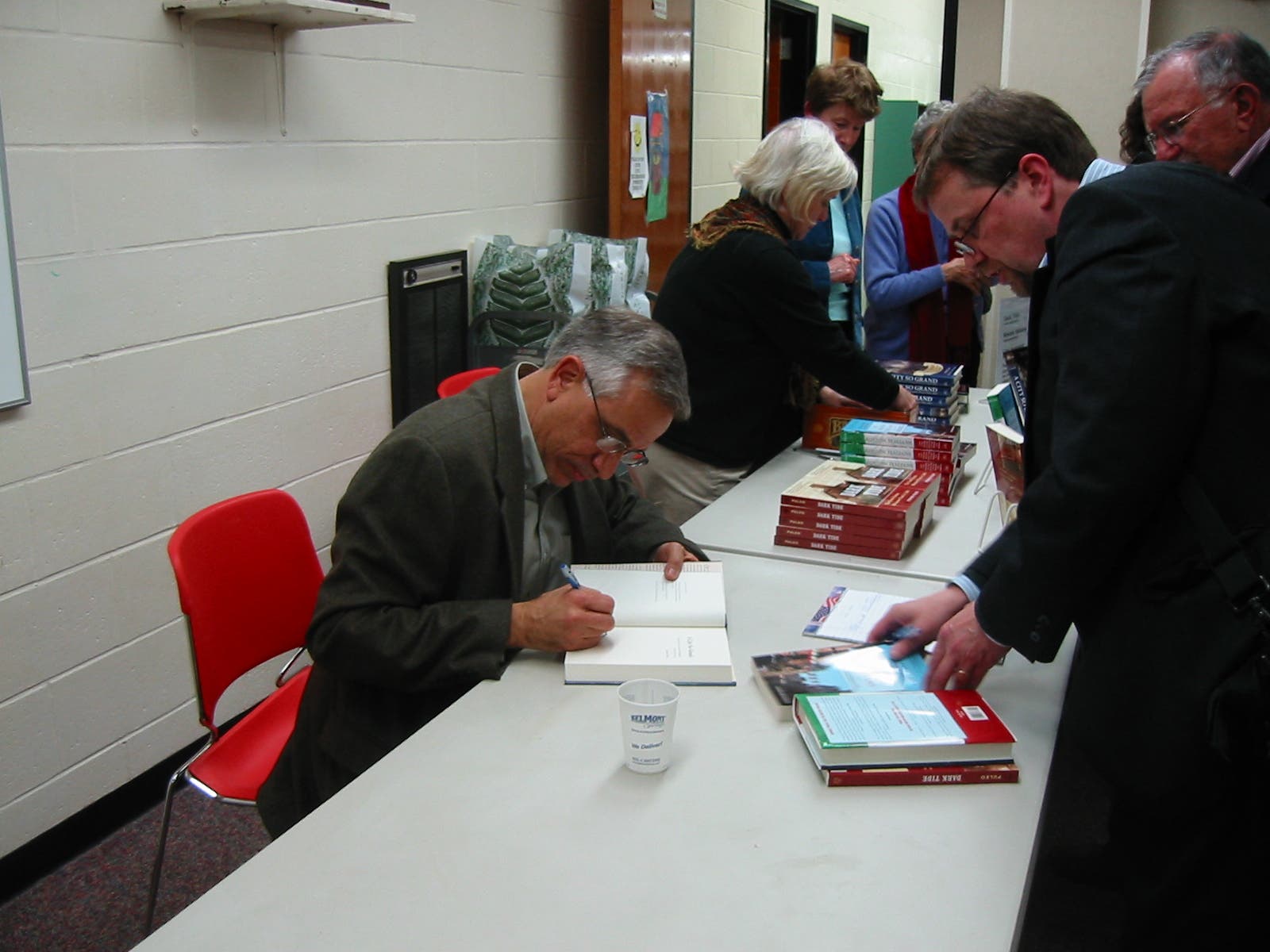


A vibrant crowd filled the meeting room of the Westwood Public Library Wednesday to embark on a literary adventure through Boston during the mid-to-late 1800s.
Taking them on that journey was author Stephen Puleo, who referred to the era as "the most dynamic and important period of all of Boston's history with the exception of the Revolutionary War."
Puleo, author of "A City So Grand: The Rise of an America Metropolis, Boston 1850-1900," among other books, visited Westwood to discuss the contents of his book, copies of which he also signed for attendees.
Find out what's happening in Westwoodfor free with the latest updates from Patch.
"This book takes Boston from the great abolitionist movement of the 1850s - a very important part of Boston's history and the country's history - to America's first subway in 1897," said Puleo.
In his presentation, Puleo talked about how the word "no" was not in the Bostonian vocabulary, and referred to the era as a "contrast era" to today, where it is harder to get big things done due to "bureaucracy, bad ideas, and disputes between people."
Find out what's happening in Westwoodfor free with the latest updates from Patch.
The book is broken down into three parts, Puleo explained. The first covers the time period from 1850 to 1859, and is "the shortest in number of years and longest in number of pages," explained Puleo.
"It starts with the abolitionist movement," he said. "The antislavery movement in Boston in this period was the most powerful in the country (and) the most active in the country. There were very strong abolitionist movements in New York, Pennsylvania, Rhode Island and Ohio certainly, but Boston was the by far the leader of this decade."
Puleo also talked about how California was entering as the 31st Free State, and discussed the Compromise of 1850 and Fugitive Slave Laws that required everyone to return free slaves to their owner.
He touched upon how abolitionist Thomas Wentworth Higginson - whom Puleo called "the most important and most interesting abolitionist" - attempted to free Thomas Sims, who was incarcerated in Boston due to the Compromise.
Puleo discussed how Boston was leading in transportation during the era, as the city had the first Municipal Horse-drawn trolley system.
"This changes things," said Puleo, who added that over 500 miles of track was laid for the trolley, which was a major help in "moving the city forward." Also mentioned was the Railroad Jubilee of 1851, where Boston celebrated the opening of railroad traffic from Boston to upstate New York to Montreal, Canada.
Boston, Puleo said, was the first city to have a Compulsory Education Law, which "requires every child between the ages of 8 and 14 to attend school for at least three months a year."
Before 1849, Boston was averaging about 4,000 to 5,000 immigrants, Puleo said. But in 1849, the number rose suddenly to 37,000, and by the mid 1880s Boston had become an Irish-Catholic city.
Puleo told the story of Barney McGinnisken, who was Boston's first Irishman in the Boston Police Force in October of 1851, and how McGinnisken was a "signal type of figure for other Irish in Boston."
Other topics of the night included the introduction of the Telegraph Fire alarm in 1854, and how before that firemen were alerted by shouting and blowing trumpets.
The filling of Back Bay in 1857 was also mentioned, an event Puleo described as "the largest single public works project over undertaken in Boston." The project, he added, was also saw the dawn of the steam-shovel and the locomotive, which ran for 24 hours a day for many years.
Moving into the topic of literature, Puleo discussed writers of the time period, including Henry Wadsworth Longfellow, who wrote the poem "Paul Revere's Ride," as well as Charles Dickens, who visited Boston for the first reading of "A Christmas Carol" in 1867 and afterwards referred to Boston as his second home.
Puleo then invited the audience for a one-on-one discussion and offered to sign copies of this book.