Neighbor News
Acera's Innovator Symposium: A Good Night for Science
At Acera School's Innovator Symposium, leading scientists bring STEM to life for 300+ parents and school-aged children.
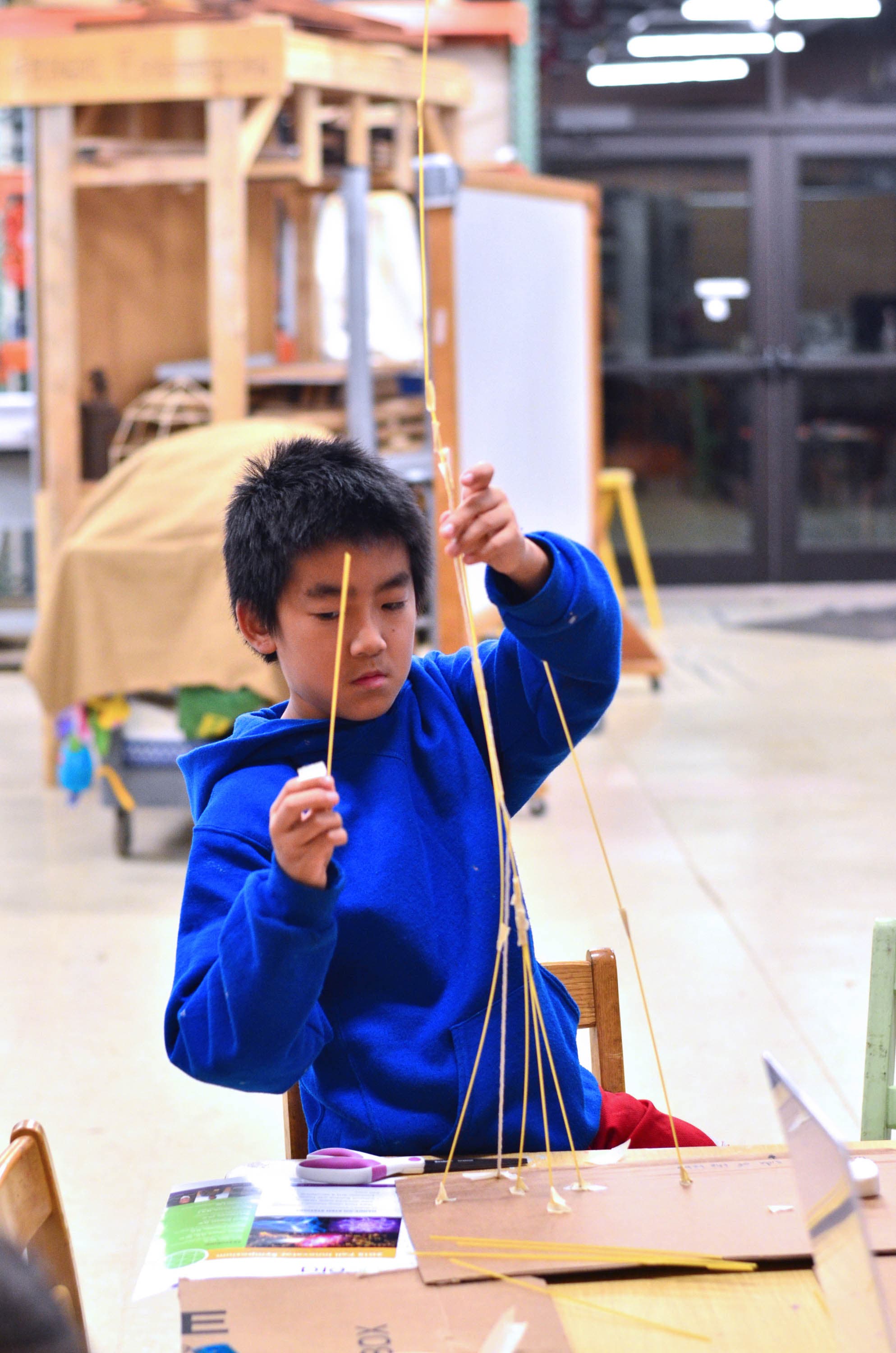


It’s a good night for science in society when at an Innovator Symposium, the distinction between stations for children and those for adults becomes irrelevant.
Tuesday night at Acera, the Massachusetts School for Science, Creativity and Leadership in Lowell Ave, that’s exactly what happened: kids were engaging with, say, a talk on immuno-oncology while adults tried to solve a “Marshmallow Challenge” or get their hands on a defense robot. Together, children and their parents (or somebody else’s parents!) worked on math and logic puzzles, remotely steered iRobot’s telepresence robot through a museum miles away, designed printable objects, or watched a drone blow some leaves while flying around in the school’s playground.
As a start-up school that focuses on progressive, project-based STEM education, the Acera School is in its sixth year and growing. Beyond what happens at the school every day, Acera organized this symposium to create community around one of its core values: that science and technology should be accessible to all, and that you can not be too young to explore STEM subjects.
Find out what's happening in Winchesterfor free with the latest updates from Patch.
And so it was that a 5-year-old was hooked to an iPad designing her first printable object: a toy she was shaping and changing using Makers Empire, a software that is bringing 3d printing software to classrooms around the world, bridging the gap between what’s possible with this major disruptive technology, and what can actually be done in the classroom.
From poster presentations to talks to hands-on makerspaces, there was something for everybody’s STEM desire. Wanted to know what the buzz around the microbiome is all about? MIT’s Eric Alm had you covered. Wanted to hear the latest about fighting lung diseases in children? Children’s Hospital’s Martha Fishman would show you. Wanted to learn more about Paul Salopek’s epic seven-year walk around the world tracing the steps of human migration, and the global learning community that is forming around it? Liz Dawes Duraisingh of the Harvard Ed School’s “Out of Eden Learn” project would take you on a journey.
Find out what's happening in Winchesterfor free with the latest updates from Patch.
Or, if you just wanted to laugh while you learn and get to know some of the weirdest experiments possible – the Ig Nobel Prize’s Marc Abrahams would point you to research that “can not, or should not, be reproduced.”
Tuesday night’s symposium was a strong indicator of just how big an appetite there is for accessible STEM themes in this city of innovators. More than 300 people made their way to the Acera School – on a busy October evening. When time was up, they were still exploring electricity by making electronic art cards, discussing how epidemiology helped identify the cause of cholera, or playing with the Touch Easel, a computer for people with arthritis, low vision, movement disorders or other predicaments that currently keep them from participating in the digital world.
Toward the end of the evening, Marshall Wentworth from MIT’s Unmanned Aerial Vehicle Team was also still flying one of his Quadcopters outside on the playground. “By the time I’d explained the technology a few times, the kids started to do my spiel, remembering every detail,” he marveled, as he was packing up. “My job was practically done, they could do it, and they were terrific.”
It’s a good night for STEM education if your school is filled with real-life scientists and innovators. If there are robots crawling around classrooms and drones flying in the back, getting all kinds of people interested in science, technology and their applications.