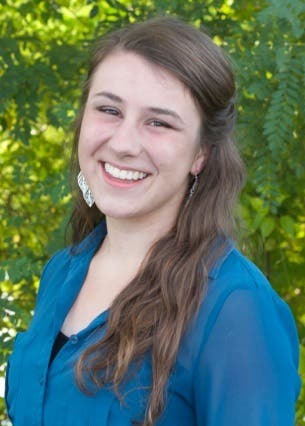
Graduating senior Kayla Bell has been selected by Winchester High School as this year’s McKeown Scholar. She will be recognized during Senior Awards Night at the school’s auditorium on Wednesday, May 20 at 7:30 p.m.
This is the 19th and final year of the McKeown Scholars competition. Woburn-based Cummings Foundation developed the program in memory of James “Jamie” L. McKeown, late president of Cummings Properties and former managing trustee of the Foundation, who died suddenly in 1996 at the age of 41. Since its inception, the program has awarded more than $2 million in scholarships to more than 830 students.
The Foundation will continue to honor McKeown through a recent commitment of $2 million to the newly renamed James L. McKeown Boys & Girls Club of Woburn.
Find out what's happening in Winchesterfor free with the latest updates from Patch.
Bell, who will attend Rensselaer Polytechnic Institute (RPI) in the fall, will receive a $10,000 scholarship and a framed certificate, to be presented by Winchester resident Denise McKeown, widow of Jamie McKeown.
“Kayla is a fitting choice for one of our final McKeown scholars,” said Joel Swets, the Foundation’s executive director and a Winchester resident. “Her commitment to community, mentorship of younger girls in the Scouts, and desire to make a difference in the world are all characteristics that Jamie embodied and that we look for in a McKeown scholar.”
Find out what's happening in Winchesterfor free with the latest updates from Patch.
Bell has been a Girl Scout since first grade and is currently working toward achieving the highest honor a Scout can achieve, the Gold Award. She is active in local Troops 71500 and 77026, and will work at a Girl Scout camp in Reading this summer.
Also an accomplished athlete, Bell is captain of the Winchester High School girls’ field hockey team.
Winchester high school seniors in the top 20 percent of their class were invited to participate in the McKeown Scholars competition, which began with a written essay under exam conditions. Then staff from the Winchester High School English Department evaluated the anonymous essays and selected three finalists. The winner was chosen by the school from among those three, based on overall essay quality, an application packet, community service record, reputation, and a personal interview.
“This scholarship gives me the opportunity to further my knowledge and use it to help others,” said Bell. “I look forward to using my education to make my community more inviting and safe.”
Bell is enrolled as an undeclared student in RPI’s School of Science and plans to dual major in Bioinformatics/Molecular Biology and Psychology.
This year’s essay question asked students, “If you could have invented any device, tool, or innovation of the modern age, what would it be and why? What modifications, if any, would you make to it, and why?”
Bell would have liked to have invented vaccines.
“I hope to do something positive with my life,” Bell wrote. “If I had developed a vaccine I could confidently say that I helped to prevent thousands of deaths.” ݁
2015 McKeown Scholar essay topic
If you could have invented any device, tool, or innovation of the modern age, what would it be and why? What modifications, if any, would you make to it, and why?
Essay by 2015 McKeown Scholar Kayla Bell
(unedited from original submission)
In the modern world, vaccines have become an important part of healthcare and an extremely debated topic among parents and health advisors. Vaccines are important tools to help doctors prevent their patients from terrifying and fatal diseases. If I could have made an innovation in medicine and science, I would want that innovation to be the creation of a vaccine.
Vaccines are helpful and can prevent the spread of disease and ultimately eradicate a human disease from our planet. The ability to eradicate a disease, like measles, is extremely valuable. Young infants and children, who are susceptible to disease, are protected by vaccines and the herd immunity. There are also individuals who cannot receive vaccines due to health risks. I want to create a type of vaccine that those who may have other health complications can receive. I want to find a way to protect every individual from bacterial and viral diseases. People who cannot be vaccinated rely on the rest of the vaccinated population for herd immunity. Unfortunately, with the increase in parents not vaccinating their children, those other vulnerable children are even more at risk. Out in California, in the Disneyland Park, an individual had measles and passed the disease on to others. Measles is an extremely contagious disease and numerous other cases of measles have been reported in California and surrounding states. This is a big issue because herd immunity should have protected against measles; in fact in 2000, measles was reportedly eradicated. However, decrease in vaccinations leads to the return of diseases. Also, without vaccines, infant fatality would be greatly increased. Polio, for instance has been eradicated as a childhood disease due to vaccines. They greatly increase the chance for survival and longevity of life. It is important to me to protect the population from potentially devastating diseases, and vaccines provide a net of safety for most individuals. For most nowadays, vaccines are a part of life and parents want to vaccinate their children to give them the best fighting chance against disease.
Unfortunately, there are people today who believe that vaccines, in particular the MMR vaccine, can cause autism. This claim is completely unfounded in science; however the fear of the harm vaccines can cause is still real. There are individuals who cannot receive vaccines because the vaccine causes a greater health risk to the individual than the benefits of the vaccine. When vaccines became popular at first, there were traces of thimerosal, which contains traces of mercury. Parents believed that their child’s health issues stemmed from the thimerosal in vaccines. Thimerosal was not present in all vaccines, and has since been removed from them. It would have been better if the first vaccines had no trace of mercury and no thimerosal. The thimerosal was a preservation factor for the vaccines and was not entirely essential. If the thimerosal had never been a part of the vaccine, parents would find it more difficult to make claims against vaccinations. The other issue is that scientists do not know if vaccines can have adverse long-term effects. Vaccines have not been around long enough to determine if there are any serious negative repercussions. No study completed to date has been able to link the MMR vaccine to autism and any negative side effects are exceedingly rare.
Another important part of vaccinations is the vaccine schedule, which focuses on vaccinating at early ages and often in a short time period. The issue is that parents fear their child will not be able to handle the stress vaccines put on the immune system. However, the immune system works all day, every day of the year fighting pathogens. I would look to see if modifications on the vaccination schedule could be implemented, but on the other hand, the earlier a child is immunized, the less his or her chance is to fall ill from disease. In order to encourage more parents to vaccinate their children, the vaccine schedule needs to be modified so fewer parents are afraid of vaccinations.
A part of the vaccine war that needs to be addressed is that parents do not always trust their doctor or the pharmaceutical companies who produce the vaccine. In addition to creating the vaccine, I would attempt to change the way people view large pharmaceutical companies. Sometimes these large companies can lose sight of how crucial it is to develop safe products and maintain the trust of doctors and patients receiving the products. This would be more difficult because it requires a change in the way people think. Pharmaceutical companies need to be honest and think about the patients who will receive the vaccines, not only the profit from vaccines. Along with the companies, pharmaceutical representatives need to be educated on the immune system and how vaccines work as well so they can help doctors and scientists teach and inform the general public of the benefits and small potential risks of vaccines.
The health of the human population is a critical problem. I believe that diseases can be eradicated from Earth and human beings should be able to live without the threat of death from disease. On the other hand, overpopulation is a real issue and with the increase in survival rates, the human population continues to increase drastically every year. I still believe vaccines to be essential because they raise the standard of living. Looking back on the Bubonic plague, a huge portion of the population died from disease. If vaccines had been invented then for the Bubonic plague, many lives could have been saved.
The issue of vaccines is part ethical and part medical. Vaccines can help save lives, but many also worry about the future of the planet and how overpopulation can affect our planet and humans. I do believe that vaccines produce more benefits than negative influences, which is why I would want to be the scientist who created the first vaccine. I hope to do something positive with my life, and if I had developed a vaccine, I could confidently say that I helped to prevent thousands of deaths.