Community Corner
Andreas Visan Builds a Prosthetic Hand Through the Austin Prep Passion Project
Six months of research, design, and persistence bring an Austin Prep student's engineering vision to life

This story was contributed by Austin Prep, a Patch Community Partner. The views shared reflect the author’s perspective and feature real experiences from the Austin Prep community.
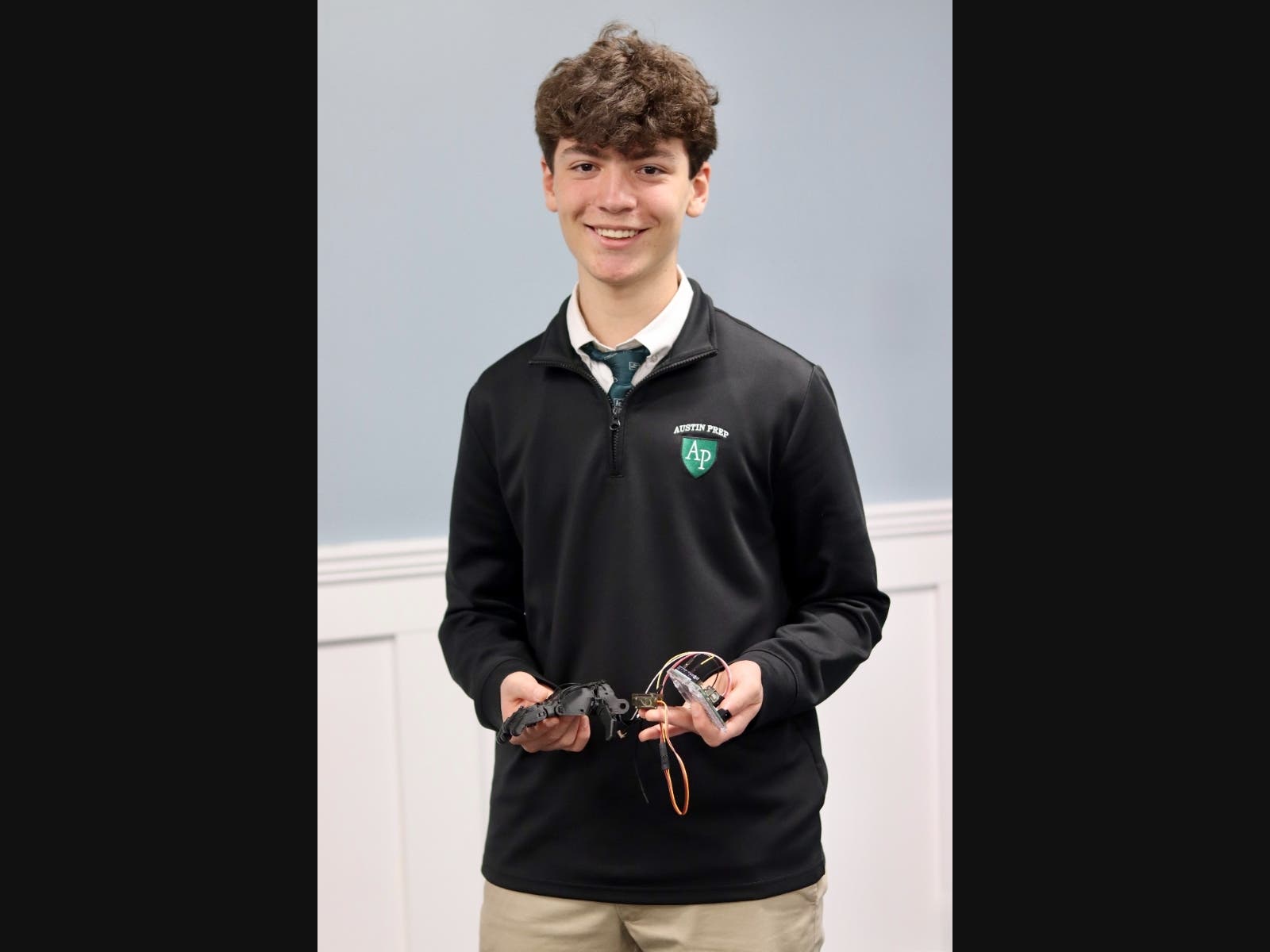
At Austin Prep, learning extends beyond the classroom. For Andreas Visan ’27 of Woburn, that meant turning curiosity into a fully realized engineering project: a self-built prosthetic hand. Through the Passion Project program, Visan spent six months researching, designing, and troubleshooting a device that reflects both his academic interests and his drive to solve real-world problems. What began as an idea became a working prototype and a deeper understanding of how engineering can create impact.
A Student-Driven Project That Blends Engineering, Creativity, and Purpose
The Passion Project, embedded within AP Language and Composition, gives students the freedom to pursue what genuinely interests them. The open-ended structure allows students to explore disciplines beyond English while taking ownership of their learning.
English Department Chair Stephanie Choate, who helps lead the program, explains its purpose.
“We give them a chance to find their own passion,” Choate said. “We ask students, what would make you stay up for another half an hour? Because you can’t help but do it. That’s how we guide them toward choosing the right project. Then they make a six-month-long plan, they set goals, we have check-ins, and they present it at the end of the year and reflect on it afterwards.”
For Visan, that passion emerged at the intersection of science and engineering.
“I first became interested in combining science and engineering freshman year,” Visan said. “I remember doing a project in my biology class on genetic engineering, and that really stuck with me. Over the summer, I wanted to turn that into something tangible, so I came up with the idea to do a project on my own. I didn’t really know about the Passion Project at the time, but it gave me an outlet to start working on something that interests me a lot.”
Turning Curiosity Into a Working Prosthetic Hand
Visan’s project focused on designing and building a prosthetic hand, inspired by the nonprofit Enabling The Future (e-NABLE), a global community that uses 3D printing to create free assistive devices for those in need of upper limb support.
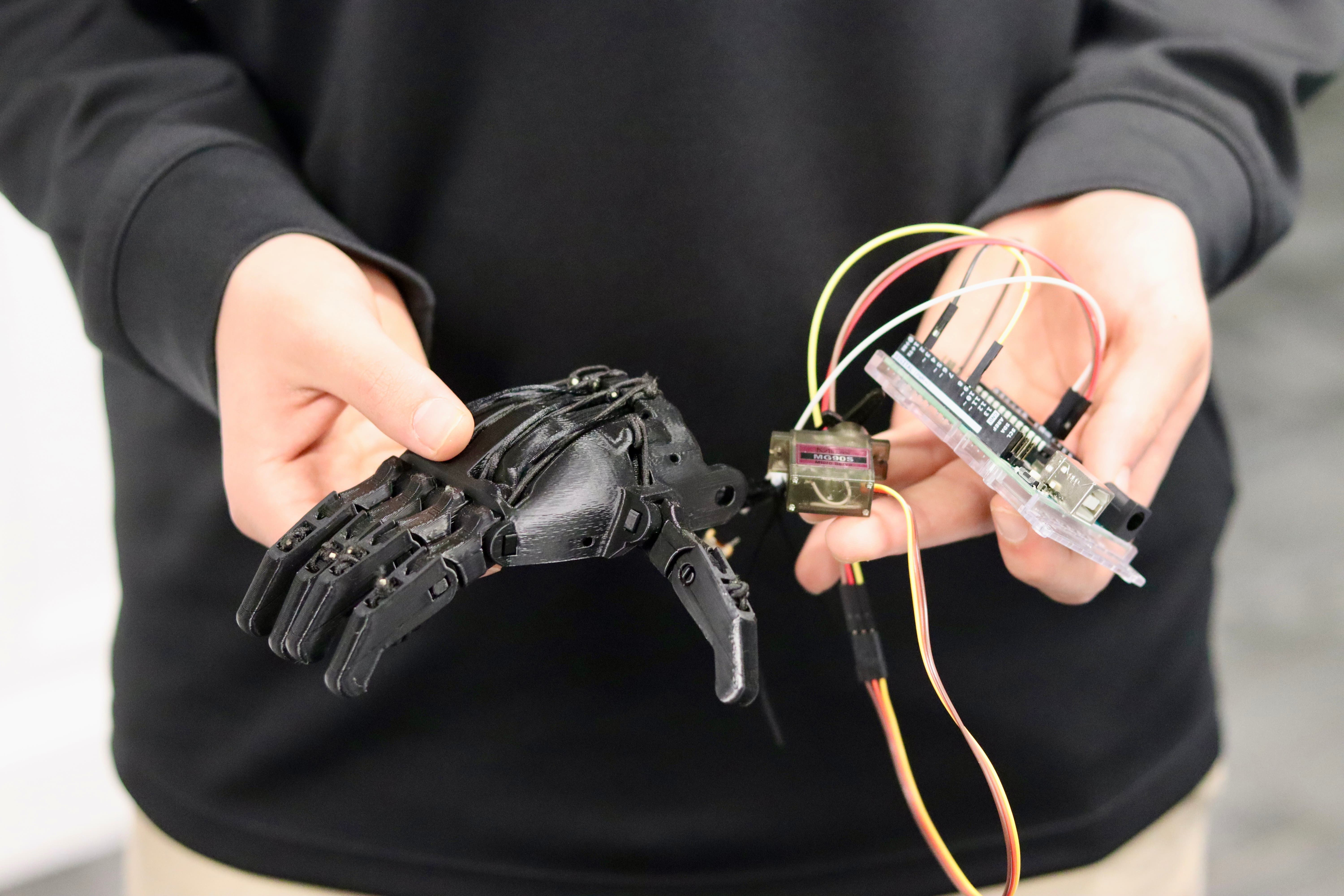
After discovering one of the organization’s models, he used it as a foundation, adapting and expanding the design.
“I found this charity… and they work with younger kids who have disabilities or are missing limbs,” Visan said. “They make very low-cost, efficient prosthetic hands. I decided to take one of their models, make it my own, and then expand on it.”
Over several months, the project required planning, resourcefulness, and persistence. Early work focused on research, sourcing materials, and producing 3D-printed components.
“The first month was spent planning and then buying materials, figuring out what I need to do,” Visan said. “Then getting the 3D printed models for the hand and using those to build out the fingers.”
He then assembled the mechanical structure before advancing to an electrical version with motorized components.
“I split it up into two parts, starting with the mechanical part of the hand, which was just assembling the model,” Visan said. “Then I changed that into an electrical version where it would be connected to a power source and a programmable controller. When you power that up and connect it to a motor, I can connect the strings of the fingers to the end of that motor, and when I spin it, it’ll close the hand, and when I spin it backwards, it’ll reopen it.”
Challenges were constant, particularly with strength and durability of the components.
“It ended up being really difficult to manage how weak the motor was,” he said. “It would break and fall off constantly. It was a big troubleshooting process trying to connect it to that.”
Despite those challenges, Visan successfully produced a working prototype, demonstrating both functionality and persistence throughout the process.
A Vision for Impact Beyond the Classroom
While the project met its academic goals, Visan sees it as a starting point. He has already reached out to Enabling The Future with hopes of continuing his work and making a direct impact.
“I want to try and maybe get one of these hands to actually impact someone, connect with a kid, see what I can do for them,” he said.
He plans to refine his designs and build additional versions in the future.
“Now that I have the experience from this one, I want to try and carry that over into making a couple more,” he said. “Especially towards the end of this year and over the summer.”
Choate sees Visan’s work as a clear example of the program’s purpose.
“He’s a student that has vision,” she said. “He can see something and create it and figure out the steps to get there. I think that in a project like his, that’s something that you 100 percent need.”
She also emphasized the level of commitment behind projects like his.
“The most impressive part of this is that really the kids are doing it all at home,” Choate said. “We do the check-ins to make sure that they’re on track, but this is something that they are making time and space for in a world where they don’t have a lot of time and space. It is clear that Andreas dedicated a lot of time to this.”
As Visan continues to explore biomedical engineering, his Passion Project stands as both a milestone and a starting point.
“If I can take what I’ve built and fit it for someone who actually needs it, that would be the goal,” he said.
Follow Your Passion at Austin Prep
Learn more about the hands-on academic experiences that set our school apart, and complete the inquiry form to start your journey at Austin Prep.