Crime & Safety
ShotSpotter Tech In Worcester: Councilors To Review Report From Police
Records about where the ShotSpotter Connect tool has sent Worcester police aren't available, according to city officials.


WORCESTER, MA — Phil Daily, a vice president from the security company ShotSpotter, went to a Worcester City Council meeting in February 2021 to pitch the company's predictive policing software tool to the public.
At the time, some residents and activists in Worcester opposed ShotSpotter Connect, fearing an increased police presence driven by technology controlled by a private security company.
Daily tried to quell those fears by promising that Connect would help improve police relations, and that Worcester police would be able to share data with the public to dispel fears of overpolicing. He said ShotSpotter would be committed to "proactive transparency."
Find out what's happening in Worcesterfor free with the latest updates from Patch.
"Connect provides powerful tracking and reporting capabilities for [police] supervisors and analysts that can be shared with community leaders to provide transparency on where officers were directed and why, how much time they spent in those areas, what activities they used and, over time, the impact of those directed patrols on crime trends," Daily said at the Feb. 1, 2021, meeting.
What Daily said at that the meeting may only be partly true. Worcester police have been using ShotSpotter Connect for more than 10 months, but city officials say they can't produce records showing where the tool has sent Worcester officers during that time.
Find out what's happening in Worcesterfor free with the latest updates from Patch.
Worcester police are on the verge of paying over $48,000 for another year of ShotSpotter Connect, and those wary of the predictive policing technology said that a lack of publicly accessible data on where the tool has sent police is troubling. One civil liberties expert Patch spoke to expressed disbelief that Worcester could not provide records about where Connect was directing officers.
ShotSpotter says that the location records are available, and in May announced a software upgrade that will allow departments to access the records more easily.
"ShotSpotter Connect does have reporting tools that at their discretion police departments can use to share the where, when, and how Connect is being used to deploy police resources," the company said in a statement.
Worcester officers have spent more than 25,000 hours of Connect-directed police patrols in more than 61,000 locations over the last 10 months, according to the department. Worcester officials contend those locations are only known by ShotSpotter. The company did not respond to a request asking them to release those locations.
City Can't Provide Location Data
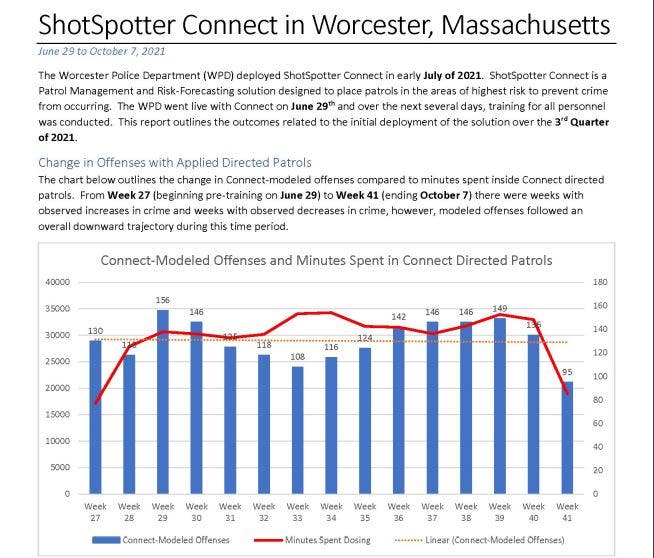
Worcester police Chief Steven Sargent in November sent the city council a report on how police used Connect between July and October. The two-page document included a graph showing crime incidents per week and the number of minutes police spent patrolling, based on directives from Connect. The report did not include any data on where those patrols took place.
Following the release of that report, Worcester Patch filed a public records request asking for the "locations of all patrols directed by ShotSpotter Connect" between July and December. The records request was an attempt to see where Connect was directing police in Worcester.
In response, a city solicitor said Worcester could not provide the records because it didn't have them. That's because officers log in to the ShotSpotter system at the beginning of each shift and view a map created by the company that tells them where to go on "directed patrols."
"There is no report built into Connect that allows an end user (the city/WPD) to see retrospectively where directed patrols have been or how many times any given area has been designated as a directed patrol. This information would need to be requested directly from ShotSpotter rather than from the police department," Assistant City Solicitor Janice Thompson said in a December response.
Patch also asked officials at other police departments using Connect — in Savannah, Georgia, and South Bend, Indiana — if they could provide data about where the tool sent police. ShotSpotter declined to provide the names of any other departments using Connect.
"From my understanding, I do not believe that it would be," Savannah police information officer Bianca Johnson said in an email after Patch asked if it would be possible to see Connect location data.
After an initial phone conversation about Connect, South Bend police media liaison Ashley O'Chap did not respond to multiple follow-up requests for comment.
Kade Crockford, the director of the American Civil Liberties Union of Massachusetts' Technology for Liberty program, said it was "unacceptable" that ShotSpotter might be recommending locations for police to patrol with no record available.
"If it is true, it’s really problematic. It essentially directs law enforcement activities, but can’t tell you anything about how it works because we don’t know? That’s not an acceptable response," she said.
The Massachusetts public records law allows anyone to request records from state and local governments. The law does not apply to private companies like ShotSpotter.
How ShotSpotter Connect Works
Worcester police Deputy Chief Paul Saucier led the department to acquire Connect last year, and he believes the tool has only helped police become more effective. He also said properly understanding how Connect functions takes a little work.
Worcester police patrol the city across 20 different "routes," which are specific geographic sections of the city. At the beginning of each shift, Connect will recommend "directed patrols" — a ShotSpotter term for a 250-square-meter box where officers go to watch for specific crimes that the tool believes might be on the rise. Each patrol route in Worcester gets its own set of directed patrol boxes during each shift.
ShotSpotter creates boxes for directed patrols using a mix of data, mainly crime previously reported by residents over a rolling five-year period. But Connect also uses data from the company's gunshot detectors, located in a few neighborhoods in central Worcester.
Connect also uses data about weather, locations of liquor stores and bars, holidays and anniversaries, and even lunar cycles. Worcester police also have the ability to draw their own directed patrol boxes.
As ShotSpotter describes, the tool "provides daily AI-driven risk assessments to direct patrol and task force units in a more precise and impactful way to deter crime."
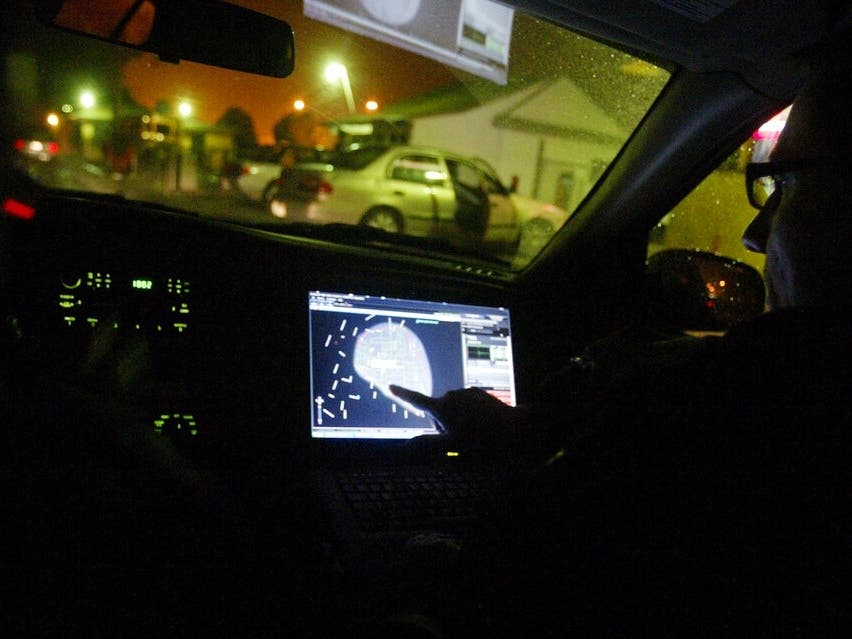
Saucier said that department does lose the locations of directed patrols at the end of each shift, but said supervisors are able to see where officers go in real time on directed patrols.
Officers also typically radio in the location of their directed patrol box, and that location information would be kept in audio logs, he said — although searching those calls would mean sifting through months of audio recordings.
"They’re still tweaking the software as far as reporting," Saucier said.
Crockford, the ACLU director, criticized the mix of data Connect uses. Sending police to areas where residents have reported crime in the past could lead to a feedback loop of police spending lots of resources in select areas.
"It's essentially a way of making the future look like the past by applying a shiny veneer of technology," Crockford said.
Crockford also highlighted that ShotSpotter has come under fire over its technology before. The Chicago Office of the Inspector General last year produced a report saying that the company's gunshot detectors "rarely produce evidence of a gun-related crime." ShotSpotter disputed the Chicago report, saying it relied on incident where a gunshot alert resulted in a "nothing to report" disposition in Chicago police records. That might just mean police couldn't find a witness or shell casings at the scene, the company said.
Saucier says the tool has improved efficiency. Before Connect, as an example, an officer might pick a random parking lot to fill out a report. But with Connect, that officer sits in an area that the tool believes may see an increase in a certain type of crime. Those visits also give police a chance to walk around and meet people, he said.
Saucier stressed that Connect is not overpolicing neighborhoods because the same number of police officers patrol routes across Worcester as they did before Connect came to town.
"We're trying to put police in the right place at the right time. That's what we're doing," he said. “We don’t have an extra 100 people. It's the same people doing it. We’re just doing it smarter.”
ShotSpotter's Response
Asked about Daily's statement at the February 2021 city council meeting that Connect could "provide transparency on where officers were directed and why," the company said Daily was correctly describing Connect's capabilities — not what local police would do with the data.
“ShotSpotter Connect provides police departments data on where and when officers spent time on directed patrols where there was determined to be a higher risk of crime at that place and time. It is at the police department’s discretion as to what information is shared with the public," the statement said.
But that data may be difficult to view. ShotSpotter says it allows police departments to pull reports on Connect for each shift. If a department wanted to look at year's worth of location data, as an example, they may have to sift through hundreds of individual shift reports to view all the directed patrol locations.
Saucier did not immediately respond to a request on Monday about whether the department has access to those shift reports.
RELATED: Worcester Police Signed ShotSpotter Connect Deal Before Council Knew
In early May, the company announced it would roll out an upgrade in Connect to give police departments the ability to look at location data in the aggregate. Worcester had not received that upgrade as of this week, and on May 18 city solicitor Thompson reiterated Worcester's inability to access location data.
"[i]t is still the case that the city does not have the ability to view or retrieve historical directed patrol locations," Thompson wrote in a May 18 email.
Helen McCarthy, a ShotSpotter spokesperson who works for the private public relations firm Trident DMG, declined to provide a person from the company for an interview (ShotSpotter did offer an interview shortly before this story was published; Daily was supposed to contact a Patch reporter on Tuesday for that interview, but never did). The company also declined to answer a set of specific questions about Connect, instead sending a larger statement.
“ShotSpotter Connect is a tool that is used citywide to provide data-driven recommendations on what specific areas are at risk of suffering from specific crime events, shift by shift, and beat by beat. ... The decision on how to use that information in deploying resources, including dispatching officers, is completely at the discretion and control of the police department. To be very clear, ShotSpotter does not directly dispatch officers," the company said in part in its statement.
In 2021, a coalition of 16 community groups from the Worcester NAACP to the Rock of Salvation church, signed a letter asking City Manager Ed Augustus Jr. to spend money earmarked for Connect on improving safety in the schools.
Asked this week to respond to the lack of data on where Connect directs Worcester police, Worcester NAACP President Fred Taylor compared it to buying a cell phone that doesn't let you retrieve data about text messages or phone calls.
"The citizens have a right to know the information," he said. “If there’s nothing to hide, it shouldn't be a problem."
Another Year Of Connect
Worcester's Connect pilot program began on July 1, 2021, the first day of the 2022 fiscal year. In its budget request for fiscal 2023, Worcester police asked for another year of Connect at a cost of about $48,300. The department wants to spend a total of $572,427 on ShotSpotter products in fiscal 2023, a figure that includes the company's gunshot detection devices. Those devices are all located in central Worcester, from Great Brook Valley south to Webster Square.
At a City Council budget hearing last week, Saucier told councilors police have spent 26,846 hours on Connect-directed patrols since last July, focusing on 12 specific types of crime, from murder and shoplifting to simple assault. Saucier also told councilors the use of Connect coincided with a 10 percent drop in crime across the city — although that figure has since been updated to 13 percent drop.
"That’s pretty amazing. A 10 percent reduction in crime in one year? So I would say the return on investment of $48,000 is pretty high," At-Large City Councilor Kate Toomey said in praise of Connect during the meeting.
But not every councilor was so enthusiastic. Last year, Councilors Khrystian King, Sarai Rivera and Sean Rose all voted against using Connect. This week, two expressed concern about a lack of data on where the tool has directed police.
"Not having data in this day and age is unacceptable and below standard," King said of the Connect location data.
He also emphatically disagreed with the department's claim about a crime drop related to the use of Connect.
"I want to be on record that ShotSpotter does not account for the [13 percent] decrease in crime in Worcester," he said. "A confluence of factors, including policing, community interventions, mental health interventions, the economy, jobs available, services available, have all been at play."
Rose's vote against Connect became a campaign issue in 2021, when he faced a challenge from Worcester police Sgt. Richard Cipro. Rose said his vote in 2021 was about a reluctance to spend money on technology with unknown ramifications.
Rose said he would reserve judgment about Connect's success until the council hears a report from police on its effectiveness.
"Anything that's helping to decrease crime, even 0.01 percent, is something I'm going to be in support of," he said. "But I'm very much looking forward to data that's going to be shared to explore this a little further to ensure we're putting our dollars in the right place."
In late May, Sargent sent councilors a report about the department's use of ShotSpotter technology, which included four sentences devoted to Connect.
"ShotSpotter Connect is a Patrol Management and Risk-Forecasting solution. Through the program, patrols are directed to areas to improve efficiency and effectiveness within the officer’s established route. Overall, the analysis over ten months and a half months 7/1/21 5/15/22 shows crime trending down with the application of ShotSpotter Connect. There was a 13 percent decrease in modeled offenses," Sargent's report said.
Mayor Joseph Petty held the item at the May 24 meeting, but it will be up for discussion at the June 7 meeting.
When Daily, the ShotSpotter vice president, concluded his presentation at the February 2021 Worcester City Council meeting, he volunteered that Sargent "would gladly share" all the data about where and when Connect was used. If not, Daily said, ShotSpotter would be at Worcester's mercy.
"If we fail to deliver on that promise, you have the power to hold us accountable by not renewing our services," Daily said. "We can’t overstate our commitment to proactive transparency."
Get more local news delivered straight to your inbox. Sign up for free Patch newsletters and alerts.