Politics & Government
Campaign Finance Watchdog Says Cox PAC Network Follows Letter Of Campaign Law, But Tests Its Spirit
The Michigan Department of State has a donation limit 10 times higher than that for traditional political committees.

May 18, 2026
Republican gubernatorial candidate and former attorney general Mike Cox has received campaign donations of more than $30,000 from eight political action committees, four of which have his wife, former Michigan Republican Party Chair Laura Cox, listed as the treasurer.
Find out what's happening in Across Michiganfor free with the latest updates from Patch.
Three of those PACs — Cox Leadership PAC, Make Michigan Grow Again PAC, and Make Michigan Safe Again PAC — have given more than 98% of the money they raised to Cox’s gubernatorial run. The fourth, Cox Majority PAC, has given around 90% to Cox.
None of this is breaking the law in any way, explained Neil Thanedar, the executive director of the Michigan Campaign Finance Network — these PACs are each classified as “Independent,” and the Michigan Department of State confirmed that each PAC has met that status.
Find out what's happening in Across Michiganfor free with the latest updates from Patch.
Independent committees, according to guidance from the Michigan Department of State, have a donation limit 10 times higher than that for traditional political committees tied to a campaign.

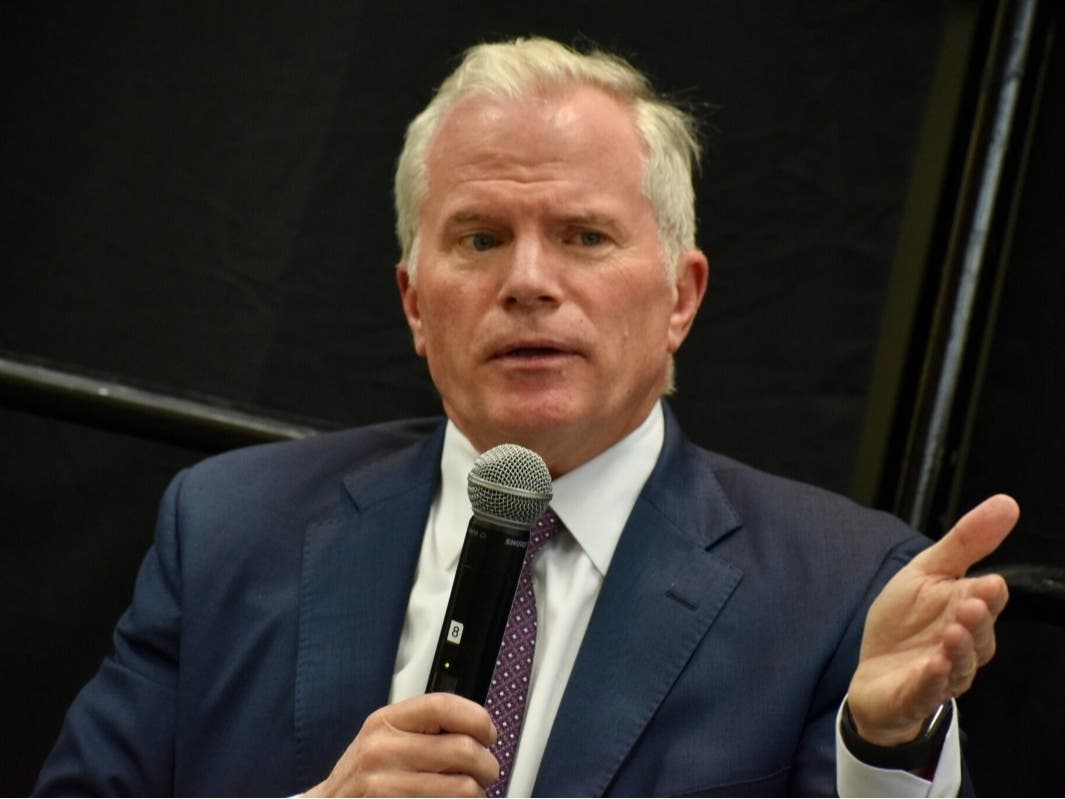
Mike Cox delivers petition signatures to the Michigan Bureau of Elections in Lansing as he seeks the GOP gubernatorial nomination. April 20, 2026 | Photo by Jon King/Michigan Advance
They’re also different from independent expenditure committees, better known as Super PACs, which are not allowed to be tied to any related party for a candidate — such as a relative or close personal connection — meaning that having Laura Cox as the treasurer for these independent PACs is completely legal.
That’s not the fault of the Cox campaign or any other campaign that chooses to use these types of PACs to fund a campaign, Thanedar said — it’s a loophole in the state’s campaign finance laws.
But funding a campaign this way is “on the edge of the law,” Thanedar said. “Not breaking the letter of the law, but definitely not ‘independent’ in practical terms.”
Michigan Advance requested comment from the Cox campaign, but received no response.
There are three requirements in the Michigan Campaign Finance Act that a committee must meet in order to be considered “independent.” Before contributing to a candidate committee for an elected office, the PAC must file a statement of organization at least six months before an election, receive support from at least 25 donors and make donations below a certain threshold — for gubernatorial candidates, that amount is $6,800 — in support of or in opposition to at least three other candidates.
Once those three requirements are met, the contribution limit for independent committees increases to $83,250. Campaign finance records show the four PACs tied to Cox each surpassed the required 25-donor threshold, though most of those initial contributions were just $5 before the PACs later received much larger donations, some as high as $90,000.
Records also show the PACs made small contributions — typically around $100 and all under $500 — to three or four other Republican candidates, allowing them to qualify for independent status just days before making multithousand-dollar contributions to Cox’s campaign.
A fifth PAC with Laura Cox listed as the treasurer, Make Michigan Smart Again PAC, has also made three small donations to state-level Republican candidates, but has yet to make a contribution to the Cox campaign as of the April campaign finance filing deadline.
The large donations to Cox also each come days after each PAC received a large donation from a single donor. For example, on July 15, Cox Majority PAC received $90,000, and on July 19, it contributed $83,250 to Cox. And on Dec. 23, Make Michigan Safe Again PAC received $50,000, and on Dec. 30, it contributed that same amount to Cox.
But to use these PACs in this way, where the vast majority of the money goes to a single candidate goes against the spirit of the law, Thanedar explained.
“The idea that these independent committees have a 10-times-higher limit than individual political committees or individuals is allowed because I think the intent of the law is that these independent committees would spread this money widely among many candidates,” he said. “If over 90% of the money is going to one candidate, one campaign, that basically is using those three donations as basically a shell to manufacture this independent status, just so that you can pass through a 10-times-higher contribution.”
Thanedar said that pattern is a sign of a bigger problem with the way these independent PACs are structured in the law.
“I think the bigger issue is that the rules are simple enough to manufacture three $100 donations and then write a $50,000 check. That really skirts the idea of independence,” he said.
Each PAC also has received fewer than 30 donations total, just above the minimum threshold of donors, with a number of repeat donors across the PACs. Eight donors gave to all five of the PACs run by Laura Cox, and another 14 gave to at least three of them. Most of those donations are extremely small — 91 percent are just five dollars apiece.
Thanedar said these highly concentrated expenditures and donations, as well as having PAC leadership so closely tied to the campaign to which most of the money is going, defies the expectations of what the general public might expect from something classified as “independent.”
“I think the public expects what would be called an independent committee to actually be independent in multiple ways, independent in terms of the leadership, and then also independent in terms of the funding in and the contributions out,” Thanedar said. “The intention is that, even if you were a political leader, you would be able to create a fund and then raise money for many different people and spend it on many different people. In this case, that’s not happening.”
He suggested a potential reform to the state’s finance law to address this issue — to make it so no more than 10% of an independent PAC’s funding could go to a single campaign. But that is not the law currently.
Despite these loopholes in the campaign finance law, this type of funding mechanism is “relatively rare,” Thanedar said, with Super PACs growing in prevalence.
“This is an interesting gray area where it allows the contribution limits to be 10 times higher, but still be controlled by a related party,” he said. “And that is unusual.”
Bob LaBrant, a retired political action executive who spent 35 years at the Michigan Chamber of Commerce and now serves on the Michigan Campaign Finance Network’s board of directors, said the Cox PAC structure reflects a fundamental weakness in the law.
“The unique characteristic of the Michigan campaign finance law is that there are no contribution limits to PACs, independent committees or separate segregated funds or political parties,” laBrant said. “That’s kind of tied into this whole gaming of the system. You get one rather rich or prominent contributor, then you start playing with that.”
LaBrant said the particular loophole the Cox PACs are utilizing could be closed by limiting those that share a common treasurer or are supporting a common candidate. However, he acknowledged that changing the practice now is unlikely to happen.
“The horse is out of the barn on this one,” LaBrant said.
The Michigan Advance, a hard-hitting, nonprofit news site, covers politics and policy across the state of Michigan through in-depth stories, blog posts, and social media updates, as well as top-notch progressive commentary. The Advance is part of States Newsroom, a national 501(c)(3) nonprofit supported by grants and a coalition of donors and readers.