Neighbor News
Clinical Trial for Kitties in Conflict
If your cats do not get along, there is hope for peace. Cats that bicker, brawl or quarrel with housemate cats may qualify.
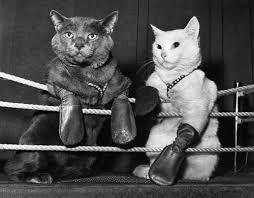
Bloomfield Hills, MI – In July of 2013, Bombay, a 1 year old male tabby cat, “let himself in” the home of Susan Holland and joined resident cats Mystique, Indigo, Gizmo, and Abigail. When the previous owners could not be located, Holland welcomed Bombay. He was friendly to people and the dogs but soon the conflict with the cats began. Holland reported Bombay was chasing, tackling and biting while the resident cats were responding by hissing, screaming and swatting. “Things were peaceful prior to the addition of Bombay but we love him and we don’t rehome”. Holland is a licensed veterinary technician and practice manager at the Michigan Humane Society. In March 2014, Holland participated in a clinical trial conducted by veterinary behaviorist Theresa DePorter DVM, DECAWBM, DAVB which utilized a new diffuser product by Ceva Animal Health, Feliway MultiCat®. After just two weeks using the new product Holland reported the “Cats were out together more. I had to decide if some interactions were aggression or play! This was more playful than they have been in 6 months” she added “I am thrilled to have the cats be social again”. By the end of the one month diffuser treatment period, after fighting daily for 8 months, she considered the cat’s aggression “significantly improved to be considered cured and resolved”. Holland added “I am so thankful to be a part of this study. The product gave my cats the opportunity to play and enjoy each other’s company again. This study allowed us to enjoy their company and personality as we know it can be”
Now, another follow up study could offer hope for desperate pet parents who cannot get their housemate cats to stop fighting with each other. DePorter, who leads the study, is recruiting cats and their owners to assess the benefits of a new synthetic pheromone diffuser to reduce aggression between housemate cats in a longer study. There is no fee for participating in this study. Volunteers are given a $50 gift card upon completion of study observations.
It’s an agonizing and common problem that can drive cat owners to organize their lives around managing their cat’s aggression which may include seemingly random bouts of hissing, chasing and screaming. “Cats are the number one pet: there are 81.7 million owned cats versus 72 million owned dogs. More cats are relinquished to shelters and disharmony between pets is a common reason for relinquishment. Estimates suggest only 4 out 10 cats who enter shelters make it out alive.[i] We need to help cats get along with housemate cats so they can stay in their homes.” said Theresa DePorter, veterinary behaviorist at the Oakland Veterinary Referral Service in Bloomfield Hills. “It can be difficult to integrate a new cat into a home. Bombay was one of the lucky ones, he found a home that was committed to keeping him.”
Find out what's happening in Huntington Woods-Berkleyfor free with the latest updates from Patch.
Cats communicate with each other by leaving chemical messages called pheromones in the environment that other cats “read,” much like we read newspapers. One way cats warn off or avoid dangerous situations is to mark areas with pheromones by rubbing, spraying or scratching.
“Two test diffusers will be plugged in the home for twelve weeks. Location for the transmission of these semiochemical messages is key so I will help each family identify the optimal locations for the diffusers,” DePorter said. The hope is that synthetic pheromones diffused steadily into the home may work on cats the same way but spread a message of peace, DePorter said. During the study volunteers keep a daily diary and record weekly observation of feline interactions.
Find out what's happening in Huntington Woods-Berkleyfor free with the latest updates from Patch.
“Aggression between or among cats forced to live in the same household is a frequent problem” according to Katherine Houpt VMD PhD Dipl ACVB professor emeritus and founder of the Animal Behavior Clinic at Cornell University, College of Veterinary Medicine. Dr. Houpt explained aggression between housemate cats “often leads to the most common reason owners complain about, relinquish or euthanize their cats -- urinating outside the litter box.”
DePorter said it’s a safety and quality of life issue for cats and for owners. “What is remarkable to me is that many of these cats have been fighting for years and years. These owners are dedicated to their cats but torn by the anguish.”
Volunteers are pre-qualified and scheduled to attend an educational meeting in which we will discuss feline social relationships, body postures, aggressive displays and other behaviors. Volunteers also receive educational materials. The cats do not attend the meeting.
During the study, owners keep a daily diary and record weekly observations for fifteen weeks. They report those findings, as well as their observations of frequency and intensity of aggression and fear. All participants are given the same guidelines for managing aggressive interactions between their cats.
Households that meet prequalification screen will be invited to attend one enrollment meeting. There will be enrollment meeting opportunities in Bloomfield Hills, MI at Oakland Veterinary Referral Services on Tuesdays in Feb, March and April. There will be meetings will be held in Allen Park on Monday March 23rd and in Ann Arbor on April 6th. Enrollment will continue until April 28th or until the limit of 70 households is reached. The cats do not attend the meeting.
To volunteer: (248) 334-6877 or TheresaDVM@aol.com
Study information: http://www.ovrs.com/departments_and_services/behavioral_catstudy.php
DePorter bio: http://www.ovrs.com/docs/bios/DePorter.pdf
OVRS: www.OVRS.com
Oakland Veterinary Referral Services (OVRS) has long been considered a leading center of specialty veterinary care in the Midwest. Theresa DePorter is board certified diplomate in the American College of Veterinary Behavior (ACVB) and the European College of Animal Welfare and Behavioural Medicine (ECAWBM)
####
[i] http://www.catalystcouncil.org/uploads/StatsonCats.pdf
Uд?