Schools
Superintendent Candidate Shaner Focuses on '21st Century Learning'
Warren Consolidated administrator discusses exchange program experience, technology, and transition in second round interview Wednesday.


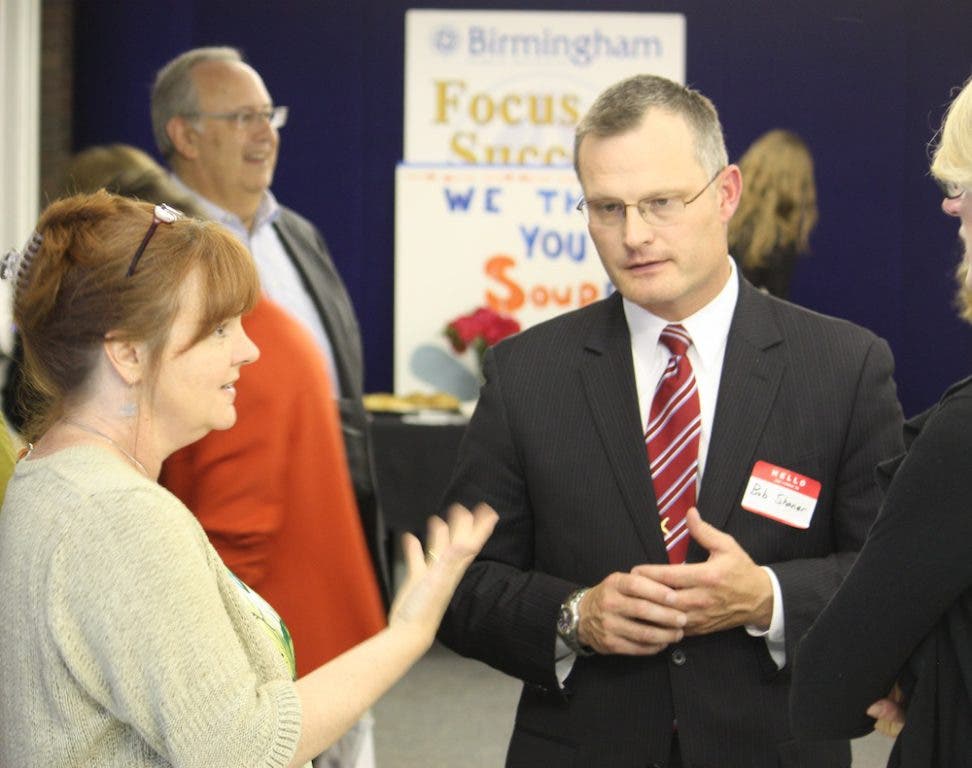
The Birmingham Board of Education continued its search for its next superintendent, as finalist Robert Shaner returned to Birmingham on Wednesday evening for a second round of interviews and tours.
The school board is working to replace , who announced in late March that he would be taking a superintendent position in Glenbard Township, IL. The board plans to choose a new superintendent at a special meeting Monday and have someone in place by July 1.
Shaner — the executive director of instruction and technology with the Warren Consolidated School District — was alongside Daniel Nerad, superintendent of the Madison Metropolitan School District in Madison, WI.
Find out what's happening in Birminghamfor free with the latest updates from Patch.
Shaner spent the entire day in Birmingham on Wednesday, touring school buildings at various levels in the morning before meeting with two committees made up of parents, teachers and community members. The community was also invited to meet Shaner during an informal reception at the district's administrative offices Wednesday afternoon before he gave his 15-minute presentation to the school board Wednesday evening and interviewed a second time.
All interviews, including Shaner's Wednesday night interview, can be watched on Birmingham's Public Access Channel 17. Nerad will visit Birmingham on Thursday for a similar lineup of activities; that interview will also be aired live on Channel 17.
Find out what's happening in Birminghamfor free with the latest updates from Patch.
'21st century learning' a focus of expertise
In a 15-minute presentation to the board Wednesday, Shaner spoke of a "paradigm shift" in schools over the past 40-60 years in which students learn as part of a global society.
As Shaner explained, he was selected into the Gerstacker Fellowship at Saginaw Valley State University, the first from Macomb County to be so chosen into the concentrated leadership training, which includes a capstone international experience throughout Asia. That was after helping to establish Warren Consolidated's first exchange program with a Chinese school — the first graduate from that program will walk on Saturday, Shaner said.
"We often hear criticism of the American education system ... in China, they really wanted to know about how we maintain creativity and innovation," he said.
As technology quickly shifts, Shaner said, students need to be able to do draw upon a solid framework of skills that will translate past knowledge of new hardware — a position on which he expounded in a blog he created for the Warren Consolidated community.
"In a comprehensive high school in the 1950s, '60s and '70s, it's somewhat of a factory-type model: You put the raw materials on one side and out the other side comes graduates ... the world is much more dynamic nowadays and requires our students to have a different set of skills," he said.
"The innovation and creativity is really the edge we have up on the rest of the world."
Interview touches on transition, military career
Highlights from Shaner's interview:
Give us an idea how you might select, develop and mentor your leadership team.
"I try to build to people's strengths and select people for their strengths. ..."
"I strongly believe that you wait to hire the right person. Every time you settle when you hire someone you end up with a situation that is not effective."
"Find people with talent. Give people things to do that are in line with their interests and abilities. And you try to fit people together based on those talents ... true collaboration is just good, old-fashioned teamwork."
Could you share a little about your experiences with PLCs (professional learning communities)?
"I did my doctoral work on professional learning communities ... the important part of a professional learning community is the collaboration time. It's the collaboration time doing something purposeful and valuable. It's not a department meeting. It's not time to get together and converse about things that aren't really about kids. The time we use for a professional learning community really needs to be based on teaching and learning."
"What I found with my doctoral work is, where people get stuck with professional learning communities is in the data analysis and that's two-fold. It's in the analysis part of it, because that's a difficult thing to do. ... The other part of the analysis of the data is putting it into practice and that's where professional learning communities really get hung up."
You've had very unique experiences relative to what someone might consider a traditional educator ... how does it inform what you're doing in the idea of transitioning from a community like Warren to a community like Birmingham?
" ... it allows me to do two things that allow me to be successful in my career: First of all, my ability to see the big picture. I'm able to look at a situation and see multiple perspectives at one time and consider them. The other thing – and I'm sorry to say this – but sometimes I try to avoid talking about the Marine Corps in public and my experience in it, because sometimes it brings out the negativity of people thinking that being an officer in the Marine Corps or being a police officer makes you an authoritarian-type of personality ... I did not lead a platoon of Marines at 21 years old out of authoritarian and sadistic bullying. I did it out of love and commitment to them."
"I think it's challenging any time you're dealing with multiple constituencies ... I realize that Birmingham is more of a white-collar community than Warren and I think it sometimes has different challenges, but I think it's really about seeing those perceptions and listening and building consensus."
How do you know when there is effective communication and collaboration?
"You know you have an effective team when you're meeting goals and interacting with purpose. Visibility is really important in collaboration. It's interesting, some people say being a high school principal wouldn't prepare you for a superintendent seat and I would argue that it certainly would because there's so many constituencies in one building. It's like we're in a small city at times. In Warren, in one building, you have four employee groups, all with different collective bargaining agreements. You also have multiple constituencies with parent groups, booster clubs, sporting teams. So, really, it's about accomplishing the goals and staying true to the position."
Does the Warren Consolidated experience translate directly in a different setting, or do you believe that you need to bring some new programs or new skills to the table? How do you look at the contrast?
"First of all, my goal for Warren Consolidated Schools was never state recognition. It was world class. If I stay there, that's still my goal for it."
"It's not a matter of translating. It's really, if I were to get this position, it's about getting here, getting my feet on the ground, getting visible, getting to know the community and making an assessment on where we need to be. Education to me is really a global enterprise at any school district I work in."
"State standards are not going to get it done for us. World class is going to get it done."
We hear about this consistent level of high expectations ... frame for me how you think about special education and the Individualized Education Program (IEP) process.
"What I've heard today about 504s and IEPs and special education is not different than what expectations we have for our children ... as parents, myself included, when I go to my child's school or deal with an issue at school, I want to be listened to, I want to be heard and I want what I say to be considered. I think that's even more intense if I were the parent of a special ed student of someone on a 504."
We have all these special programs and resources which demand a whole cadre of specialists and yet, we want to keep them in the natural environment. We want to have the same expectations. How do you manage that ... either at a building level or at an executive level?
"My thought on creating that kind of environment is to not treat the special ed staff differently from the general ed staff or creating two different constituencies. They're all teachers, they all work together and they all work for the common good of kids. Somehow, in education, and I think it's getting better, but when I first got into teaching, it's really amazing to me how big of a divide there was between gen e. and special ed. It's gotten better ... but I think we need to approach it from the standpoint of teaching and learning, because I'm pretty sure there are some special ed strategies that special ed teachers have that can work pretty well in a general education setting with general education kids."
Where does RTI (response to intervention) fit?
"RTI really needs to be at a fundamental level in the entire school building."
"RTI, really is about meeting kids at their level and trying to move them ahead. I think you have a special opportunity here in Birmingham where you don't deal with an enormous amount of transiency. RTI is especially powerful because you can start it early."
Could you describe how you see the arts and music in a school environment?
"I think the arts and music are an integral part of a 21st-century education. I really do ... from a brain-based standpoint, in terms of just plain the power of learning, and also from the standpoint of society and culture. I've been known to tickle the ivories myself, but I'm not very good at it any more."
There's a sense in this community among some people that gosh, Birmingham deserves, demands, a sitting superintendent ... what's your sense of those perceived missing skill sets from a sitting superintendent's perspective?
"I work in an intense union environment in Warren and ... I'm making a value judgment on this and I probably shouldn't, but I don't know that there's too many places like Warren where unions are as powerful as they are."
"As a building principal, it's important to have those relationships. We go as far as to, in building a negotiations team, we put building principals on that team. And I was on that team with the last teacher negotiation and I am on a number of negotiating teams right now with different bargaining units."
To see what Shaner had to say in his first interview, visit .
Check out Birmingham Schools Superintendent Search 2012 for more on Birmingham Public Schools' search for a new superintendent this spring and summer.
Get more local news delivered straight to your inbox. Sign up for free Patch newsletters and alerts.