Home & Garden
Chronic Wasting Disease Found In Michigan Deer
Confirmation oc the state's first case of chronic wasting disease in a free-ranging deer triggers response plan.


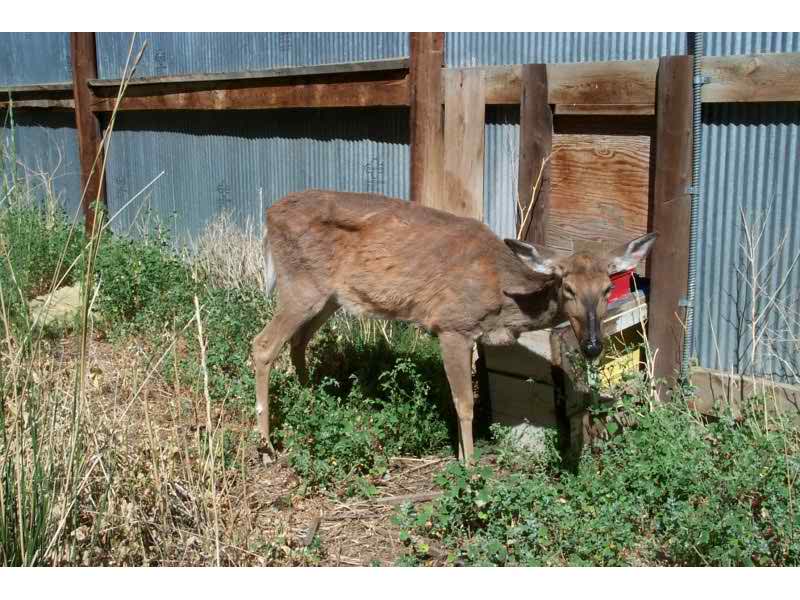
This deer has chronic wasting disease. (Photo by Dr. Terry Kreeger, Wyoming Game and Fish Department via CWD Alliance, used with permission)
The first case of chronic wasting disease has been reported in Michigan, the state departments of Natural Resources and Agriculture and Rural Development confirmed Tuesday.
Find out what's happening in Birminghamfor free with the latest updates from Patch.
A free-ranging deer in Meridian Township (Ingham County) tested positive for CWD, a fatal neurological disease that affects white-tailed deer, mule deer, elk, moose and other members of the Cervidae family, the two state agencies said in a news release.
In 2008, a white-tailed deer in a a privately owned facility in Kent County tested positive for the disease, but this is the first time CWD has been found in Michigan’s free-ranging deer population.
Find out what's happening in Birminghamfor free with the latest updates from Patch.
A Merdian Township homeowner reported seeing the deer wandering around nearby and showing signs of the illness. The animal was euthanized.
Initial tests conducted at the DNR Wildlife Disease Laboratory at the Michigan State University Diagnostic Center for Population and Animal Health in Lansing. The results were confirmed by the U.S. Department of Agriculture’s National Veterinary Services Laboratory in Ames, IA.
Also on Patch:
- Michigan Bans Use of Drones to Hunt, Fish
- Royal Oak Has Coyotes, But Are They a Problem?
- Watch: Wildlife Officials Confirm Endangered Cougar Sighting
There’s no evidence that chronic wasting disease poses a risk to other non-cervids, including humans. However, as a precaution, the U.S. Centers for Disease Control and Prevention and the World Health Organization recommend that infected animals not be consumed as food, either by humands or domestic animals.
DNR Director Keith Creagh said state officials are working with local, state and federal wildlife experts to determine the extent of this disease and take steps to limit further transmission and eradicate the disease if possible.
The confirmed positive finding triggers several actions in the state’s surveillance and response plan for chronic wasting disease, including conducting a population survey in the area where the deer was found and issuing unlimited antlerless hunting licenses and implementing other measures to control the spread of the disease
The Agriculture and Rural Development Administration wil work with privately owned cervid facilities within 15 miles of the Meredian Township to ensure compliacne with CWD testing requirements.
Game preserves and other similar facilities aren’t affected by the plan, but are encouraged to voluntarily test their herds.
Chronic wasting disease first was identified in 1967 as a clinical disease in captive mule deer at the Colorado Division of Wildlife Foothills Wildlife Research Facility in Fort Collins, Colorado. Since then, most CWD cases have occurred in western states, but in the past 15 years it has spread to some Midwestern and Eastern states.
The disease is caused by the transmission of infectious, self-multiplying proteins (prions) contained in saliva and other body fluids of infected animals. Susceptible animals can acquire CWD by direct exposure to these fluids or from environments contaminated with these fluids or the carcass of a diseased animal. Once contaminated, research shows that soil can remain a source of infection for long periods of time, making CWD a particularly difficult disease to eradicate.
Some chronically CWD-infected animals will display abnormal behaviors, progressive weight loss and physical debilitation. There is no cure; once a deer is infected with CWD, it will die.
Although this is the first positive CWD finding in the state’s free-ranging deer population,
tens of thousands of free-ranging Michigan deer were tested from Jan. 1, 1998-Dec. 31, 2014, showed no evidence of chronic wasting disease, according to a release.
The test group included 34,207 deer, 1,607 elk and 70 moose .
In privately owned deer populations, approximately 21,000 samples have to date been tested for CWD. All of those have been negative as well, with the exception of the 2008 Kent County case.
Michigan residents play an important role in controlling the sread, said Dr. Steve Schmitt, veterinarian in charge of the DNR Wildlife Disease.
“Strong public awareness and cooperation from residents and hunters are critical for a rapid response to evaluate any deer suspected of having chronic wasting disease,” Schmitt said in the news release. “We’d like to thank the resident who called local authorities, as well as the Meridian Township Police Department for its swift response.”
The DNR asks help from the public and hunters in reporting deer that are:
- Unusually thin.
- Exhibiting unusual behavior (for example, acting tame around humans and allowing someone to approach).
Suspicious looking deer in wild popultions should be repoted to the DNR Wildlife Disease Lab by calling (517) 336-5030 or online. Road-kills found in the core surveillance area can be reported to (517) 614-9602 during office hours. Leave a voicemail with location information and staff will attempt to pick up carcasses on the next open business day.
Schmitt said hunters can play an important role if they don’t abandon the area where CWD was reproted, but instead assist in monitoring those herds for signs of the disease.
“Historically, areas where chronic wasting disease has been found have experienced a decline in hunter numbers,” he said. “Because hunters are often familiar with the deer herd locally, one of the best things they can do to help manage this disease is to continue hunting and bring their deer to check stations this season.”
Michigan is one of 23 U.S. states and two Canadian provinces in which chronic wasting disease has been found in free-ranging or private preserves.
More information on CWD – including Michigan’s CWD surveillance and response plan, FAQs and a link to the CWD Alliance website where more photos and video are available – can be found at www.michigan.gov/cwd.
Get more local news delivered straight to your inbox. Sign up for free Patch newsletters and alerts.