

Michael: Bus Rapid Transit (BRT) from Detroit to Pontiac - I read that officials are going gung ho on this venture.
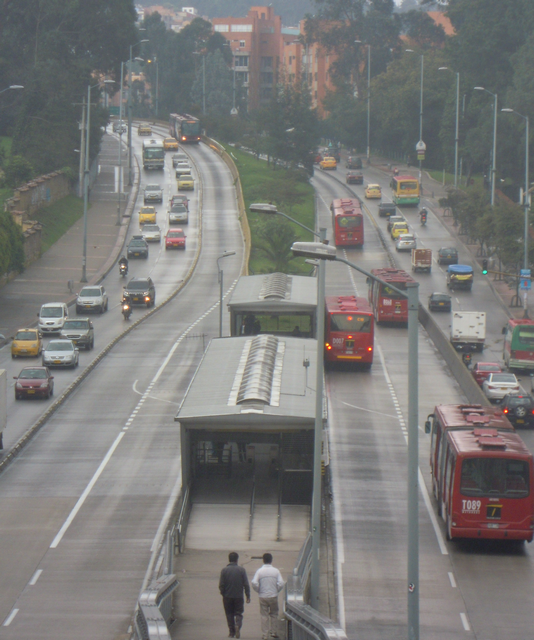
Well, we live in Bogotá, a city that has one of the most extensive BRTs in the world. In fact many European planners come to study our system for use in their countries. Graciela and I have much experience with the Transmilenio, as they call it here in Bogotá. The system carries over 1.5 million passengers each day. For eight years now we have ridden the buses three times a week or more, and at all hours of the day.
There is another system with which we are familiar with. Every day for three months we rode the Mass Rapid Transit (MRT) in Singapore. We wish to present to readers what knowledge we have gained that may help in designing the Detroit to Pontiac BRT.
Before we get into that let me say that it is about time mass transit came to the area. There are many advantages if it is implemented correctly. It would invigorate the area. However I caution that if implemented incorrectly it quickly turns into an underused system that does little to help the majority of people, the environment and businesses. It can easily become a source of money for corrupt individuals. Any plan for a BRT should have the most stringent safeguards against corruption and offer public transparency concerning the funds.
The BRT should provide an economical enough method for lower incomes in Detroit to ride to better jobs in the suburbs. In addition I can easily see it used for those between the two cities to visit Detroit restaurants and places of interest. Therefore, in my opinion, another route traveling Gratiot Avenue would be beneficial in brining Detroit back to life.
From my experience a light rail system is the better choice. Research reveals that initial cost is more, but annual operating expense is less. There are many other advantages as well including speed, better scheduling and ability to easily increase passenger space. However experience from living in the Detroit to Flint area for over 50 years tells me they will take the cheapest way out and a method that has more possibility of corruption.
Graciela: Michael mentioned something very important, "if implemented correctly." Other places have tried for a descent BRT but it failed to meet the expectations because part or parts were not planned or put in place correctly. To cover every detail is very important.
Michael: Cost - It is reported that the Transmilenio BRT here in Bogotá cost $8 million USD per mile to construct. That puts the proposed system from Detroit to Pontiac at about $216 million. If the people responsible quote a figure lower than that then there are two possibilities to watch out for. First they may not be building and setting it up for the best use. Second, if they are asking for the taxpayer to finance the project then putting the low cost may be just to get their initial support. However soon they will come back asking for more money to finish the job. The idea being that taxpayer will not abandon a half built project and pay to finish it.
If the project people quote an amount much higher than the $8 million per mile, then possible corruption should be looked into.
Graciela: Safety is an important issue. A mass transit system, especially one where people are crowded, draws pickpockets and other criminal activity. Here in Bogotá we have one to two police officers at every station and sometimes additional private security. In Singapore cameras monitor the platforms and the cars. Groups of police frequently ride on the trains and walk from one car to another. Videos in the stations constantly ask for passengers to report any suspicious activity.
In addition routes to and from the stations must be secure.
Michael: For both security and to allow more to use the system, here in Bogotá, they have feeder buses called alimentadores. They travel to and from neighborhoods taking people to the Transmilenio station.
For Detroit, I see the possibility of a restaurant having its own van shuddling between the dining place and the station. Or possibly the BRT could have a bus that stops at various restaurants in the area.
Graciela: How passengers pay - In Bogota customers purchase a card. They have choices. One card is temporary and the turnstile keeps it when the money is exhausted. The second system is a card registered to you that you put a substantial amount of money on and it deducts from the card each time you cross a turnstile. They are now starting implementation of a card assigned to you and has your photo on it. If you are a senior citizen then the machine gives you a discounted price. Customers only have to use their card to enter the station not to exit. For one price you can ride as far as you want.
In Singapore you have to use your card both when you enter and when you exit the station. You are charged for the distance traveled. The other thing I like about the Singapore system is they have machines that accept money or credit cards to recharge your ride pass. That helps avoid the long lines at the ticket booth frequently seen In Bogotá.
Michael: My wife has a point that a decision must be made to charge one price regardless of distance traveled or different prices for different distances. But either way the cost must be low enough to make it beneficial to use the system and enough to cover operating expenses.
The amount to be charged is critical. Riots have occurred in Bogotá when citizens though the price too high. Of course the capital city of Colombia is a place where minimum wage is just a little over $4,000 USD a year. Singapore on the other hand is one of the ten most expensive cities in the world with one in every six people being a millionaire. Cost to ride in Bogotá is about 85 cents regardless of the distance. We went all over Singapore on their system and averaged about $2.50 per trip. In my opinion an acceptable price would be $2.50 to $4.50 for one way between Detroit and Pontiac.
Graciela: The buses in Bogotá have 48 seats, however they hold 160 people. During rush hour the buses are full. It is important to think if people want to stand for the time it takes to go between Detroit and Pontiac.
In Singapore there are seats and people standing. A big difference however is they run enough trains that you can usually get a seat, and the trains are faster so you do not have to stand too long.
Michael: Let me elaborate some on what my wife wrote. Bogotá runs an insufficient number of buses, possibly to save money. The people are frequently packed in like sardines. Someone is pressed up against you on all sides. Because of the economic social strata in the country the Transmilenio can get away with that. Residents have very few alternatives. A taxi could easily cost them half a day's pay.
In Singapore, even during rush hour, no one touches another person. As for the chairs, the country is much more etiquette minded and young adults freely give their seats to senior citizens. While in Singapore last time there was an article about a young man who did not give his seat to an older gentleman. The kid's boss actually fired him from the job because such action reflected badly on the company.
I personally do not see Michiganders tolerating overcrowded buses. Think of a couple wanting to go from Royal Oak to have dinner at a nice restaurant in Detroit. The whole experience is ruined if they have to standup the entire way with people pressing against them. What I am saying is it is very important to run enough buses with sufficient seats.
Graciela: The Singapore system is a rail line with no ability for one train to pass another. Therefore every train stops at every station. But the speed of the train between stations makes up for it.
In Bogotá if every bus stopped at each station it would take forever to get anywhere. Therefore they have express buses. Each station has a passing lane that allows the express bus to pass the buses picking up and dropping off passengers.
Michael: Experience has shown that a BRT system without express buses is certain to have unsatisfied riders. People will drive their cars instead. The downside is that some might believe the system is not maximizing money potential. But really, calculate the amount of fuel spent getting a bus loaded with over 100 people going after a dead stop.
Graciela: A big decision is what hours to run the BRT. The Transmilenio runs from 6 a.m. to 11 p.m. The MRT in Singapore begins service at 5:30 a.m. and makes the last run at 1 a.m. In Singapore, in an attempt to reduce crowding during the morning rush, they give reduced and sometimes even free, transportation for those who travel between 5:30 a.m. and 6:30 a.m.
Michael: If the designers run the buses to any sports or concert venue like The Palace of Auburn Hills, Pine Knob, Comerica Park, etc. then those hours might have to be expanded on event nights.
Graciela: Website - The Transmilenio uses a website that not just shows the routes, but allows you to fill in your starting point and your ending point. The system then tell you what buses to take and the estimated amount of time to arrive. There is also information about the feeder lines. Singapore has a downloadable and printable page of their map. A mass transit system should have a easy to navigate website with information to make a rider's journey planning as easy and stress free as possible.
Michael: Temperature - Bogotá is like an eternal spring therefore the buses have neither heaters or air conditioners. In Singapore it is always hot mandating that the trains be air conditioned. But Michigan has seasons. I have looked at the design of the buses used and believe it is going to be difficult to control air temperature for all passengers. However it is much easier on a train using a rail system like Singapore does.
Graciela: In our opinion anyone involved in the design and/or implementation of a BRT system should come to Bogotá and study what we have.
Michael: If you have any question please go to our webpage, www.michaelandgraciela.com and write us on our Contact or Ask us a Question about Colombia page.