Politics & Government
5 Things Jesse Jackson Said About Trump, Pardons, Electoral College, Protests
The Rev. Jesse Jackson, a civil rights leader for 50 years, was honored in a daylong symposium at the University of Michigan.


ANN ARBOR, MI — The Rev. Jesse Jackson discussed wide-ranging topics, from the electoral college to Donald Trump’s election to Hillary Clinton’s email server scandal and what should be done about it, during a daylong celebration Wednesday at the University of Michigan honoring the civil rights luminary for decades of social justice work.
Jackson, who ran for president twice in the 1980s and founded the Rainbow PUSH Coalition, visited Michigan a week after a historic election that brought back to the forefront some of the civil rights and social justice issues that he has spent a half century fighting. Jackson’s keynote address at the U-M symposium in his honor touched on the future of the struggle for economic, political and social justice in the Trump era.
While visiting Ann Arbor, Jackson reflected with reporters about some of his takeaways from the election. Here are five things he said in interviews and his keynote address.
Find out what's happening in Detroitfor free with the latest updates from Patch.
1. What would Gerald Ford do? It couldn’t have been a coincidence that Jackson evoked memories of the namesake of U-M’s Gerald R. Ford School of Public Policy, where the symposium was held. Before he leaves office in January, President Barack Obama should pardon Hillary Clinton for any future crimes she might be indicted for in the investigation surrounding her use of a private email server while serving as secretary of state, Jackson said.
“It would be a monumental moral mistake to pursue the indictment of Hillary Clinton," Jackson told the Detroit Free Press, noting that President Ford pardoned Richard Nixon, who resigned over the Watergate scandal, “because he thought it would be best for the country.”
Find out what's happening in Detroitfor free with the latest updates from Patch.
“There are those who want to drag her for the next three years,” Jackson said. “It will not stop until they find a reason to put her in jail. That would be a travesty."
2. Electoral College should go, but that’s not all: Clinton was the second candidate in modern history to win the popular vote — the former secretary of state was up by more than 1 million votes on Wednesday as the final precincts straggled in — but fall short in the deciding count of electoral votes. Jackson favors a one-person-one-vote system and has previously called the Electoral College a relic of the past that “dangerously saps the legitimacy of the presidency.”
At the symposium, he called for a litany of other reforms that would make it easier for Americans to vote: declaring Election Day a national holiday, automatically registering people to vote when they turn 18, expanding rather than reducing early voting opportunities, and closing voter rights gaps used to target and suppress voters.
“It’s the tug of war for the soul of America,” Jackson told The Detroit News. “The point is to make voting easily accessible if you believe in the democratic (process) from the bottom up, rather than top down.”
3. Donald Trump struck the match: Trump knew when he made them that he couldn’t deliver on his immigration promises and that some of the assertions he made against Mexicans were untrue, Jackson said, comparing the fears Trump exploited to a dry field that was easily ignited.
“The one who set the field afire must be the one to put it out,” Jackson told the Free Press. “He had the option to pour water on it (the dry field) and let it grow. He didn't do that — he chose to light it on fire. One of my concerns is that we see the division in America now because of that. We see classmates, roommates in a conflict over the way the campaign turned out.”
4. Trump supporters are not to blame: Trump may have “unleashed massive hatred, fear and division in our country,” Jackson said, but that’s not what attracted many of his supporters. They were concerned about jobs, stagnant wages, poverty and other issues that left them feeling left behind in America, and they simply wanted change, he said.
5. America has an “identity crisis”: America has an “identity crisis” as old civil rights battles surface anew, Jackson said. Persistent protest rallies on the U-M campus and elsewhere across America in the eight days since the election are “born out of fear,” Jackson said. “Fear that the Klan will ride again. Fear that violence (against minorities) is coming back. In this election, voters voted for fear. I think hope will defeat hate, but it's a battle.”
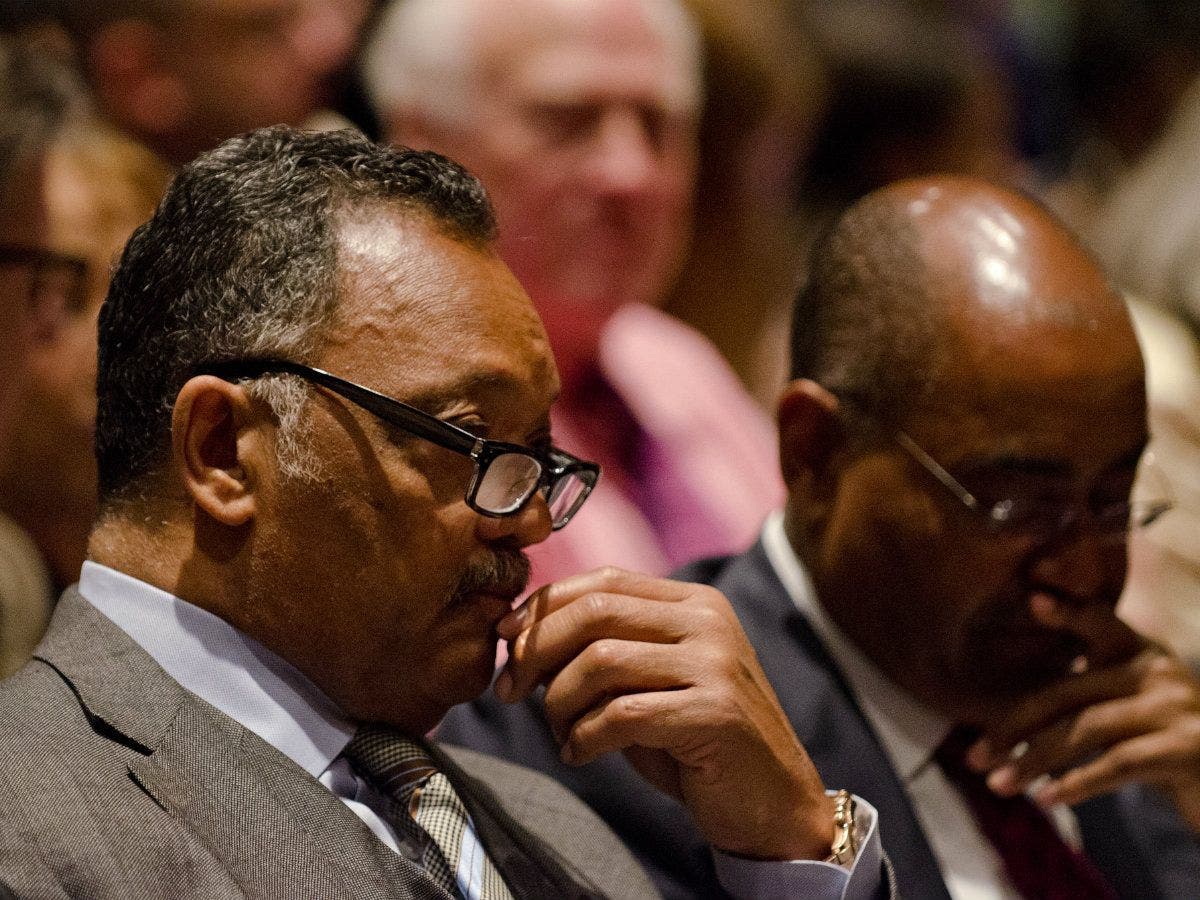
Image: At the LBJ Library on April 10, 2014, the Rev. Jesse Jackson waits for President Barack Obama's keynote address. Photo by Marsha Miller via Public Domain
Get more local news delivered straight to your inbox. Sign up for free Patch newsletters and alerts.