Politics & Government
Barbara-Rose Collins, MI's 1st Black Congresswoman, Dies At 82
Collins was the first black woman from Michigan elected to Congress, where she served in the U.S. House of Representatives for six years.


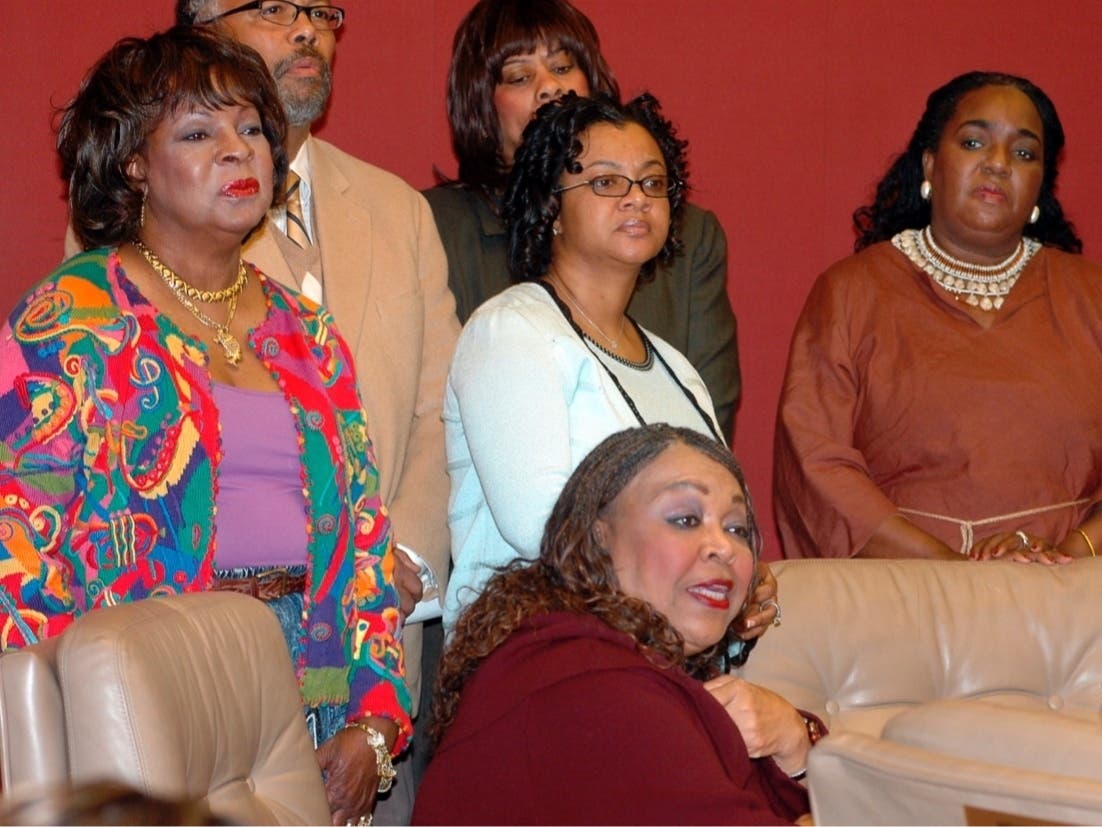
DETROIT — Former U.S. Rep. and Detroit City Councilwoman Barbara Rose-Collins died Thursday after contracting COVID-19, her family said in a statement. She was 82.
Collins was the first Black woman elected to Congress from Michigan in 1990, where she focused on minority rights by ensuring that Black families and Black communities had the resources and opportunities they needed to thrive.
She served in the U.S. House until 1997, where she endorsed several bills that became law, including the Food Dating Bill and helping to bring the Neighborhood Enterprise Zones to Detroit, according to The Detroit News.
Find out what's happening in Detroitfor free with the latest updates from Patch.
"She lived her whole life in the same neighborhood, same house she was born in, on the lower east side," her son, Christopher Collins, told The Detroit News. "That says a lot about a person."
She also served three terms in the Michigan House from 1975 to 1981, as well as two separate stints on Detroit City Council from 1982 to 1991 and from 2001 to 2009.
Find out what's happening in Detroitfor free with the latest updates from Patch.
Live in Detroit? Click here to subscribe to our free breaking news alerts delivered to your inbox and mobile devices. Follow us on Facebook and Twitter, and download our free mobile app on Android or iPhone.
“My heart breaks to hear of the passing of Rep. Barbara Rose Collins,” U.S. Rep. Brenda Lawrence tweeted. “In 2018, I awarded her the Shirley Chisholm 'Unbought & Unbossed' award because she always put Michiganders first. She was a lifelong fighter for her communities, and she will be sorely missed.”
Collins was the eldest of four children and born in Detroit, Michigan, on April 13, 1939. She graduated from Cass Technical High School in 1957 and attended Detroit’s Wayne State University majoring in political science and anthropology.
However, she left college to marry her classmate, Virgil Gary Collins, who she had two children with Cynthia and Christopher. The couple divorced in 1960, and Collins was left as a single mother.
She began working multiple jobs, before landing a job as a business manager in physics department at Wayne State University, which she held for nine years.
It was in the late 1960s when Collins first heard a speech by Black activist Stokely Carmichael at Detroit’s Shrine of the Black Madonna Church that inspired her to focus on uplifting Black neighborhoods.
Collins then purchased a house within a block of her childhood home and joined the Shrine Church. She was then elected to Detroit’s region one school board, where earned widespread recognition for her work on school safety and academic achievement.
Although Collins considered running for Congress in 1980, her mentor Detroit Mayor Coleman Young advised her to run for Detroit city council instead, where she won. She did eventually run for the U.S. House of Representatives, but narrowly lost to George William Crockett Jr. in 1988.
Shortly after losing Crockett Jr. for Congress, Collins' only son was convicted of armed robbery. She believed that he got into legal trouble because he lacked a strong male role model.
"I could teach a girl how to be a woman, but I could not teach a boy how to be a man," she later told the Detroit Free Press.
Collins used this experience to rally under "Save the Black Male," and promised to pursue legislation to support Black families.
So Collins ran again for the U.S. House in 1990, and she won with 80 percent of the vote. She focused on bringing federal money to Detroit, an economically depressed and segregated city. She re-elected twice with even higher percentages.
She worked closely with longtime Michigan Representative John David Dingell Jr. and received assignments to the Committee on Science, Space, and Technology and the Select Committee on Children, Youth, and Families.
She was also a member of the Congressional Black Caucus and the Congressional Women’s Caucus and was appointed a Majority Whip At-Large from 1993 until 1994.
While Collins generally agreed with President William J. (Bill) Clinton’s policy initiatives, she she voted against the President’s April 1994 omnibus crime bill. She objected to adding more federal crimes to the death penalty and a section that mandated life in prison for people convicted of three felonies.
Collins believed these provisions would affect minority communities disproportionately.
Despite her popularity, Collins ran into trouble with the Justice Department in 1996, where the House Ethics Committee investigated her office in 1996 for the alleged misuse of campaign and scholarship funds.
Although Collins was defeated by Carolyn Cheeks Kilpatrick in 1996, she remained active in local politics. In 2001 she won a seat on the Detroit city council. Collins was re-elected in 2005 to the council for a second term and retired in 2009.
"My grandmother was not only an inspiration to many, but a guiding light in my path to be of service to citizens in my community," her grandson, City of Detroit Ombudsman Bruce Simpson said.
Funeral arrangements will be announced soon for those who want to pay their respects to Collins.
Get more local news delivered straight to your inbox. Sign up for free Patch newsletters and alerts.