Politics & Government
Ann Arbor Transportation Authority Presents Master Plan
Dexter residents get first glimpse at AATA's long-term goals in Washtenaw County.
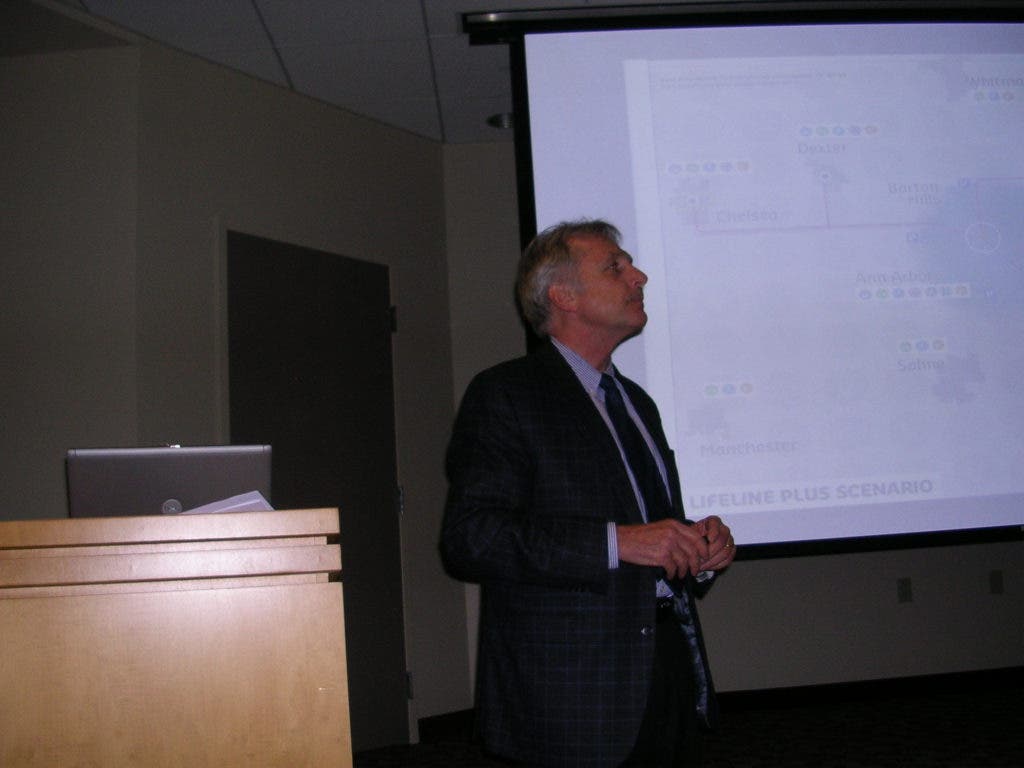

The Ann Arbor Transportation Authority laid out its ambitious Countywide Transit Master Plan on Wednesday at the to an audience of both skeptics and enthusiasts.
The plan, presented at a town hall meeting by AATA Project Manager Michael Benham, projects the state of transportation in Washtenaw County up to 2040 and suggests three different scenarios that would improve transit conditions in Ann Arbor and surrounding communities.
“This is about building a new layer of transportation for Washtenaw County,” Benham said.
More than 30 community members attended the event, many of them seniors. The audience listened to the plan and was encouraged to submit their preferred scenario on a feedback sheet.
Find out what's happening in Dexterfor free with the latest updates from Patch.
Benham shared three possible scenarios at the forum being considered for the AATA's new master transit plan, which includes car, bus and rail transit along with bicycling and walking plans.
One is being dubbed the "Lifeline Plus" option. This would improve services largely where they exist today, and double current service to hubs in Dexter and Chelsea, he said.
Find out what's happening in Dexterfor free with the latest updates from Patch.
The "Accessible County" option would add more hubs in places like Manchester, Saline and Whitmore Lake as well as express services between Dexter and Ann Arbor.
The most elaborate scenario involves adding more local transit hubs and express services throughout the county. It would also add regional rail services, including a Washtenaw Avenue Corridor and an Ann Arbor-Detroit commuter rail.
A rail system was the preferred scenario for Tom Phillips, a Dexter resident and vice president at Hobbs & Black Architects in Ann Arbor. Phillips said a commuter rail would "revolutionize" Michigan transit.
“We seem to be a conservative state with these things, but the more committed the investment is, the more permanent it will become,” he said. “It can be a legacy. Imagine people talking about the time their children took a rapid rail line to go see a baseball game.”
Construction costs for the commuter rail plan are estimated at $465 million with another $100 million in operating costs. The Lifetime Plus and Accessible County plans are estimated to cost $48 million with operating costs of $70 to $80 million.
“The impact of this plan could change so drastically just on gas prices alone,” Benham said. “If some of the experts predictions come true, public transit is going to be needed more than ever.”
All scenarious have facets that could benefit Dexter riders. Integrated ticketing is a proposed feature, meaning that passengers connecting from the Western Washtenaw Area Value Express (WAVE) bus to an AATA route will not require an additional payment, a key complaint riders have now according to WAVE Executive Director Michaelene Pawlak. Additionally, door-to-door services would be provided to seniors countywide. In both the Accessible County and Smart Growth plans, a service called “flex-ride” would provide similar care to all riders in need.
The master plan also calls for more Park-n-Ride intercept lots (such as the one currently on Maple Road near M-14) to be built closer to Dexter. The village would also be in a new network of local AATA circulators.
Addressing how any of the proposals would be funded, Benham said a funding analysis was next on the AATA's agenda. Currently the AATA is paid through property taxes of Ann Arbor residents only.
Benham said the AATA will continue to hold town hall meetings throughout the county until a scenario is selected, after which it will move into the implementation phase and set an official timetable and budget.
For more information, visit www.MovingYouForward.org.