Community Corner
Tapping into Northville's Early Taverns
Public houses and hotels catered to weary travelers and local townsfolk.


This week’s St. Patrick’s Day revelry makes it an opportune time to look back at some of Northville’s earliest public houses and hotels — establishments that offered “spirits” to weary travelers and local townsfolk.
Many of Northville’s earliest settlers came from upstate New York in the late 1820s and early 1830s. Considering the treacherous trek endured by these pioneers, is it any wonder that a tavern was established before the village was officially settled?
Pioneer David Clarkson, who traveled to Northville in 1831 with Capt. William Dunlap’s party from Seneca County, New York, shared his recollections of Northville’s early days in a series of pioneer sketches published in The Northville Record from 1874 to 1878. In an 1874 article, Clarkson made reference to what is believed to be Northville’s first tavern.
Find out what's happening in Northvillefor free with the latest updates from Patch.
Clarkson noted that once land was cleared in the early 1830s, “settlers came very fast. . . People came here to trade, and for lumber and this began to be a business centre. Mr. Sterling (most likely pioneer Samuel Sterling) sold his farm to J. DeMott and came here and built the first public house or tavern. The same house is now owned and occupied by Capt. Dunlap.”
The house, located at the corner of Dunlap and Center streets, is now the American Legion Hall. It once faced Center Street, but was bricked and turned to face Dunlap after the American Legion purchased it in 1944.
Find out what's happening in Northvillefor free with the latest updates from Patch.
Clarkson further noted, “John Waterman purchased the tavern of Mr. Sterling, and kept a first class public house.” By 1835, another establishment opened when “Michael Thompson became the owner of the Northville Hotel . . . and with his brothers Lewis, William, and Phineas became citizens of Northville. Lewis taught our school, William and Phineas kept the hotel after Michael. Phineas was a very popular landlord, social, genial, good-hearted, charitable, friendly and liked by all.”
Throughout the 19th century and into the early 20th century, Northville boasted many public houses and hotels. Among the most notable was the Ambler House, built in 1858 by William Ambler. An abolitionist, Ambler and his wife, Ursula (Randall), moved to Northville in 1854. Their hotel, located on the southwest corner of Main and Center streets (now the site of the MainCentre development), was the first balloon frame building in the area. It also was the headquarters for the stage routes to Detroit, thus making it a popular spot for weary travelers.
According to a 1907 article in The Northville Record, “In the early days, Mrs. Ambler was well known throughout the country as the popular landlady of the Ambler House, and it may be truly said that much of the success of that place was due to her untiring efforts for the welfare of her guests.”
The Ambler House was eventually sold to Jabin Elliott, and it became the Elliott House. By 1889, the hotel had been purchased by O. Butler and Sons, which completely remodeled and refurnished it. Touted as “the best $2 per day house in Michigan,” it became the leading hotel in town, noted for its well-stocked bar and excellent cuisine. In 1893, the hotel was put on the market again and was purchased by William Thurtle, a retired lumberman who also purchased the Northville Opera House, which at that time was known as the Moffat Opera House (located on southeast corner of Dunlap and Center streets). Thurtle planned to convert the opera house into a hotel but abandoned the idea after purchasing the Park House. The hotel was destroyed by fire in 1929.
In addition to the Ambler House, two other hotels of note were the Exchange Hotel, located on the northwest corner of Main and Hutton streets, and the Stanley House, which was west of the Exchange Hotel in a brick building that once housed E. C. Huickley’s Billiard Parlor. George Stanley owned both hotels. Neither of the buildings remains today.
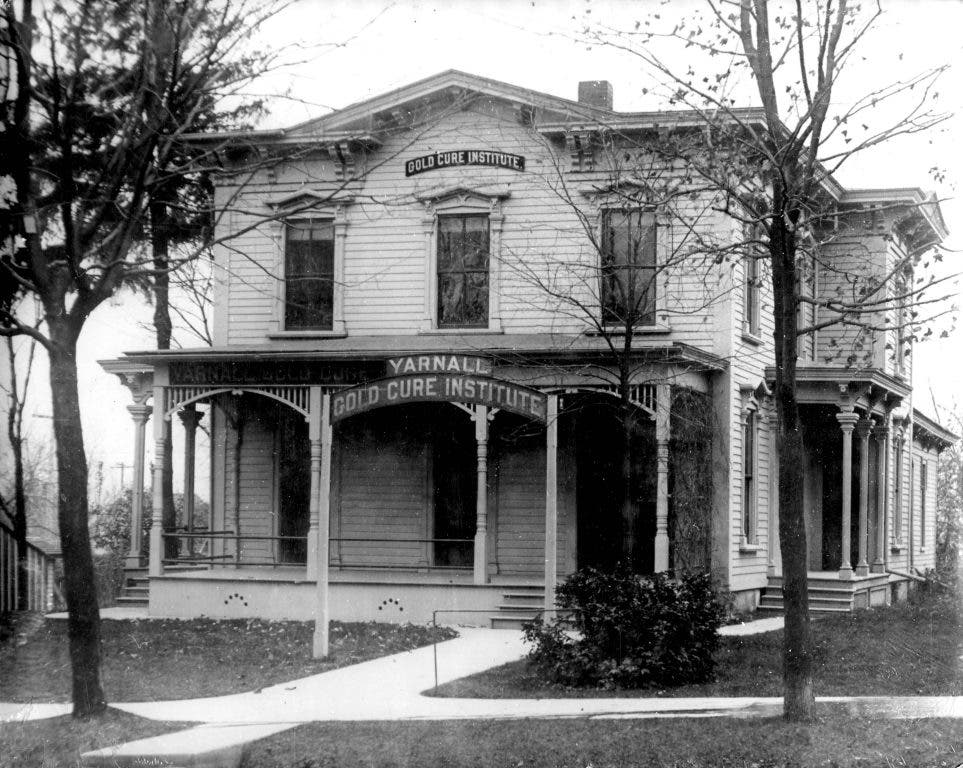
For those who spent too much time in Northville’s hotel bars, the Yarnall Gold Cure Institute at 404 West Main Street opened its doors in 1892 to provide treatment programs “for liquor-cursed men.” Founded by Dr. William H. Yarnall, it was “an institution for the rational treatment and radical cure of the alcohol, opium, cocaine, tobacco and cigarette habits,” and offered three-week alcohol treatment programs for $50 “payable in advance.”