Politics & Government
Millage No Vote Recommended
A detailed data analysis review of the City of Plymouth's Public Safety Millage request.


Fellow citizens, I recommend a NO VOTE on the “Public Safety Millage” being voted on in the City of Plymouth this Tuesday the 24th. This recommendation is based on a concerned citizen reviewing the data and facts (which is why you will find several web links below), not political spin or a bias against our fine police and fire departments. In fact, a No Vote in my opinion is a vote FOR our public employees whose pensions and retirement health care are underfunded to the tune of ~$11 Million AND FOR the taxpayers at the same time.
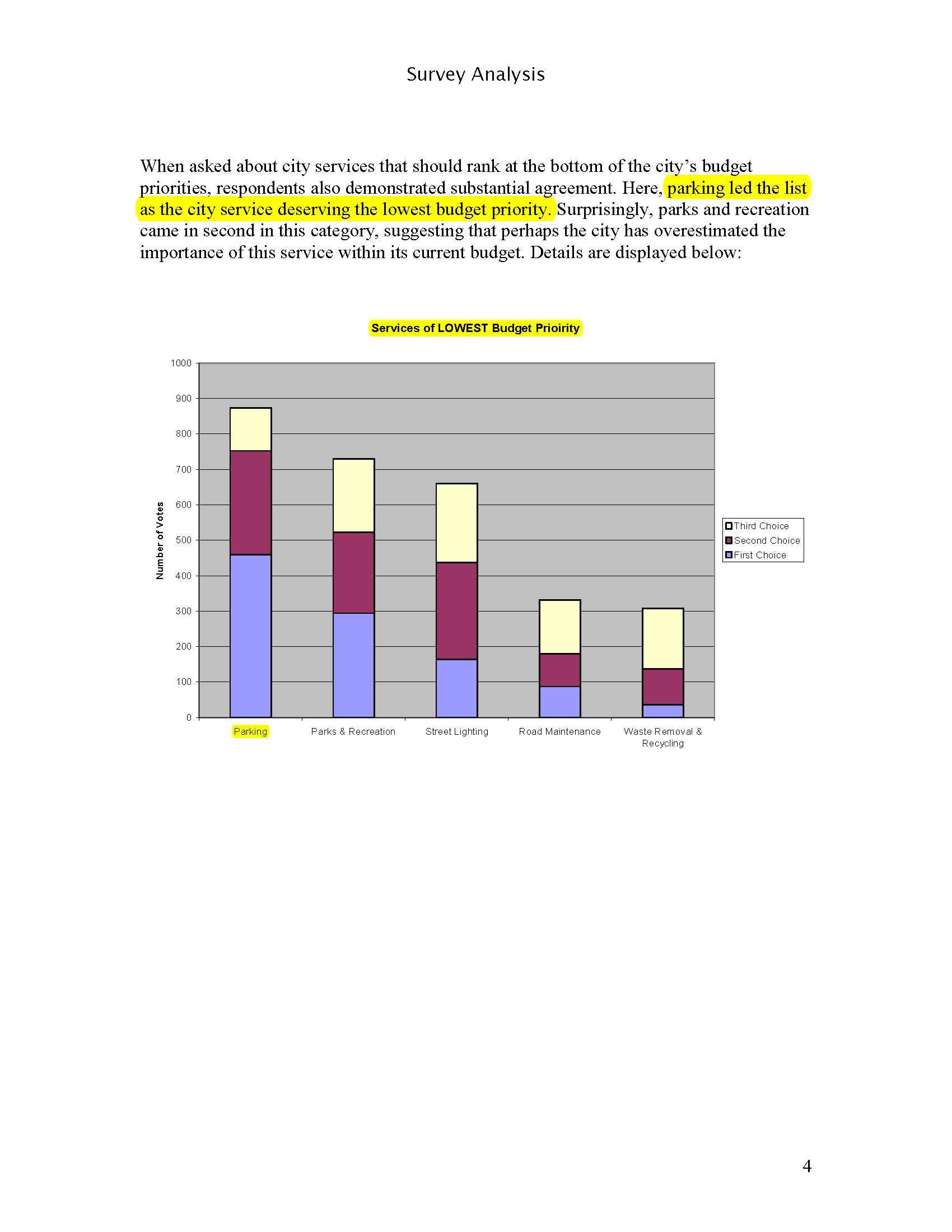
How is it possible to VOTE NO and help both our public servants and the taxpayers? In the included bar chart, you can see one of the main results of the 2005 (Yes, I know this is older but it is the same survey the City cited several times during their Tuesday 2/17 Open House presentation trying to justify more police) University of Michigan survey of Plymouth residents (Full survey available at: http://mi-plymouth.civicplus.com/documentcenter/view/74) Parking was listed as the lowest priority by the citizens surveyed. Yet our city commissioners have had additional parking listed as one of their top goals for the last two years and have been negotiating for the purchase of the Saxton’s parking lot at an initial cost of over $2 Million (~$500 for every household in Plymouth). Improvements to that lot could result in even more significant expenditures. Since over 90% of the Downtown Development Authority’s budget for this project comes from the taxpayers, we are paying for this parking lot...something we have clearly told our city we do not value. If this amount of parking lot money in total were redirected to Public Safety, it would most likely completely cover the tax increase requested by the Public Safety millage and also comply with the survey voice of the citizens of Plymouth.
The fact that the city is spending taxpayer money on a parking lot we clearly don’t value when this money could be used to replace the need for a Public Safety Millage should be reason enough to VOTE NO. Additional facts regarding police staffing, the major focus of the cities informational meetings, are detailed below and were summarized in the Plymouth Observer Guest Column I wrote on 2/12/15, page A12 http://www.hometownlife.com/story/news/local/plymouth/2015/02/20/op-ed-stats-support-cops-plymouth/23189925/
Find out what's happening in Plymouth-Cantonfor free with the latest updates from Patch.
City of Plymouth Public Safety Millage Ballot Proposal Opposition
On February 24th, the citizens of Plymouth will be asked to vote on a new “Public Safety Millage” tax of up to 1.5 mills; for a $300k home, this would amount to approximately $225 per year, every year, for 5 years or a total of $709k/year to the city. The city has summarized its need to “…Secure funding to hire additional police for downtown bar/restaurant patrol, thus freeing up current officers for increased neighborhood patrols” in its presentation at http://www.ci.plymouth.mi.us/DocumentCenter/View/3437. However, I feel that the data presented does not support this need, nor do the majority of citizens agree this is a high priority for the city. I will attempt to use the city’s own data to prove my point.
The city’s main rationale for a tax increase is a large increase in “calls for service” by the police; however, the city did not analyze or sort the data. A simple review of the data as shown in the included line graph details a extremely strong linear relationship between the number of calls for service and the increased number of liquor licenses allowed in the city since 2006.
Additional data presented by the city includes charts showing the number of officers, population, square miles of jurisdiction, etc. Simple sorting as shown in the included table again reveals Plymouth with 15 officers is already the 3rd highest out of over 20 jurisdictions at 6.8 officers per square mile. Northville, the usual comparison for Plymouth, was conspicuously left out of this data due its smaller size…but still trails Plymouth with 5.9 officers/square mile. Note that the city has already hired a 16th officer as of January...even though we haven’t voted on funding the officer(s) yet.
Find out what's happening in Plymouth-Cantonfor free with the latest updates from Patch.
Some might argue that officers/mile is not a meaningful comparison; alternatively I would suggest that crimes/1000 residents would be a good indicator of how safe a community is…and would also show if there was a need for more policing. As shown in the table above, adding the 2013 FBI crime data to the data used in the city’s presentation shows a total crime rate of 11.2 crimes/1000 residents…the lowest of any of the municipalities used by the city. In fact, Chief Cox was quoted in the Plymouth Observer on 12/13/14 as saying that “The city is indeed a safe place to live and visit” (http://www.hometownlife.com/story/news/local/plymouth-township/2014/12/12/plymouth-crime-rates-compare-favorably/20312049/).
So crime data shows Plymouth is the safest community in the city’s police only data, that it has a larger than average number of officers per square mile and that calls for service increased in lock step with the number of liquor licenses the city has allowed. One might then deduce that those who are causing the increased calls for service, the bars, should pay for any needed additional officers. In my opinion, the city has to find a legal way to do this. While most residents enjoy having these establishments, the bar owners are the ones with the most to gain by owning the liquor licenses and so they should be the ones paying for any incremental policing costs (which we can assume only occur on the weekends). If police and fire departments are allowed to levy charges for “false alarms”, one would think they would be allowed to come up with some way to charge for “multiple calls for service”. Just implementing such a system may cause the bar owners to police themselves, thus totally eliminating the extra police need.
While the cities presentation focuses on adding two police officers at a total cost of $152k/year (initially), the millage would raise up to $709k. This leads one to wonder what the balance of this funding would be used for. The language of the proposal says “…to provide funds to staff, equip, maintain or operate the Public Safety Department and for any other Fire, Police of Public Safety purposes authorized by law, including the hiring of additional police officers.” What is bothersome is that hiring seems to be an afterthought. With the city already having $7M in unfunded retiree health care, $4M in unfunded pensions, $4M in costs being disputed with the Township, along with a pending +$2M Saxton’s parking lot purchase, what is not made clear in the language will be the biggest actual use of the millage.
In summary, based on the city’s presentation and comments, the FBI’s data and my analysis of the data, Plymouth police are doing a great job without the need for additional officers. If there is a need for additional police, it is apparently due to increased bar traffic. I believe it is reasonable to assume this should be a cost of doing business for the bar owners OR the city should use the money they are spending on Saxton’s to pay these costs. As a result, I urge the citizens of Plymouth to VOTE NO in person or via absentee ballot on the proposed millage. I would also hope the city commission would refocus on the goals of their constituents (such as the PARC or Quiet Zones)...and not on parking lots and raising taxes.
Fellow Citizen (And Non City of Plymouth Employee): Jack Wilson