Sports
Plymouth Whalers' Players Find Home Away From Home with Billet Families
What starts as strangers living in the same house turns into a relationship that lasts a lifetime.
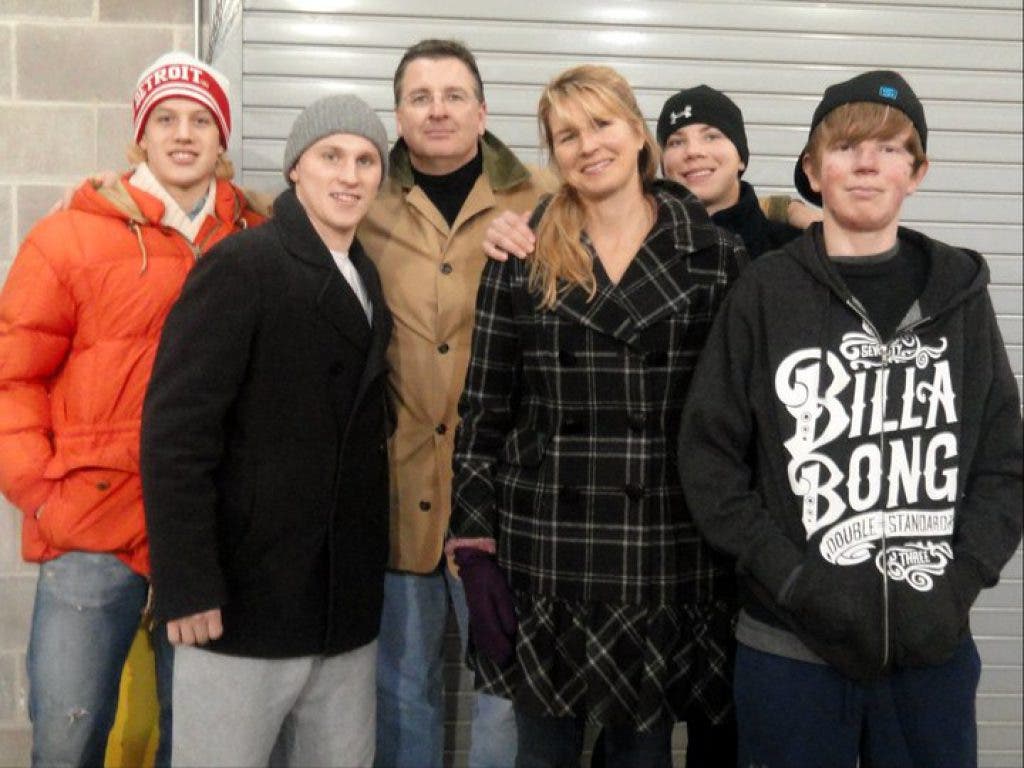


When he was only 15, RJ Mahalak moved less than 40 miles away from his hometown, prepared to begin a new chapter of life.
He settled into a new community and into a new school where he made new friends—all which are steps in a young hockey player’s pilgrimage toward a career in the National Hockey League.
But perhaps the biggest adjustment for the Plymouth Whalers' left-winger was calling a new place home. Literally.
Find out what's happening in Plymouth-Cantonfor free with the latest updates from Patch.
Plymouth provided a new environment from the one he grew up in Monroe. But in addition to different surroundings, Mahalak became part of a new family.
Like each of his Whalers teammates, Mahalak was taken in by a billet family, which links together Plymouth families with teenagers continuing their journey toward a professional hockey career.
Find out what's happening in Plymouth-Cantonfor free with the latest updates from Patch.
Whalers officials try to match players with families similar to those in which they grew up. But like with any other new relationship, establishing a bond can take time.
“Living with a different family was definitely new for me,” Mahalak said. “I had no idea who these people were.”
Little did he know that his new family – Tom and Margaret Predhomme – were seasoned veterans when it came to providing a home for household names within the Whalers' organization. Prior to Mahalak, the couple opened their home to current NHL players Jared Boll (Columbus), Justin Peters (Carolina) and John Mitchell (New York).
Still, they wanted their newest Whaler to feel right at home.
So before Mahalak moved in, the couple contacted him through a series of emails, phone calls and text messages, making sure he felt comfortable before he even moved in.
The hospitality worked.
“I felt like one of their own as soon as they took me in,” Mahalak said.
Each year, the Whalers depend on between 18 and 20 local families to serve as billets. Players routinely move in before training camp in August and spend the school year living with their new families.
The Whalers provide a monthly stipend of about $300, helping out with the added expense of having another mouth to feed. But before long, families discover they are providing much more than a home to their new tenant. In the billets, players find a sense of security and a feeling of being at home.
Even if they aren't.
“The billet is a family for some of these players away from their family,” Whalers assistant general manager Brian Sommariva said. “They provide structure and it’s a lot more than a bed to crash in at night.
“They really bring these families into their homes as if they are their own child.”
That’s the feeling Ryan Hayes got when he arrived in Plymouth during his Whalers career.
The Syracuse, NY, native had spent time in Ann Arbor playing with the USA Hockey National Team Development Program. His time in Ann Arbor had helped him adjust to one new family. But when he signed with the Whalers in 2009, he moved again – this time into the home of Steve and Suzanne Kowalkoski.
The Kowalkoskis are Whalers season ticket holders and felt opening their home up to one of Plymouth’s hockey heroes was a good way to give back to the community. They had two sons – Ben, who is 17 and Tom, who is 13, and they felt that volunteering as billets would provide their sons a window into what athletes competing at a high level go through.
Steve Kowalkoski makes it a practice of calling the parents of the players they billet, getting a feel for how they raised their son. Although the new addition to their family would come to be treated as just that, he makes sure players understand the expectations of the relationship.
“We want them to know that this is our house and his area,” said Steve Kowalkoski, whose family has served as billets for three players. “We want them to be comfortable, but we also want them to know what we expect.”
Kowalkoski wanted to make sure his two sons would get role models out of their new houseguests. Soon, he found that hockey players at this level are very structured, lending serious time to their studies, to conditioning and to practice time during the season.
But quickly, he learned he and his family would gain much more than a tenant to share their home with.
"I don't think you expect how close you're going to get with them," Kowalkoski said. "You open your home and you open your heart and they they open themselves up to you. I never expected that."
For Hayes – who grew up with an older brother – he soon discovered he was gaining an extension to the family he was used to.
While his time in Ann Arbor helped him adjust to life away from home, he found that being in a home like the Kowalkoskis' afforded his mother back in New York some peace of mind.
“It is weird because you’re jumping into a new house and so you have to get comfortable,” said Hayes, a prospect in the New Jersey Devils’ system. “The first year was really tough for my mom – she didn’t want me to leave.
“But Steve called my mom and soon, everyone meshes in together as a family so it’s really good.”
Although many of the billet families become return customers, the Whalers are constantly in need of new billets. Each applicant goes through a background check and application process to ensure that they are good matches for the families.
Even in the off-season, the families tend to get drop-in guests for dinner and for visits – evidence that the player-billet family extends well beyond the season the initial relationship starts.
For families like the Predhommes who have opened their house to Whalers players for the past 10 years, locals find themselves with links to the NHL. Teenagers who at first show up as strangers grow into extended family members, building a bond that goes on for years.
“I didn’t know what to expect coming in but the Predhommes are like lifelong friends now,” Mahalak said. “Even when I’m done with the Whalers and 10 years from now, I will still know them and hang out with them and call them and everything.
“They’re part of my family now.”