Neighbor News
Oakland University biology professors repeat ecological survey after 40-plus years
Keith Berven and Scott Tiegs surveyed amphibian and reptile populations in northern Ecuador. Dr. Berven first surveyed the area in 1971.
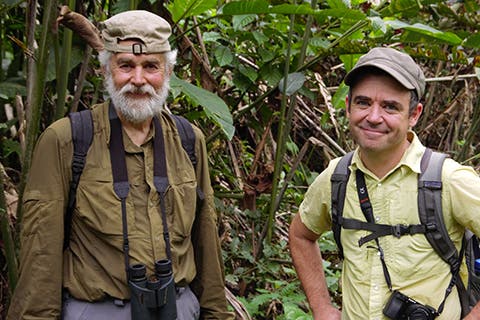
Two professors in Oakland University’s Department of Biological Sciences were recently in South America following up on an ecological study conducted more than 40 years ago. Scott Tiegs and Keith Berven spent five days in late May surveying the reptile and amphibian population in an area of the Limoncocha Biological Reserve in northern Ecuador. It was familiar territory for Dr. Berven, who surveyed the area in 1971 as an undergraduate student at Pacific Lutheran University. The pair wanted to see how the diversity of the reptile and amphibian population had changed over the past four decades in light of major environmental changes in the area.
“We sampled the same forest and presumably, in many cases, the same trees,” said Dr. Berven. “I can say this because we were in the same area and we are talking about trees that are very old. GPS did not exist (in 1971), but now we have GPS coordinates for all 180 trees we sampled.”
In order to make the two studies as similar as possible, Dr. Berven and Dr. Tiegs sampled the same number of trees as the 1971 study. The 2015 study also included approximately 150 frogs, toads, caecilians, lizards and snakes – representing about 25 species – which is comparable to the 1971 study, Dr. Berven said.
Find out what's happening in Rochester-Rochester Hillsfor free with the latest updates from Patch.
While results from the two studies have yet to be compared in detail, early indications are that biodiversity in the area remains intact. This is encouraging, Dr. Berven says, because rainforests worldwide have experienced dramatic changes over the past four decades. The area surrounding the study site hasn’t been immune to these changes. In 1971, Dr. Berven’s research team accessed the area via a small plane. There were no roads. This year, however, he made the trip by truck.
“With the discovery of large oil deposits near the area of our study in Ecuador, roads now crisscross the area, small towns and cities have developed along these roads and large tracts of land have been cleared,” Dr. Berven said. “As development increases, it is important to preserve as much of the tremendous biodiversity found in tropical forests as possible.”
Find out what's happening in Rochester-Rochester Hillsfor free with the latest updates from Patch.
Development is not the only threat to biodiversity in the tropics. Chytrid Fungus, a disease responsible for the mass extinction of amphibians around the globe, has been found in Ecuador. As part of their research, Dr. Tiegs and Dr. Berven will have the amphibian specimens they collected screened for the disease and housed in a museum in Quito, Ecuador.
Dr. Tiegs investigates global health of rivers and streams
Along with assisting Dr. Berven, Dr. Tiegs is spending six months in Ecuador to conduct research through a scholar-exchange program called Prometeo. The government-sponsored program is based in Ecuador and is similar to the U.S. Fulbright Scholar program. The goal of the research is to initiate a large-scale experiment in streams and rivers across the globe. The project currently consists of 165 partners from 45 different countries who will each perform an identical experiment in four streams near their home institution.
“The experiment will entail quantifying organic-matter decomposition rates in each stream, which can be used to assess stream health,” Dr. Tiegs said. “This project and the work with Dr. Berven are good examples of research that is needed to document human impacts on the environment across large temporal and spatial scales.”
To learn more about programs in Oakland University’s Department of Biological Sciences, visit oakland.edu/biology.