Politics & Government
Carriage Maker George Vandeventer Helped Establish Rochester Fire Department
After two homes burned to the ground, Vandeventer urged civic leaders to organize Rochester's firefighting efforts.
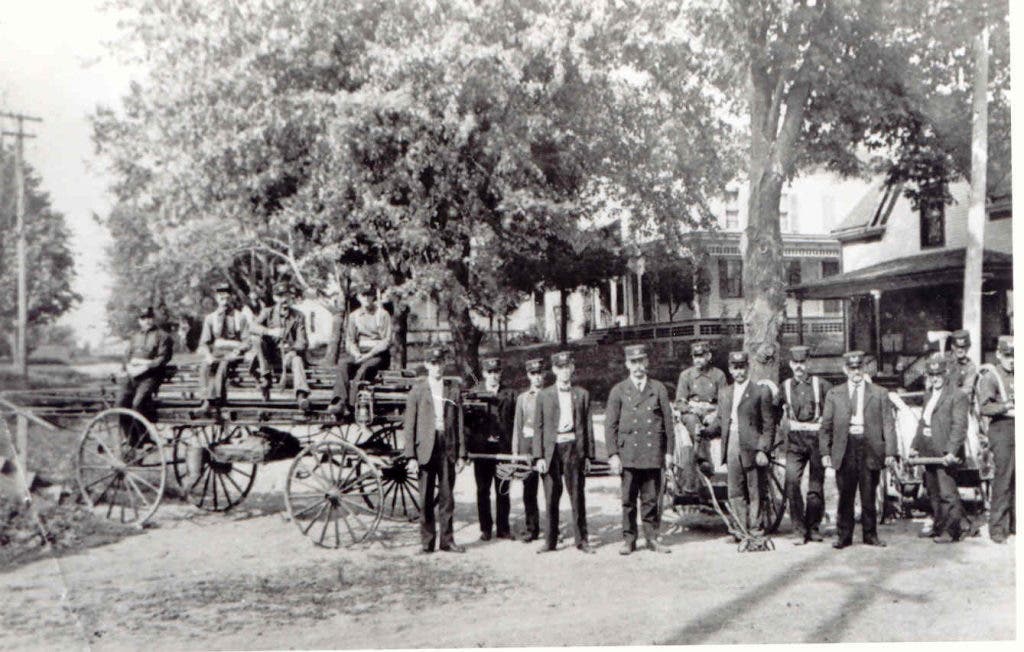


George W. Vandeventer's name may not be familiar to many, but his life and times in Rochester left an indelible mark on the development of the town.
Not only was he a successful pioneer merchant and politician in what was then the Village of Rochester, but Vandeventer also held a number of prominent public offices in both Rochester and Avon Township (now Rochester Hills) and is credited with helping to establish Rochester’s fire department.
Settling in and setting up shop
Born in New York in the 1820s, Vandeventer and his parents traveled to Avon Township from Romulus, New York, in 1834. Their first residence in Avon Township is unknown, but according to the 1850 Federal Census, Vandeventer was living in the home of carriage maker Levi Davis and his wife, Louis.
Find out what's happening in Rochester-Rochester Hillsfor free with the latest updates from Patch.
In June 1853, Vandeventer married Julia Pixley, also from Avon Township. A year later, he purchased a lot on the west side of Main Street near the northwest corner of Main and Third streets in downtown Rochester where, according to a local newspaper’s business directory, Vandeventer opened a carriage and wagon shop of his own. He later moved this shop to a neighboring lot he purchased from L.E. Hamlin.
By the 1860s, Vandeventer had become a successful businessman and politician in both the Village of Rochester and Avon Township, where he held a number of prominent public offices. The Village of Rochester was formerly incorporated on April 12, 1869, and Vandeventer was elected as one of the first village trustees. In 1861, he was elected Commissioner of Highways for Avon Township. He became the village’s school board moderator in 1873.
Find out what's happening in Rochester-Rochester Hillsfor free with the latest updates from Patch.
Perhaps Vandeventer’s most notable achievement in the field of public office, however, was his election as president of the Village of Rochester. According to “Record of Village Council, Rochester, Michigan Vol. 1 (1869-1885),” he held this position three times; in 1873, 1875, and 1878.
Vandeventer remained active in public life until the 1880s, serving as a trustee for the village each year from 1881 to 1884.
Aside from his pubic life, Vandeventer seemed to enjoy the community’s social scene. Together with his son, Marshall, Vandeventer played in Rochester’s Silver Cornet Band in 1876.
Where there’s smoke, there’s fire
In addition to his successes as a merchant, politician and amateur musician, Vandeventer was instrumental in creating Rochester’s fire department.
In 1875, fire destroyed Vandeventer’s home for the second time.
On April 1, 1875, the Rochester Era reported: “Last Friday morning, at about half past ten o’clock, fire was seen issuing from the roof of Geo. W. Vandeventer’s fine residence on Third Street, and before a general alarm could be sounded, the flames were under such complete headway that all thoughts of saving the building were abandoned. ... He had finally succeeded once more in obtaining a pleasant and beautiful home, when again the devouring element suddenly deprived him of it.”
As a result, Vandeventer called a special meeting of the village council on June 1 to discuss obtaining a fire engine and hall for the village. For years the board acted only verbally, despite several more fires which destroyed homes and businesses in Rochester.
In A Lively Town: 152 years in Rochester, published in 1969 by the Rochester Centennial Commission, it’s stated that in the early 1880, “ordinance number forty-seven ordered the council to appoint a fire warden whose duties would be to inspect, four times a year, all buildings using lights or fires, order chimneys cleaned and repaired, and act as custodian of fire buckets and ladders.”
In his book The Rochester Fire Department: A Centennial History, 1895-1995, William Cahill cites the Feb. 2, 1882, edition of the Rochester Era in which the paper took a critical tone stating, “Of course the appointment of a Fire Warden answers the purpose of a fire engine and water works. Don’t it?”
After fire destroyed a Rochester woolen mill on July 9, 1882, a special council meeting was called to again discuss the need for improved fire protection. At another special meeting held on August 14, Vandeventer, perhaps exasperated with the council’s delays and indecision, offered a resolution.
According to Cahill and village council records, Vandeventer proposed “that this board take immediate steps toward providing some efficient means of fire protection for said village.”
Vandeventer and two men were appointed to a committee to investigate ways the village could provide fire protection, and report their findings at the next meeting. In Sept. 1882, the Village Council finally approved the purchase of a lot and building materials at a cost of $400 for a fire hall. No mention was made, however, about purchasing a fire engine.
Firefighters continued to form “bucket brigades” using water from wells and rivers to extinguish flames.
According to Cahill, in Oct. 1882, the Village of Rochester “ordered a special election ... to bond the village for ... $10,000 for the purpose of supplying water.” The election results were dismal: 80 votes no and 54 votes yes. A fire engine was of no use without a water system. The fire hall, for which land had been purchased, was not completed.
As noted in A Lively Town, a water reservoir was finally built in 1895, prompting the village council to formally organize a village fire department with a chief engineer and “two volunteer hose companies, twenty men in all, who received no compensation.”
A truck and ladder was purchased for $325 and $125 was spent on uniforms. The fire department was up and running and would only continue to improve and grow over the years.
Time to rebuild
After fire destroyed his home in 1875, Vandeventer began to rebuild. He constructed another house on the corner of Third and Oak streets in downtown Rochester.
In the summer of that year, the Rochester Era reported that Vandeventer had “erected a small building, which he intends ultimately for a wood house, upon his premise recently vacated by fire.”
Today, a state-issued historical marker honoring Vandeventer’s life and accomplishments in Rochester stands in front of his house, which is still a private residence.
The marker reads:
New York native George Vandeventer, who came to Avon Township as a child in 1834, became a successful businessman and civic leader in Rochester. When their home burned in 1875, George and his wife, Julia, built this Italianate-inspired house. The fire persuaded George, who served three terms as village president, to lead the campaign to establish the fire department, which was formed in 1882.
Vandeventer died at the age of 82 on Mar. 21, 1909, and was laid to rest in Mount Avon Cemetery.