Community Corner
From Grangers to Little League, Our Field of Dreams Rooted in History
Did Joe Louis play ball in Rochester? It's one question that remains in 150 years of the sport's local lore.
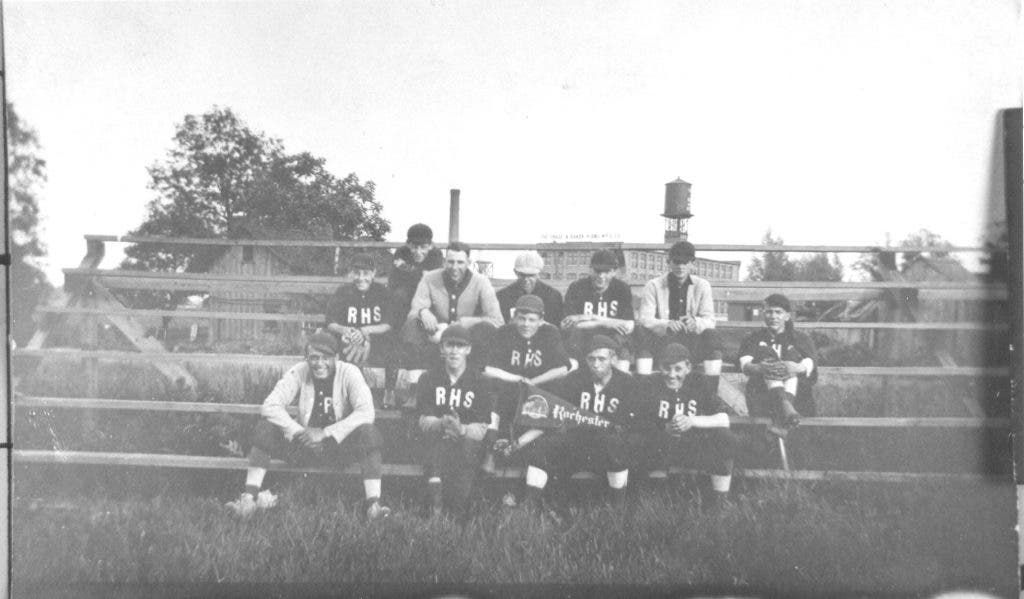


Before the Detroit Tigers, there were the Rochester Grangers, Mechanics and Independents – "base ball" teams that entertained and excited sports fans in Rochester beginning in the 1860s.
In those days, when the term “baseball” was two words (and still is when referring to the vintage game of the 1800s), teams were formed by merchants, clubs, workers and neighborhoods.
By the early 1900s, Rochester baseball was dominated by high school teams and the occasional ladies game. In the 1930s, the Brown Bombers, an African-American softball team organized in Detroit by famed boxer Joe Louis, traveled the country, playing in large cities and small towns such as Rochester until it disbanded in 1944.
Find out what's happening in Rochester-Rochester Hillsfor free with the latest updates from Patch.
Baseball was so popular in Rochester that by 1925, a vacant piece of land on Woodward was converted into a baseball and athletic field. Later named Halbach Field, the grounds included grandstands and lighting for nighttime games. Ballgames drew large crowds of fans from in and around Rochester, making baseball the town’s favorite pastime.
'There’s no crying' in base ball
Even though 19th-century base ball was similar to today’s game, it was still quite a different experience. Players were expected to be gentlemen on the field and to exhibit polite behavior throughout a match – rules that the current roster of Rochester Grangers, a team of local men who replicate the old style in games throughout southeast Michigan, continues to demonstrate.
Find out what's happening in Rochester-Rochester Hillsfor free with the latest updates from Patch.
According to the , “hi” was not part of the vernacular, so players addressed each other with a “good day” or “good afternoon.” The men could roll up their sleeves during warm-weather games but had to roll them down when speaking with ladies in attendance.
Gloves were not commonly used. The Vintage Base Ball Association website notes that prior to the 1880s, players caught balls with their bare hands, though some catchers with “raw hands” began wearing gloves in the 1860s. Pitches were thrown underhand until the mid-1880s.
Base ball rules of the 1860s varied from team to team but often included the following, as noted on website for the Rochester Grangers:
- Infield players must have one foot on the sack (base) when balls are pitched.
- No stealing, swearing, spitting or sliding
- For batters, no balls or strikes are called
- Batters cannot overrun first base; they must stop on it
- No gloves
- Once they cross home plate, a player must approach the scorer’s table, ring a bell and politely request the scorekeeper to “tally your ace.”
To add to the fun and excitement of the games, players were given nicknames such as Lumberjack, Cookie or Lefty (which are used by today’s Rochester Grangers). Early on, fans were referred to as spectators or simply the audience, but by the late 1800s, they were called “cranks.”
Additionally, there were rules regarding the weight, size and diameters of the bats and the balls, as well as the placement of sacks and the selection of the ground for the fields.
Hometown boys
According to A Lively Town, written in 1969, organized base ball formed in Rochester in 1873, though there is evidence suggesting that leagues formed in the 1860s. In those days, merchants and workers formed teams, such as the Rochester Grangers and the Rochester Mechanics.
The Grangers’ name is rooted in Rochester’s agricultural history. According to the Rochester Hills Museum, the name was inspired by The National Grange of the Order of the Patrons of Husbandry – a fraternal organization with a mission to protect farmers whose earnings were being eaten up by freight costs. The Grange gave a voice to farmers and spread across the United States, establishing more than 21,000 chapters between 1867 and 1875. It was also one of the first organizations to welcome women as full members.
The Rochester Grangers team comprised farm boys who sought fun and revelry with neighbors and friends in the form of base ball.
A Rochester newspaper clipping from August 1875 reported that a “grand return match will be played between the Mechanics and the Grangers next Saturday the 14th, upon the base ball grounds in this village.”
According to A Lively Town, the Grangers beat the Mechanics 25-15.
In September 1875, another clipping reported on a game between the Rochester Mechanics and the Brooklyn O.K.’s.
“A large number of spectators witnessed the game,” the paper noted, “which was an exceedingly animated one.”
Brooklyn beat the Mechanics 45-29. The paper admonished the hometown team for losing and urged “our boys ... to buckle on their armors and ‘try, try again.’ ”
The importance placed on proper conduct and decorum was evident in a Rochester Era report in 1879, in which the paper scolded a member of a Birmingham team for his unruly behavior during a recent match.
“We would advise the Birmingham boys who came here last Monday to play base ball with our boys,” the paper stated, “to leave that red-whiskered chap at home the next time they go off to play anywhere, for he will disgrace any company with his drunken and silly conduct.
“We do not think the Birmingham boys approved in the least of his actions, for they all, with this single exception, appeared to be perfect gentlemen.”
By the 1890s, it was clear that base ball was Rochester’s favorite spectator sport.
In May 1896, the paper noted that “base ball promises to be all the rage in Rochester this summer. The boys are already practicing daily, and several clubs will be formed.”
One of the more thrilling games took place between the Stony Creeks and the Rochesters in September 1896.
It was reported to be “one of the most exciting games ever played in Stony Creek ... and witnessed by about 300 cranks.”
The Rochesters won 9-8.
“It was nothing to boast of to defeat Stony Creek at (their grounds),” the Rochester Era reported. “The Stony Creek boys put up a game that would have been a loser on the Rochester fair grounds. Naturally, the Rochesters took advantage of this and came off with flying colors for they hammered (George) Rook’s curves until they were tired.”
Highlights of the game included a batter named Norton and the “long distance fly of W. Bigger (that) nearly set the cranks wild.”
The girls of summer
Nineteenth-century girls got into the spirit of baseball, too.
Bloomer Girls teams were organized in cities throughout the United States during the late 1800s and early 1900s. Some reports suggest that their name came from the style of pants worn by athletic girls of the day. When playing sports, knickerbockers or athletic bloomers – loose-fitting trousers that ended just below the knee – were preferred over long skirts and blouses with high necklines.
Still, others claim the name was inspired by suffragette Adelaide Jenks Bloomer.
Bloomer Girls popped up in big cities such as Boston, Philadelphia and New York. They traveled the country by train and, despite being billed as all-girls teams, Bloomer Girls often had at least one male player.
According to baseballguru.com, “Their opponent one night might be an amateur club, while the next it would be semipro. This was the reason many promoters brought in men to play with the ladies. This made the games more competitive when they had a topper or two. Topper was the title attached to male players who wore curly wigs atop their own hair.”
One of the most famous Bloomer Girls was Maude Nelson of Boston.
In 2001, Nelson, who died in 1944, was inducted posthumously into the National Italian American Sports Hall of Fame.
On its website, the Hall of Fame notes that Nelson was born Clementine Brida and was a young child when she immigrated to the United States, where she “learned to play baseball and took the name Maude Nelson. Even before she was 16, she was pitching for the Boston Bloomer Girls, who traveled the country in 1897. She started virtually every game, usually pitching a few innings then moving to third base.”
In May 1902, the Boston Bloomers were scheduled to play a ballclub in Rochester. The team, which likely included Nelson at the time, was expected to arrive in high style.
“The Boston Bloomers ... will arrive in the city May 21,” the Rochester Era noted, “and give an exhibition on Ostrom lot, South Rochesters being their opponent. The Bloomer Girls do not expect to draw crowds entirely on the account of being female players, but really put up an incredible exhibition of the national game.”
Like their male counterparts, decorum and politeness was the rule of the day for female ballplayers.
“They travel in a private palace (train) car and carry a canvas fence for enclosing the grounds, a grandstand with a seating capacity for 2,000 and everything necessary to give a first-class exhibition,” the paper reported. “They have toured all over the western states and have everywhere received good notices from the press, not only for their good base ball playing, but also for their ladylike behavior.”
The Bloomer Girls played ball for nearly 40 years before disbanding in the 1930s.
The Brown Bombers
In 1935, famed boxer Joe Louis formed the Brown Bombers, an African-American softball team comprising boyhood friends from Detroit.
According to Neil Lanctot in Negro League Baseball: The Rise and Ruin of a Black Institution, Louis “aspired to baseball stardom as a child and remained a passionate fan of the Detroit Tigers.”
In Champion Joe Louis: Black Hero in White America, Chris Mead notes that in the summer of 1935 when Louis visited his old Detroit neighborhood, he was “distressed to see that many of his boyhood friends did not have jobs. ... He bought them a bus and uniforms, christened them the Brown Bomber softball team and gave them money to start touring the country. He promised to help them draw fans by playing with them when he could.”
Nearly a year before he would avenge his loss to boxing foe Max Schmeling in a match that captured the world’s attention, Louis was credited for “blazing a trail with his new softball team.”
On Sept. 23, 1937, the Prescott Evening Courier reported that “Heavyweight Champion Joe Louis has blazed the trail by finding a new source of revenue for the wearer of boxing’s most prized crown – softball. ... The Bombers have been packing them in. At first Joe only played an inning or two ... but recently has been holding down first base throughout the games.”
Louis’s participation in the games drew more than huge crowds, however. It sometimes caused near riots.
On Sept. 25, 1937, the Afro-American reported that fans in Baltimore swarmed the field, almost mobbing Louis and forcing the cancellation of the game.
“Joe Louis came to town Tuesday night with his softball team and tried to play a game at Bugle Field,” the paper noted, “but rabid Baltimore fans had something else to say about the matter. They didn’t care much about the game. They came to see Joe Louis.”
While the Brown Bombers played in major cities across the country, they also traveled to smaller towns, including Owosso and Rochester.
In July 1940, the Owosso Argus Press reported the Brown Bombers' loss against the Goebel’s Beer team of the Owosso Open City League before “several hundred fans, making up the largest crowd in the season to date.”
Sometime in the late 1930s or early 1940s, the Brown Bombers were scheduled to play in Rochester, but the only known documentation about the game is a simple advertisement owned by a local collector of Rochester memorabilia.
According to the ad, the Brown Bombers and Rochester Potere Service (a team comprising local gas station workers) were to play at 9 p.m. Aug. 5 at Halbach Field. Admission cost 50 cents for adults and 12 cents for children. It’s unclear whether the game ever took place.
While the Brown Bombers drew crowds, mostly because of Louis’s presence, the team did not make a profit. As noted in Black Baseball in Detroit by Larry Lester, Sammy J. Miller and Dick Clark, “by the end of the 1938 season, the team ... had cost Louis about $50,000.”
The Brown Bombers disbanded in 1944. An attempt to regroup in the late 1940s and 1950s never took off.
Rochester’s own field of dreams
In the 1920s, an informal baseball field sat on a vacant lot once occupied by a Detroit Sugar Mill Co. factory on Woodward. In 1925, the lot, owned by the village of Rochester Hills, was groomed and turned into a full-fledged athletic field.
“Rochester has needed just such a field these many years,” the Rochester Clarion reported.
As noted by Deborah J. Larsen in Home Town Rochester: A History of Avon Township, Rochester and Rochester, Michigan, in the 1930s, the field “was improved with funding from federal relief programs ... as well as contributions from local citizens and businesses.”
In 1936, civic leader and Detroit Edison employee Fred Halbach “led a community drive to add lighting and a new grandstand ... so that evening softball games could be played,” Larsen wrote.
Today, Rochester continues its love affair with baseball. While the days of the merchant clubs are gone, remains a summer host to all sorts of local baseball and softball teams, from Little Leaguers to community teams for men and women.
In addition, the Rochester Grangers recently opened their 2011 season with a 30-9 win against the Wyandotte Stars. Though Rochester doesn’t have a minor league baseball team, the Grizzlies draw crowds of fans throughout the spring.
So, 150 years later, people still come to see baseball in Rochester. It has united people through time and across generations.
As James Earl Jones said to Kevin Costner in the 1989 film Field of Dreams, “The one constant through all the years ... has been baseball. ... It’s part of our past.”