Neighbor News
Oakland University professor awarded $2.2M NIH grant for arthritis research
OU professor Yang Xia, Ph.D., is now studying how to monitor what happens to the body before the disease sets in.


According to the U.S. Centers for Disease Control and Prevention (CDC), osteoarthritis is the leading cause of disability in the country.
Oakland University Professor Yang Xia, Ph.D., is now studying how to monitor what happens to the body before the disease sets in with a $2.2 million grant from the National Institutes of Health (NIH).
“At the moment, people have no way of monitoring how healthy their cartilage is,” said Xia. “We are trying to find out what the early signs of degradation after a specific impact are. If we can accurately monitor that, then the next step would be to design a procedure or a drug to treat osteoarthritis.”
Find out what's happening in Rochester-Rochester Hillsfor free with the latest updates from Patch.
An estimated 52.5 million adults across the country have doctor-diagnosed arthritis, and 22.7 million report limitations due to the disease, said CDC experts. In 2003 alone, medical expenditures and lost earnings due to arthritis and other rheumatic conditions in the U.S. were about $128 billion.
“The major costs for arthritis care are the loss of productivity associated with the lengthy chronic disease and the cost of joint replacement,” said Xia. “If the disease can be discovered early and monitored before the ‘bridge of no return’, a procedure could be developed clinically to slow down the disease progression or even reverse the degradation process. These developments will not only make people healthy and happy, but also reduce the medical care cost on tens of millions who suffer from this debilitating disease.”
Find out what's happening in Rochester-Rochester Hillsfor free with the latest updates from Patch.
Xia, who is funded by the NIH through 2021, said his research has been continuously supported by four five-year NIH R01 grants since 1999, with a total funding of over $7 million. The recent grant began in early April, and Xia over the next five years will be pulling together a team of colleagues and students to assist him in his research.
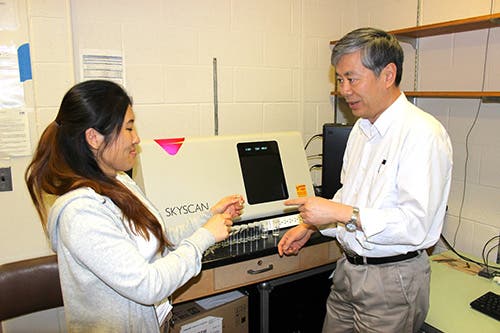
Xia and his collaborators use an interdisciplinary microscopic imaging approach to study different aspects of cartilage degradation, such as what happens to tissue after an impact like a sports injury, an accident, or a wound suffered on the battlefield, said the professor. The Physics Department at Oakland has six microscopic imaging systems in its lab that will help Xia over the course of his studies.
Brad Roth, Ph.D., director of Oakland’s Center for Biomedical Research, said it’s rare for any researcher throughout the country to be awarded a grant from the NIH.
"National Institutes of Health grants are significant because the best researchers from throughout the country are competing head-to-head for scarce resources,” Roth explained. “To be awarded an NIH grant means you are among the best of the best in our nation."
Xia is also lead editor of the book “Biophysics and Biochemistry of Cartilage by NMR and MRI,” a unique book that focuses on cartilage research. Its publication date is tentatively set for Sept 2016.
For more information about Xia’s background and research, visit oakland.edu/users/xia/web. The Oakland University Department of Physics can be found at oakland.edu/physics and the Center for Biomedical Research at oakland.edu/cbr.
This research is supported by the National Institute of Arthritis and Musculoskeletal and Skin Diseases of the National Institutes of Health under award number R01AR069047. The content is solely the responsibility of the authors and researchers and does not necessarily represent the official views of the National Institutes of Health.