Community Corner
Michigan Fireball Meteor Registers As Quake: 5 Things To Know
Meteors may have played a part in the origins of life on Earth.


NEW HAVEN, MI — The spectacular fireball meteor that streaked across Michigan's night sky and caused a loud boom on Tuesday night registered as a Magnitude 2.0 earthquake, shaking homes, cars and businesses, officials said. People from across the midwest reported seeing the fireball.
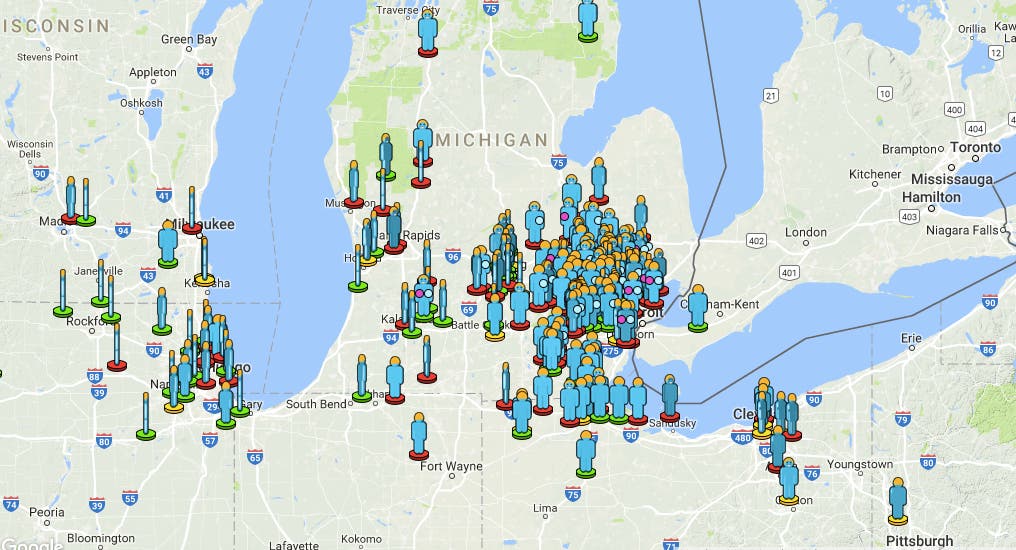
The American Meteor Society received more that 350 reports spanning several states about the meteor, mostly from Michigan but also in Illinois, Pennsylvania, Ohio, Indiana, Missouri and Ontario, Canada.
The National Weather Service in Detroit in a tweet late Tuesday confirmed what many people suspected: The unidentified exploding object was, in fact, a meteor. It had an epicenter of New Haven, Michigan.
Find out what's happening in Royal Oakfor free with the latest updates from Patch.
Bill Cooke of NASA's Meteoroid Environment Office said in a statement that their NASA meteor camera at Oberlin College in Ohio recorded the fireball on video, even through heavy clouds. Cooke said the meteor could be a "superbolide," meaning a meteor with a brightness between that of the moon and the sun. NASA estimated the meteor was a yard or two in diameter and traveled at about 28,000 mph.
David Gerdes, a faculty member with the University of Michigan's astronomy department, tells Patch the event was pretty rare. He was inside at the time of the fireball, but says he's watched multiple videos online and estimated the meteor was likely 1 meter in diameter.
Find out what's happening in Royal Oakfor free with the latest updates from Patch.
"A good size rock," he says. "Not as big as a car, but bigger than a grapefruit."
There are about 1000 visible meteors per second, he said, but most are the size of a grain of sand. He estimates a meteor that size might hit the earth once every few years — often times in places where there are no people, such as over the ocean, or during the day, making it harder to see. This event was extraordinary because the meteor was pretty large, flew over a densely populated area and happened at night making it easy to see.
Gerdes says researchers will now try to find and study the fragments, examine the trajectory and angle that it entered.
Here are five things to know about meteors:
1. Get the terms right.
Meteoroids, NASA says, are small chunks of rock and debris in space. They become meteors upon falling through a planet's atmosphere and leave a bright trail as they are "heated to incandescence by the friction of the atmosphere."
NASA explains that as the rock falls toward Earth, air resistance causes it to become extremely hot and what you see is a shooting star. "That bright streak is not actually the rock, but rather the glowing hot air as the hot rock zips through the atmosphere."
A meteor shower is when many meteoroids fall at once. They're named for the constellation where their radiant is located. Perseids come from Perseus, so it was named Perseids.
Chunks that hit the ground are called meteorites.
2. Meteors may have played a part in the origins of life on Earth.
While meteoroids, meteors and meteorites cannot support life, they could have provided Earth with a source of amino acids, which are the "building blocks of life," NASA said.
4. There's a visible meteor shower somewhere on Earth roughly every 12 days.
There are about 30 meteor showers a year that people can watch. Some showers — such as the Perseid meteor shower that occurs every August— have been around for more than a century, NASA said. They were first observed about 2000 years ago and were documented in the Chinese annals.
5. The color of the trail actually means something.
Meteors sometimes leave a colorful trail. That color is determined by the meteor's chemical composition and the way its atoms interact with molecules in the atmosphere.
The meteor's atoms become hot entering the atmosphere and emit light. They burn and release different wavelengths of light, or different colors.
The atmosphere's atoms become ionized by the hot meteor and they emit photons with certain wavelengths.
It's the combination of those two kinds of emissions that produce the colors you see in the sky. Sodium atoms give off an orange-yellow light, iron atoms give off a yellow light, magnesium atoms give off a blue-green light, ionized calcium atoms might add a violet hue, and molecules of atmospheric nitrogen and oxygen atoms give off a red light, NASA said.
Photo credit: YouTube Screenshot
Get more local news delivered straight to your inbox. Sign up for free Patch newsletters and alerts.