Schools
Dr. Mona Hanna-Attisha Visits Troy Schools
Dr. Mona Hanna-Attisha Visits Troy Schools: Supporting Athens "FlintKids" and Troy High "Friends for Flint"



Dr. Mona Hanna-Attisha Visits Troy Schools:
Supporting Athens “FlintKids” and Troy High “Friends for Flint”
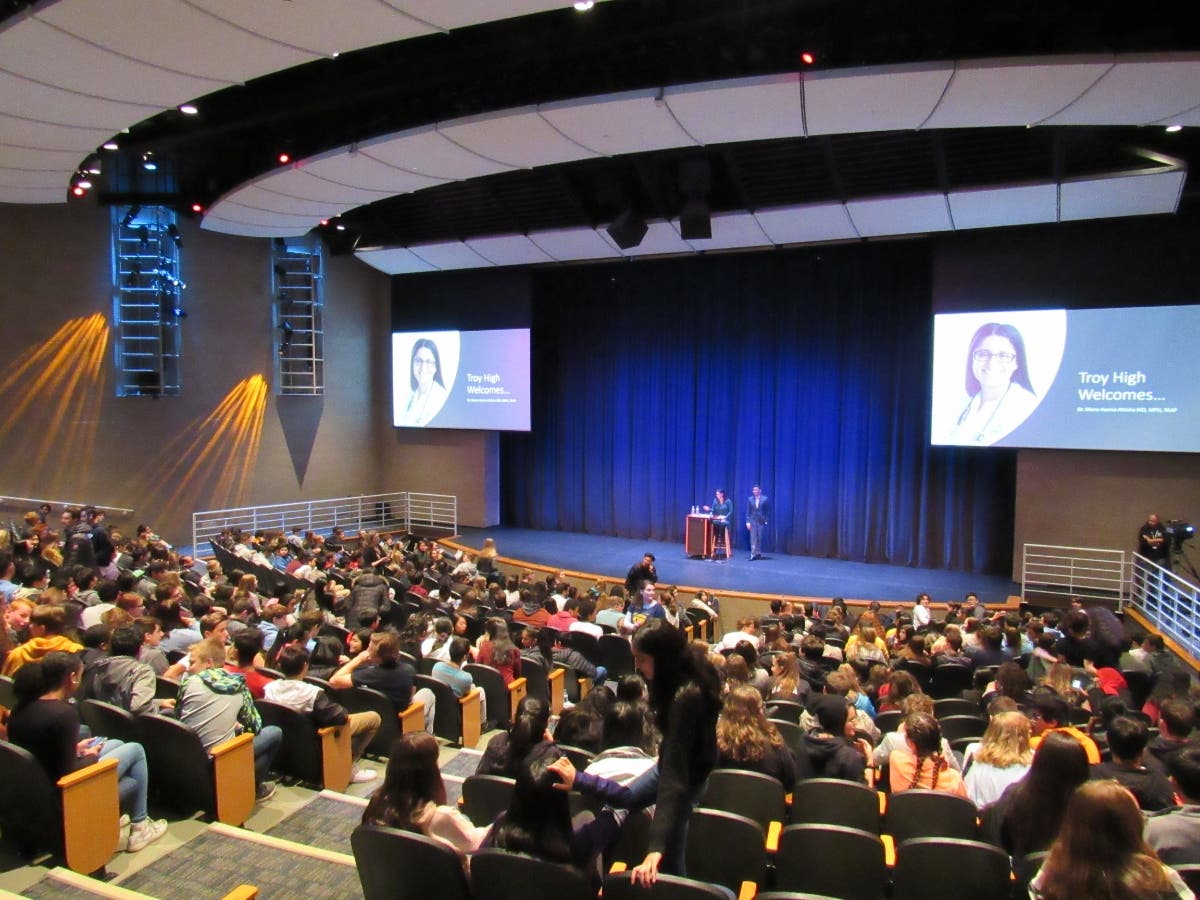
The Book Clubs of Athens and Troy High along with their respective Student Governments welcomed Dr. Mona Hanna-Attisha to speak at both high schools on the 5-year anniversary of the beginning of the Flint Water Crisis. Dr. Hanna-Attisha is a pediatrician, professor, and public health advocate whose research exposed the Flint water crisis and who is now the director of an initiative to mitigate the impact of the crisis on children and families. She is also the author of What the Eyes Don’t See: A Story of Crisis, Resistance, and Hope in an American City.
Find out what's happening in Troyfor free with the latest updates from Patch.
Dr. Hanna-Attisha began each presentation with an explanation of who she is, where she came from, and how she became an activist. It started when she was a high school student in Royal Oak. As a member of Kimball High School’s Environmental Club, she helped the effort to stop a nearby incinerator from being reopened. “I remembered that feeling of being able to DO something, to make a difference,” she said. And those feelings came to the surface years later in 2014, when as a pediatrician in Flint, she began seeing her youngest patients present with elevated lead levels in their blood, some as much as double digits higher than allowed.
Something was wrong. She started sniffing around, trying to gather information on why this might be happening, and put the pieces together that pointed back to the change in Flint’s water supply; from the Great Lakes Water Supply to the Flint River---a move that was quietly made in order to save money for the struggling city. But that move had an immediate impact: there was lead in the water in the Flint River. And it attached itself to the pipes and water system that delivered water to each and every home and business in Flint—with disastrous consequences. “I saw the immediate impact in my patients. But when I tried to report it, I was shut down, discouraged to reveal my findings (by people in power)” Hanna-Attisha continued.
Find out what's happening in Troyfor free with the latest updates from Patch.
“It took fortitude and courage to keep pushing against the tide. My credentials were questioned, and I was called ‘an unfortunate researcher’ and accused of causing ‘hysteria.’ Of trying to make the city look bad. When all I wanted was to get to the bottom of what was hurting my patients, the children of Flint.” To make a long story short, she did in fact get to the bottom of the problem and is credited with exposing the issue and trying to find a solution.
“It wasn’t easy, but the story needed to be told.”
And on this, the 5-year anniversary of the beginning of the crisis, Dr. Hanna-Attisha has added another job title: author. “It took me two years to compile all of my findings, that turned into my book What the Eyes Don’t See. The title refers to the fact that what people tell you, what you ‘see,’ isn’t always clear. Sometimes you have to follow your gut instinct and delve deeper in order to be able to ‘see’ what’s really happening.”
She concluded her presentations by telling students that they are our best hope for a better future, and challenged them by asking “What kind of world do you want to live in? Then do what it takes to make that happen. You have the power.” Athens will be raising money and awareness via a program called “FlintKids,” and Troy High has been supporting the Flint community for the past four years via their chosen charity “A Friend for Flint.” President of the Book Club at Troy High Hemanth Tadepalli summed it up well: “People should know what happened, and who the hero was behind this to fix it.” Athens Book Club President Aubre Thomas agreed: “We have amazing people and students in our community who are willing to help people in need.”