Community Corner
Doc Retires Early to Fight Often Invisible Suburban Poverty
KidzKare, a charity with a strong social ethos, rallies community to address relatively new problem of suburban poverty.


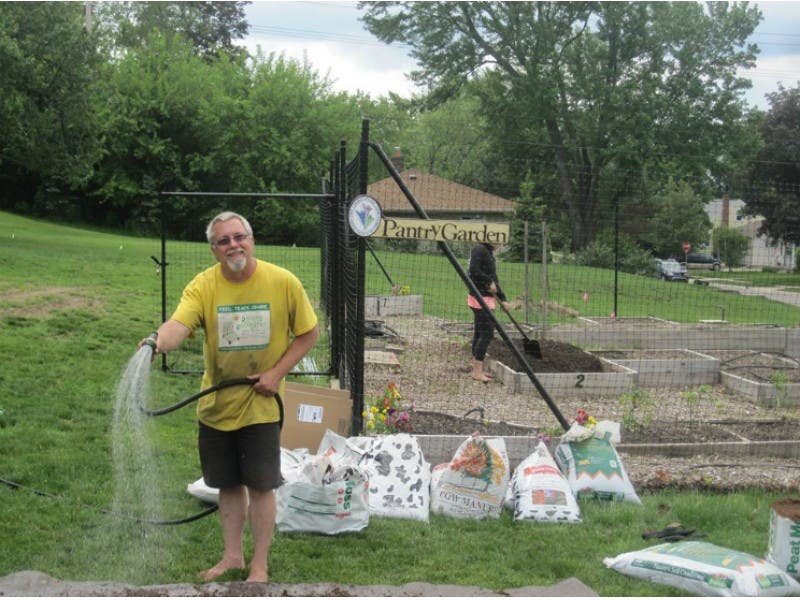
After 28 years as a pediatrician in the Rochester area, Dr. Jay Mitchell retired early so he could work full-time for his charity, KidzKare Inc. Its community garden project raises produce for local food pantries. (Photo via Facebook)
In one of the richest communities in one of the wealthiest counties in the America, Dr. Jay Mitchell stared into the eyes and saw the face of the relatively new phenomenon of suburban poverty.
Find out what's happening in White Lake-Highlandfor free with the latest updates from Patch.
Leading a session not long ago for the Raising Rochester community gardening project, one of the nonprofit programs he retired early from his pediatric practice to shepherd, Mitchell asked a group of local fourth-graders what poverty looked like.
“Homeless,” someone said.
Find out what's happening in White Lake-Highlandfor free with the latest updates from Patch.
“Yeah,” Mitchell recalled replying. “Some are.”
“They’re dirty and don’t shave,” another student said.
“Yeah, some are,” Mitchell repeated.
“They’re scraggly and have dirty clothes.”
Mitchell paused, then asked again, “What does poverty look like?”
“A little girl raised her hand,” Mitchell said. “She had a two letter answer:
“ ‘Me.’ ”
The other students looked at their classmate in stunned disbelief, Mitchell said. She didn’t look poor. She looked like every other kid in bucolic Rochester Hills, named by Money magazine as the ninth-best place to live in America.
In a way, its high quality of life is one of the big reasons the Rochester area is wrestling with suburban poverty.
“You can move here, take advantage of top-notch schools, a great parks system, and a safe city compared to nearer suburbs or Detroit,” Mitchell said.
When they lost their jobs, as many people did during the brutal Great Recession year, they sacrificed in other ways and took low-paying, unskilled jobs so they could hold onto their homes in the Rochester area, he said.
“It’s not the very deep abject poverty you’ll see in Detroit, but it’s still poverty,” Mitchell said. “It’s the people who already lived here and lost their jobs, or saw their income drop, or who moved into Rochester from other areas so their children could have the advantage of what we have here.
“If there were 50 people in a room, you wouldn’t be able to pick out who’s in poverty. We all kind of look like each other.”
Suburban Poverty Relatively New Phenomenon
Appearances are deceiving.
Mitchell got an education into how many families are barely hanging on financially during 28 years of serving large numbers of low-income patients at his pediatrics practice. He started the nonprofit KidzKare Inc. in 2011 after it became apparent to him “there just wasn’t enough of a safety net for low-income people.”
Mitchell, 53, said he had always planned to retire while he still had the energy and motivation for humanitarian service, but he wasn’t planning his exit quite as soon as it happened. But last year, he saw increased demand for the charity’s services, “and it wasn’t too big a jump to say, ‘I want to devote more time.’ ”
By the time he retired in 2014. about half of his patients were covered by Medicaid, were significantly underinsured or had no insurance at all.
“That’s changing dramatically with Obamacare, but not as fast as everyone would like,” Mitchell said. “There’s a lot of poverty.”
Perhaps surprising to anyone who’s ever driven through Oakland County and gaped at its mansion-filled gated communities, 2013 U.S. Census figures showed the number of people in poverty in suburban areas exceeds the number of those in poverty in urban and rural areas combined.
“The pace at which it is growing is twice as fast as urban areas,” Mitchell said, adding that though the economy is improving around the country and in Michigan, “suburban poverty is continuing to rise, in a sense leaving urban poverty behind.”
Mitchell echoes the findings of a 2014 study by social services provider Lighthouse of Oakland County, which noted a “seismic shift” that challenges assumptions about where poor people live.
The report, “Combating Poverty in Oakland County,” showed that poverty grew 77 percent during the Great Recession years of 2005-2012, resulting in more than 118,000 residents – 37,184 of them children – living in poverty in the affluent county.
The report mirrors a national trend of increasing suburban poverty documented in The Brookings Institution’s report, “Confronting Suburban Poverty in America,” published in 2013.
Oakland County has some differences with other areas around the country seeing steep increases in suburban poverty. Though its ranking slipped during the tough recession years and it’s no longer in Forbes’ Top 10 ranking of the country’s richest counties, Oakland County is still one of the richest in America.
Strengthening Porous Safety Net
Because it’s a place where life has generally been good for most people, charities play an all-important role now that poverty is taking hold. The safety nets in place in urban areas, where poverty is more generational and historic, just don’t exist to the same extent in affluent suburbs like those in Oakland County, Mitchell said.
KidzKare offers a core group of programs, each with a strong social ethos.
Raising Rochester, for example, is a raised bed, food gardening program that provides fresh produce to local food pantries. Gently used books are collected and distributed free at local pediatrician offices in the Recycled Reader program.
One of it’s biggest efforts of the year is Saturday’s big back-to-school bonanza.
At the all-free annual event, dozens of merchants, health-care providers and others offer backpacks and school supplies, haircuts and apparel, physicals, vision and hearing checks, dental exams, immunizations and almost everything else needed to send kids back to school, but which families living in poverty can’t afford.
Now in its fourth year, the back-to-school event has already reached 1,600 kids and provided more than $250,000 in services and merchandise. In the inaugural year, 380 kids were served, the number rose to 550 in 2013, and last year, 664 kids were served. Mitchell expected around 800 kids this year.
About 15 percent of the nearly 15,000 students in Rochester Community Schools qualify for free and reduced lunches.
“That’s over 2,200, just in Rochester schools, in poverty,” Mitchell said, “so we’re only touching one-third of the students available to be served.”
The providers don’t just offer free services the day of the Bonanza. Kids whose vision screenings show they need glasses get vouchers for free or discounted services through the Lions Club. Likewise, ear, nose and throat specialists and audiologists provide free treatment to kids referred to their practices, and dentists offer free cleanings and fillings.
Mitchell said he’s aware of other communities offering back-to-school fairs like the Bonanza, but “most are not as sizeable as Rochester’s,” where about 50 community partners donate their time, goods and services.
One of Mitchell’s goals with KidzKare is to develop a program that can be franchised and shared with other communities also wrestling with suburban poverty.
- Tell Us: What other good works are going on in the community?
The charity runs mostly on the goodwill of its neighbors and grants.
“A shoestring budget would be a dramatic improvement,” Mitchell said. KidzKare has one half-time employee, and when that salary is taken out, the charity’s operating budget is about $10,000 to $12,000 a year.
“It depends on how much we can pull in,” he said. “This is a situation of ‘you eat what you kill.’ If you want to continue a program, the only way to do that is if there’s money available. Sometimes, you step out on a limb and pray the money comes in – and it usually does.”
The charity started right out of the gate trying to close as many service gaps as possible.
“We didn’t grow into this,” Mitchell said. “I said, ‘These are the things we want,’ and that’s where we started.
“The safety net is very thin and porous, compared with urban and larger areas,” Mitchell continued. “Without events like the Bonanza, many of these kids would not be getting an annual checkup or hearing and vision screenings. Follow-ups with dentists – even if they’re on Medicaid – would not be paid for, and they’d have to buy their own school supplies.
“Could you do without these things? Yeah, but you’re looked at like an outlier – or, if the family decides these things are a priority, maybe they’re not paying heat or rent.”
New Breed of Philanthropist
Rochester Hills Mayor Bryan Barnett said KidzKare is “an outstanding organization” responding to an important community need.
“The business community steps up over and over,” Barnett said. “Businesses and organizations aren’t just focused on achieving things for themselves, but rather how we lift all of our citizens.”
The charity is raising a new breed of philanthropist to build on what Barnett called the Rochester area’s strong legacy of generosity.
“A big thing I’m seeing – after having grown up here, worked here professionally and been involved personally – is that kids in high school today are the opposite of older generations,” said Mitchell, whose own family tradition is one of social support and service.
“They don’t want to donate money, they want to see who they’re helping, and they don’t mind getting their hands dirty gardening or giving up a Saturday when they come home for a weekend from college,” he said. “They just want to dive in and do things themselves and, literally or figuratively, get in and get dirty.”
Get more local news delivered straight to your inbox. Sign up for free Patch newsletters and alerts.