Health & Fitness
Fixing Your Problematic Tomatoes
Tomato plants can develop different disorders that distort plants and spoil the fruit. Three of these disorders include Blossom End Rot, Physiologic Leaf Roll, and Sunscald.


Did you stop by the Master Gardener booth in the Horticulture Building while you were enjoying the State Fair? I was there on Saturday at the booth and giving a talk on backyard composting. We were very busy at the booth responding to your questions about all things pertaining to vegetables, flowers, fruit trees, and everyone’s favorite, how to eliminate Japanese Beetles and four-legged critters.
The majority of vegetable questions centered on tomatoes. Specifically, “Why were my plants struck by so many problems this year?” Many of you may have experienced problems with your tomatoes, from maturing later than you expected, to misshapen fruit, to leaf diseases and cracking.
Tomato varieties differ in their susceptibility to these problems. By experimenting with different varieties and checking the plant labels and seed catalogs, you should be able to find varieties that are not as affected by these problems.
Find out what's happening in Edinafor free with the latest updates from Patch.
Here are just three of the more common problems you may have experienced.
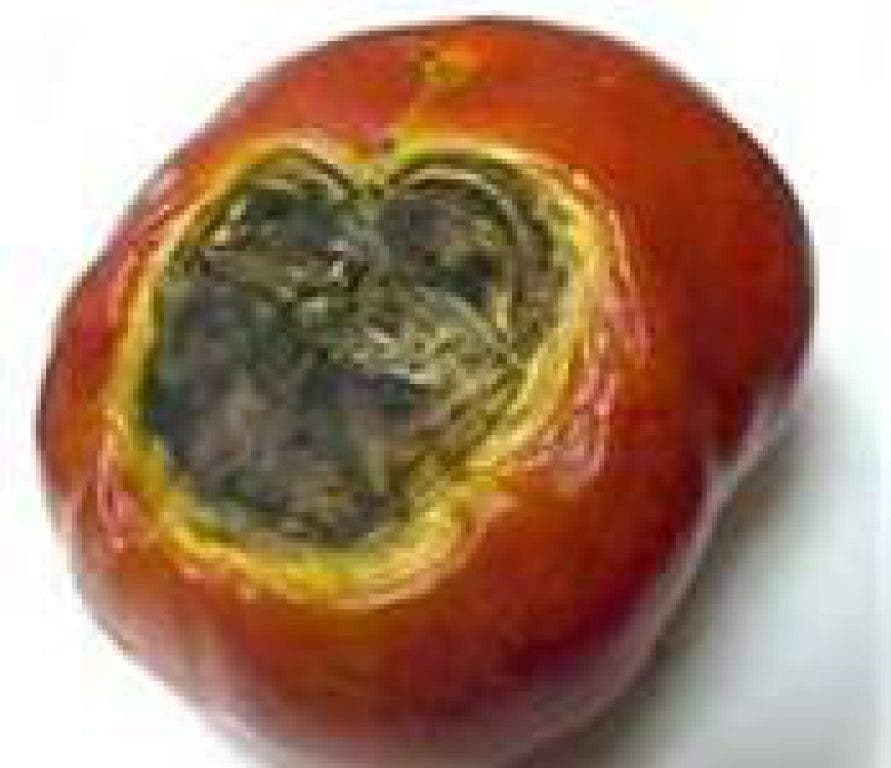
Blossom-End Rot (BER).
This can be a serious problem not only your tomatoes, but also for your peppers and eggplants, both of which are in the same botanical family (Solanaceae, as are potatoes). BER develops on the blossom end of the fruit, away from the stem. It first appears as a spot or water-soaked area. As it develops and enlarges, it becomes sunken and turns black and leathery-looking. And it looks a bit nasty. On peppers BER occurs at the tip of the fruit and appears as a tan or light brown area and can look like sun-scald, which is white-ish in color.
Find out what's happening in Edinafor free with the latest updates from Patch.
BER is caused by a physiologic disorder associated with lower levels of calcium in the fruit. These lower levels could be the result of insufficient calcium in the soil or due to excessive use of fertilizers high in nitrogen. BER can also occur when plants experience extremes of drought, then high moisture levels. Spraying for BER is a waste of your time and money once it appears.
Next year, work calcium into the soil (or container) where you intend to plant your tomatoes, peppers, and eggplants. You can use crushed eggshells (rinse them so raccoons don’t dig them up) or oyster shells (purchase these at a farm store or garden center) and even antacid tablets (a bit pricey, but they typically are 100% calcium). Maintain uniform soil moisture, using mulch to conserve that moisture, and applying fertilizer as a result of a soil test, which you can easily get through the University of Minnesota for only $15 per sample.
Physiolgoic Leaf Roll.
A tongue twister perhaps, but the leaves of your tomatoes may have experienced this. It is typically associated with hot, dry weather (remember July!), but can be in response to rapid growth. That is, if you applied too much fertilizer (dry or wet) too often. Forget what you see in the commercials. These plants do not need that much fertilizer.
The tomato leaves curl inward. That is the plant’s way to conserve moisture. Usually, you will see this on the lower leaves first. And once the leaves curl they will not unfurl even if they get more rain or the weather cools.
You can prevent this problem by reducing the amount of fertilizer you use and by keeping the plants evenly watered. Sound familiar? Use mulch around the plants to conserve moisture. You can mulch with weed fabric, newspaper, grass clippings, plastic, and straw, for example. As a Plan B for next year, consider buying shade fabric (from a garden center) that you may be using now to keep your pet cooler when kenneled in an outdoor enclosure. The porous fabric reduces the amount of light and keeps the plants cooler.
Sunscald.
This is easy. The fruit has been exposed to too much sun. They get a “sun burn.” Sunscald typically occurs because the plant has suffered leaf loss or because of leaf rolling. Leaf loss can also occur because of plant diseases, such as Septoria Leaf Spot, Early Blight, and Bacterial Spot. These diseases affect the leaves, which eventually shrivel and curl, exposing the fruit to the sun. Extensive insect damage can also cause sunscald.
In short, maintain healthy plants through consistent watering and by keeping a check on insect damage and immediately removing any leaves affected by disease. Discard those leaves. Do not leave them in your garden.
Rotate your peppers, tomatoes, eggplants, and potatoes. You can plant one or more of these in the same area, but then do not grow any of these Solanaceae family plants in that area for at least three years. I use a five year rotation cycle. If possible, keep the leaves as dry as possible. Drip irrigation or using a soaker hose works, but then it does rain! Water in the early morning hours so the leaves dry quickly as the sun rises. Stake or cage your plants. Mulch your plants to conserve moisture and to keep the weeds down which means less work for you and more time to enjoy your garden.
I will have more on tomato diseases.
Got questions? I will be happy to respond.