The average American consumes around 30 pounds of cheese a year.
At our house, string cheese serves as a healthy snack for the kids and cheddar slices fill sandwiches at lunch. Feta adds zing to pasta. Mozzarella tops pizza at least once a week, and we love to enjoy a plate filled with flavorful—sometimes stinky—cheeses alongside a glass of wine.
But how is cheese made? Why is one cheese hard and full of holes, while another is soft and runny? Why do some cheeses stink, while others do not?
Find out what's happening in Edinafor free with the latest updates from Patch.
The answers lie not only in the traditions of generations of cheese-crafting artisans, but in chemistry and microbiology. Regardless of the source being a cow, goat or sheep, all real cheese comes from milk.
Milk straight from a mammal, like a cow, consists mostly of globules of fat, large casein protein molecules called micelles, other proteins, lactose (the carbohydrate in milk) and some bacteria, all suspended in a watery solution. The casein and fat molecules help give milk its white color.
Find out what's happening in Edinafor free with the latest updates from Patch.
In order to begin the cheese-making process, milk is often “soured” by anaerobic fermentation. In other words, bacteria in the milk metabolize the lactose without oxygen and produce lactic acid.
If the milk hasn’t been pasteurized—or heated—to kill harmful bacteria, the bacteria already in the milk from the cow are sufficient to sour the milk. However, if the milk has been pasteurized, bacteria are often added to sour the milk.
Next, a special enzyme mix called rennet is added to the sour milk. Rennet is naturally made in the stomachs of all mammals to help them digest milk. When rennet is added, it causes the casein molecules, which normally repel each other, to stick together, forming curds. If you’re from Minnesota, you’ve probably tasted fried cheese curds at the Minnesota State Fair.
In cheese curds, casein proteins form a lattice that traps fat globules and some water while other proteins are left behind in the liquid whey. At this point, the curds are melted, kneaded or packed together into their traditional shape and the excess whey is squeezed out. Sometimes the curds or formed cheeses are cooked. At this point, the cheese is young and mild.
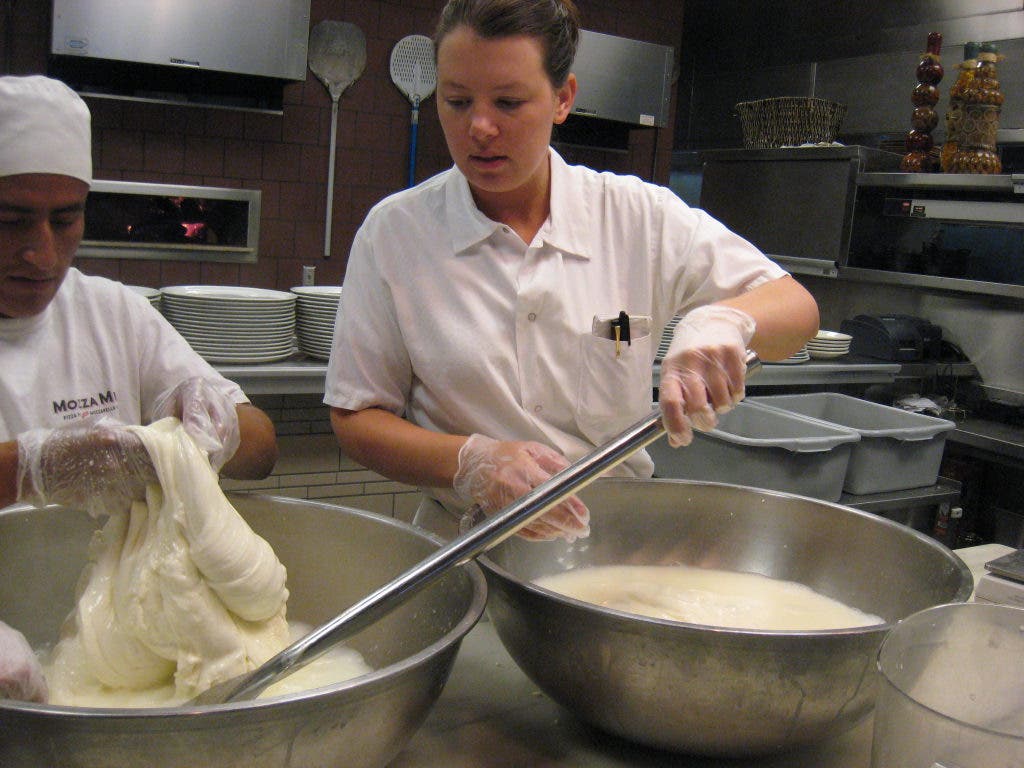
At , I watched the staff add hot water to a curds and whey mixture, melting the curds and allowing them to be stretched and formed into beautiful spheres of . Salt had been added to milk before it was curdled, and the new cheese was delicious—warm, salty and smooth with a mild, milky flavor.
In order for cheese makers to make different types of cheeses with different textures and flavors, microbes can be added to the surface of the formed cheese or injected into the cheese. The microbe is chosen depending on the type of cheese being made.
Bacteria or fungi, like the bread mold used to make Roquefort, have enzymes that break down the proteins and milk fats in the cheese into amino acids, amines and fatty acids. Depending on the microorganism you use, you will get a different aromatic mixture which will give each cheese a unique flavor.
Microbes can change the appearance of the cheese as well. Gas-producing bacteria are responsible for the holes in Swiss cheese.
The length of time you age a cheese will also influence its flavor, as will the type of animal milk used, the fat content of the milk and the animal’s diet. Young, mild cheeses, like mozzarella, are best when they are perfectly fresh, but others, like Parmesan Reggiano, are aged for at least a year to obtain their complex flavors.
As American writer and editor Clifton Fadiman put it in the 1960s, “A cheese may disappoint. It may be dull, it may be naive, it may be over sophisticated. Yet it remains, cheese, milk’s leap toward immortality.”